Germany and France propose lighter EU membership version for Ukraine, FT reports

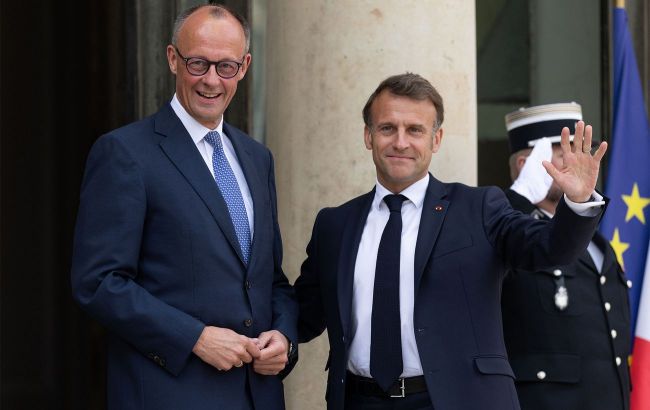 Photo: Emmanuel Macron and Friedrich Merz (Getty Images)
Germany and France have proposed light EU membership for Ukraine, along with granting it "symbolic" benefits. Kyiv would not have voting rights, but the format could include provisions for mutual defense, the Financial Times reports.
Berlin is pushing for Ukraine to be given "associate membership" status, under which its representatives would take part in meetings of EU ministers and leaders but would not be able to vote. In addition, Kyiv would not have automatic access to funding from the EU’s common budget.
France, meanwhile, is proposing a similar model, calling it an "integrated state status." Under this approach, access to the Common Agricultural Policy and European funding instruments such as cohesion policy would be postponed until after accession.
The FT writes that the "lighter" membership format could include EU mutual defense provisions. It is noted that such a clause "could be made de facto applicable through a mere political declaration."
A substitute for full membership?
Germany and France stress that the proposed model is a simplified solution, not an alternative to full membership. The light format would be easier to implement and, in the view of the two countries, could "play an accelerator role towards" full accession.
Two sources in the European Commission told the outlet that the final proposal for Ukraine is likely to be close to the initiatives outlined by Paris and Berlin.
However, according to a Ukrainian official, Kyiv fears that any softened concept may be seen by a war-weary public as a "poor substitute" for full membership. At the same time, the official acknowledged that some elements of the French and German proposals "could be useful."
Ukraine’s EU bid
Earlier, Ukrainian President Volodymyr Zelenskyy said the government would do everything possible to ensure the country is ready to join the EU by 2027. Kyiv has called on Brussels to set January 1, 2027, as the date of Ukraine’s accession.
Recently, EU Commissioner for Enlargement Marta Kos said Ukraine’s accession in 2027 is not feasible. According to her, the membership process depends on two key factors — achieving peace and carrying out reforms.
Some EU governments do not support active discussions or the acceleration of new members' accession, including Ukraine’s. Among them are France, Germany, the Netherlands, and Italy.