Europe could take over Ukraine-Russia negotiations from US, Merz office says

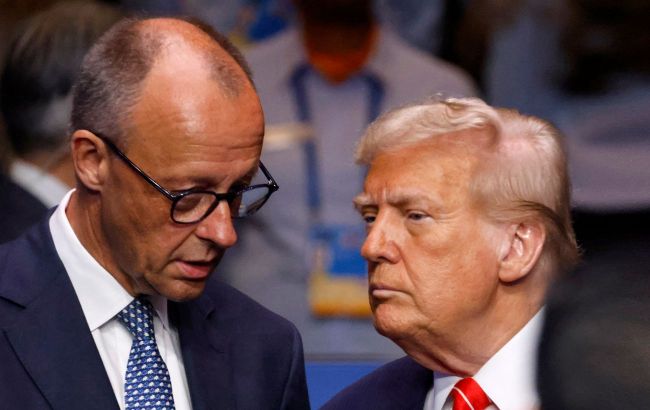 Archive photo: German Chancellor Friedrich Merz and US President Donald Trump (Getty Images)
European leaders are ready to take on a leading role in negotiations aimed at ending Russia’s full-scale war against Ukraine. In Berlin, officials emphasize that this will happen "in close coordination with the US," Politico reports.
The statement came after a meeting of the leaders of Ukraine, France, Germany, and the United Kingdom in London on Sunday evening.
"What is new, I believe, is that this process is now gaining new momentum in Europe. Another new development is that we are taking up and continuing the negotiation process that the US has largely led. We are doing this in close coordination with the US," Stefan Kornelius, Merz’s spokesperson, said.
Why Europe is taking the lead on peace talks
US special envoys to President Donald Trump, Steve Witkoff and Jared Kushner, have led mediation efforts between Russia and Ukraine since the beginning of 2025, but without significant results.
Europe’s increased engagement comes as Washington increasingly focuses on ending the US-Israel war with Iran.
European countries — and Germany in particular — have become Ukraine’s strongest military supporters.
They are expected to take a tougher stance in negotiations with Moscow than their American counterparts.
According to Kornelius, European leaders will further discuss their approach to potential peace talks at the G7 meeting in Évian and at the European Council summit in Brussels next week.
"We need the broadest possible support from all European partners in order to actually push toward peace," he stressed.
At the same time, the Chancellor’s spokesperson suggested that it "could take weeks or even months" before Putin agrees to sit down at the negotiating table. In his view, "only a strong Ukraine and pressure on Russia will persuade Putin to back down."
The idea with Schröder failed
Earlier, Putin proposed former German Chancellor Gerhard Schröder, known for his close ties to the Kremlin, as a potential negotiator.
European capitals quickly rejected the proposal, describing it as a calculated attempt by Putin to divide the continent and portray himself as a good-faith partner in negotiations, knowing the proposal was unlikely to be accepted.
On June 7, the leaders of the United Kingdom, France, and Germany, together with Zelenskyy, met in London and set out five conditions for peace with Russia.
These included an immediate ceasefire, the current line of contact as the starting point for negotiations, legally binding security guarantees for Ukraine, frozen Russian assets as a tool for compensation, and direct Ukraine-Russia talks with the participation of the US and Europe.
Diplomatic activity intensified after Zelenskyy sent an open letter to Putin. Putin rejected the proposal for a personal meeting.