Elon Musk’s dream to colonize Moon may fail: Scientists find fatal flaw

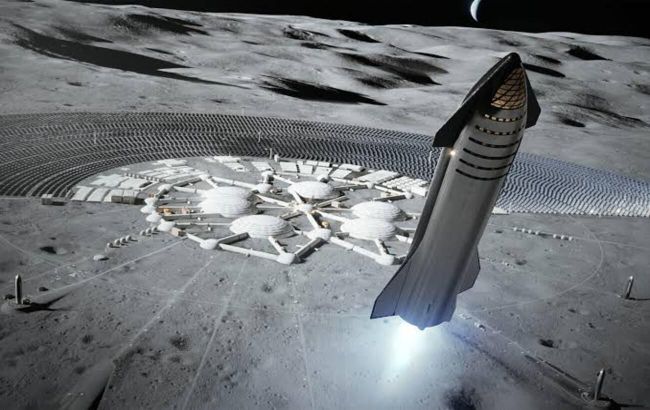 Elon Musk won’t colonize the Moon (photo: SpaceX)
Musk wants to build a self-growing city on the Moon in less than 10 years. A new study casts doubt on the possibility of such a colony. The main problem is that lunar water may not be enough to support a large population for an extended period, according to Gizmodo.
Resource assessment: The supplies won’t be enough
According to current scientific data, around 600 million metric tons of water ice are hidden in the Moon’s permanently shadowed regions.
In a paper published in the journal Frontiers in Space Technologies, a research team calculated the actual needs of a potential megacity and reached disappointing conclusions.
Consumption rate: A city with a population of more than 1 million people would completely exhaust all estimated lunar water supplies in just over 2 years.
Origin of the moisture: The water ice formed as a result of impacts from water-rich asteroids that bombarded the Moon’s surface during the early stages of its existence.
Location: The ice has survived only inside deep craters at the poles, where sunlight never reaches.
Real limits
The presence of water ice at the poles fundamentally changes the concept of establishing a base, as it makes it possible to avoid the extremely expensive task of delivering every liter of water from Earth.
"The presence of water at the Moon’s poles radically changes our understanding of human missions to the Moon. It is entirely possible to imagine a ‘lunar village’ where people could survive without bringing absolutely everything from Earth. They could grow their own food, take showers, and use functioning toilets," said study co-author and Smithsonian Astrophysical Observatory astronomer Martin Elvis.
However, although the presence of water makes the establishment of a small research base or lunar village realistic, even the most optimistic estimates of the amount of ice show that the Moon cannot provide for the autonomous existence of a full-fledged city of one million people.