Crimea's water crisis deepens as Russian funds disappear, Ukraine's intelligence says

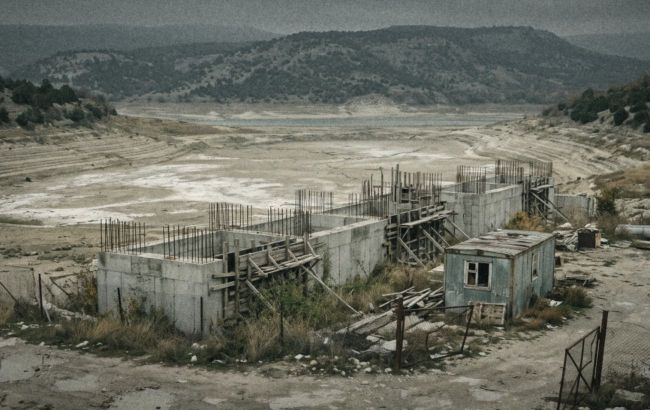 Corruption and lack of funding have disrupted reservoir construction in Crimea (photo: gur.gov.ua)
Freshwater shortages are worsening in temporarily occupied Crimea as Russian authorities have suspended construction of new reservoirs, according to the Defense Intelligence of Ukraine.
According to Ukraine's Defense Intelligence, the Russian administration had previously planned to address water supply problems, particularly in Yalta and Alushta, by constructing two large artificial mountain reservoirs.
These were the Sonyachnohirsk reservoir, with a capacity of 8.6 million cubic meters, and the Martovske reservoir, with a capacity of 6.5 million cubic meters.
However, both projects are now effectively on hold.
Ukrainian intelligence attributes this to a significant budget deficit caused by Moscow's cuts to funding for so-called federal programs, as well as widespread corruption within Russian administrations.
A significant portion of the allocated funds has simply disappeared. As a result, the estimated cost of the Sonyachnohirsk reservoir has increased severalfold over the past two years and is now estimated at several tens of billions of rubles.
Preparations for the construction of the Martovske reservoir have been repeatedly delayed due to errors in assessing the geological stability of the slopes, creating a high risk of landslides when the reservoir is filled with water.
Russian authorities have only managed to clear the forest and carry out initial earthworks.
In addition, the water supply pipeline from the Nizhynske, Novohryhorivske, and Prostornenske underground water intakes to Feodosia and Kerch remains unfinished.
Ukraine's Defense Intelligence also noted that Russia is directing an increasing share of its resources toward the war against Ukraine, leading to cuts in spending on maintaining temporarily occupied territories.
As of the end of October 2026, spending under the socioeconomic development program for Crimea and Sevastopol amounted to 88 billion rubles.
This was 3.7% less than the amount planned for the year (91.4 billion rubles) and 22% less than Russia spent last year (112.9 billion rubles). Moscow plans to continue reducing this spending in 2027–2029.
Due to the lack of new projects, Russian authorities continue to extract groundwater from wells on a massive and uncontrolled scale. This leads to increased mineralization of the water and damages Crimea's environment.
Meanwhile, existing infrastructure, including canals, pumping stations, and old reservoirs, is partially destroyed and in critical condition.
The situation with critical infrastructure on the temporarily occupied peninsula is rapidly deteriorating in several areas.
In particular, in early November, Sevastopol came close to a power supply collapse. Due to a shortage of power generation capacity, Russian authorities were forced to introduce severe electricity restrictions, under which even the 2 hours on, 6 hours off schedules no longer apply.
Widespread power outages were also reported in other cities and villages across Crimea.
In addition, transport and logistics connections between the peninsula and Russia have become more complicated.
On the night of November 17, the Crimean Bridge came under a massive Ukrainian attack, causing one of its arches and a section of the roadway to collapse into the water, completely blocking shipping through the Kerch Strait for Russian forces.