China losing race to SpaceX: Reusable rocket test ends in failure

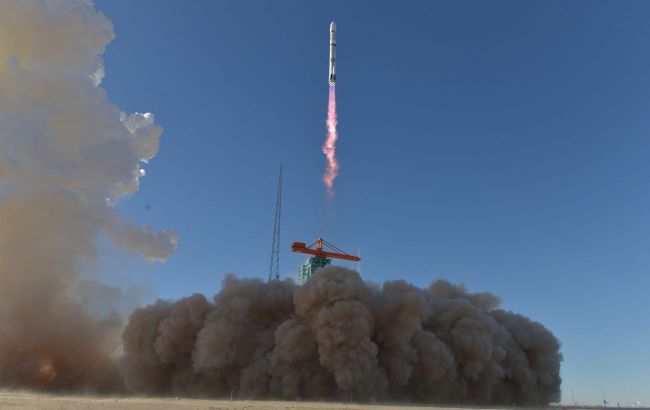 Illustrative photo: launch of a reusable rocket (Getty Images)
China’s reusable Zhuque-3 rocket made an emergency landing after launch. This demonstrated that China is lagging behind SpaceX in the space race, Bloomberg reports.
On Wednesday, December 3, the Chinese startup LandSpace Technology Corp. suffered a setback during the launch of its new partially reusable Zhuque-3 rocket. It is known that after liftoff, an "abnormal burn" occurred during the recovery phase.
This was the first attempt by a Chinese private company to place a rocket into orbit and try to reuse its first stage.
The launch took place from the Dongfeng Commercial Aerospace Innovation Test Zone, a test spaceport in northwestern China.
Although the mission partially failed, it demonstrated China’s ambitions to catch up with the technologies that the American company SpaceX has been successfully using for decades.
SpaceX’s achievements
Since 2017, SpaceX has successfully recovered and reused the first stages of its Falcon 9 rockets. This means that after launch, the rocket doesn’t simply fall into the ocean or onto a test range — it can be retrieved, prepared for a new flight, and used again. This approach significantly shortens the time between launches and saves money because a new rocket doesn’t have to be built each time.
Thanks to this, SpaceX has gained a huge advantage in the market: the company has almost monopolized heavy payload launches into orbit and has become a key provider of low-Earth-orbit internet services. Its Starlink network, which includes more than 9,000 satellites, is used to provide high-speed internet access in remote regions of the world, as well as for commercial and government projects.
This rocket reusability technology allows SpaceX to carry out more missions for less money and at a high pace, making the company a leader in the global space industry.
China aims to replicate SpaceX’s success
China is currently in the early stages of creating similar satellite networks and still relies on single-use rockets to send spacecraft into orbit.
Along with the Zhuque-3, the country is actively developing other reusable rockets, including the Tianlong-3 by Beijing Space Pioneer Technology Co. and the Hyperbola-3 by Interstellar Glory Aerospace Science and Technology Corp. (iSpace).
According to state media, the Zhuque-3 rocket is 66 meters tall and can place up to 18 satellites into orbit in a single launch. LandSpace, one of the leading startups that emerged after China opened its private space sector, became the first company in the world in 2023 to launch a rocket powered by methane fuel, which is potentially safer and more environmentally friendly than traditional propellants.
Despite the Zhuque-3’s emergency landing, the launch is an important step for Chinese private companies in the race for technological leadership in the space industry and in moving closer to SpaceX-level standards.
China recently tested parcel delivery using a rocket.
RBC-Ukraine also reported that China tested a 10-ton hydrogen–oxygen engine for spacecraft, which was developed as part of the country’s deep-space exploration program.