Ceremony of descent of Holy Fire in Jerusalem will take place in a limited format

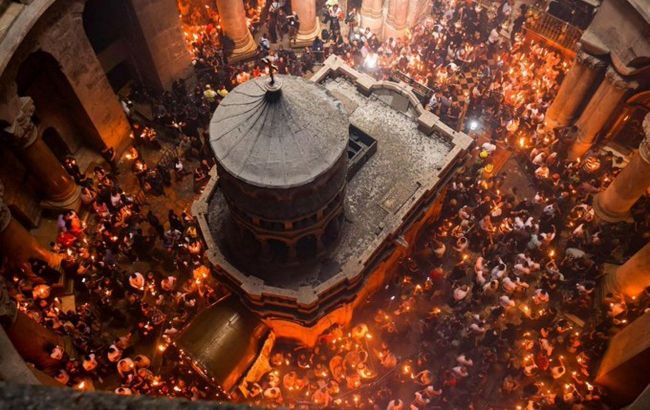 Photo: the descent of the Holy Fire in Jerusalem (twitter.com/BloombergAsia)
The corresponding decision was made after a meeting between law enforcement officials and the Latin Patriarch of Jerusalem, Pierbattista Pizzaballa.
"There was broad agreement during the meeting regarding the unique security situation this year, and that current conditions do not allow for large-scale gatherings," the statement from the Israeli law enforcement authorities said.
The agency also notes that since the beginning of the Israel–Iran military conflict, many sites traditionally visited by pilgrims have been closed.
It is reported that over the past two weeks, several incidents of rocket impacts and fragments from intercepted missiles have occurred near and at some holy sites.
"The danger is real, present, and immediate. The primary objective shared by all parties, the police and religious leaders alike, is above all, the protection of human life," emphasized the police of Israel.
The measures were announced by Israel Police in Jerusalem.
How the ceremony takes place
On the eve of Easter, all lights in the Church of the Holy Sepulchre are extinguished: lamps, candles, and chandeliers. After that, in the morning, clergy from various Christian denominations inspect and seal the Aedicule (the Kuvuklia) — the shrine where, according to tradition, Jesus Christ was resurrected.
After the ceremony concludes, a procession begins. The Jerusalem Patriarch enters the Kuvuklia for prayer. Before doing so, he is carefully checked to ensure that no external fire is brought inside.
When the Holy Fire descends, the Patriarch brings out 33 lit candles from the Kuvuklia — symbolizing the age of Jesus Christ before his crucifixion. Outside the church, representatives of seven Christian denominations wait each year for this miracle, after which they carry the Holy Fire to their respective countries.
Easter in 2026
The date of Easter is movable and is calculated annually using a special method (the Paschalion), which takes into account the date of the vernal equinox and the first full moon after it.
Due to differences in calendars, the dates of Easter for Orthodox and Catholic Christians often do not coincide. In 2026, Roman Catholics and most Protestant communities will celebrate it on April 5, while Orthodox believers will observe it on April 12.