Astronauts may live underground: NASA discovers natural radiation shelters on Moon

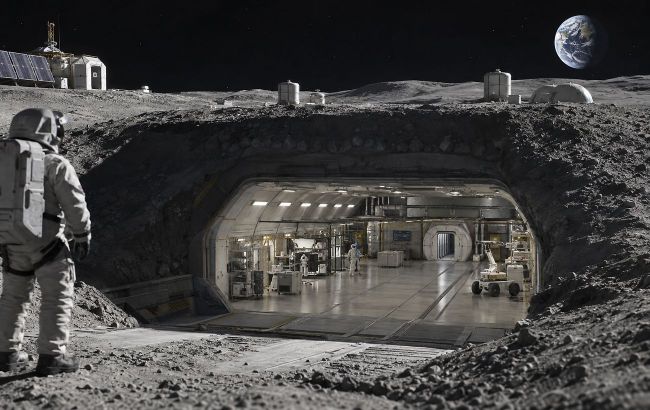 NASA seeks location for future lunar base (image: RBC-Ukraine)
NASA is organizing a new scientific mission, GIMLI, to explore underground tunnels and caves on the Moon. A pit in the Marius Hills could become a potential site for establishing a space base, according to research published in Science Daily.
Pit in the Marius Hills: a natural "window" into the interior of Earth's satellite
At the center of scientists' attention is a pit known as the Marius Hills Pit. It is a giant opening on the lunar surface up to 46 meters deep and 91 meters wide.
Scientists believe this is a so-called skylight - a collapsed roof of an underground lava tube formed during the Moon's ancient volcanic activity.
Previously, the object was studied only using orbital satellites. The new GIMLI (Geophysical Instruments for Marius Lunar Pit Investigation) program involves studying the pit directly from the lunar surface.
Rover equipment and mission objectives
To conduct measurements, scientists at the Planetary Science Institute will equip a lunar rover with specialized instruments:
- Ground-penetrating radar for soil probing;
- Seismic sensors;
- A gravimeter to measure local gravitational field variations;
- High-resolution cameras to image exposed rock layers.
Researchers explain that studying the exposed layers of regolith and solidified lava will help determine exactly how volcanic processes occurred on the satellite in the past.
Most of the instruments will be built by Honeybee Robotics. The project itself is funded through NASA's PRISM program, and delivery to the surface will be carried out by a private contractor under the Commercial Lunar Payload Services (CLPS) initiative.
Ideal "shelter" for a future base?
Scientists' primary interest in underground structures is linked to the safety of future lunar expeditions. Due to the lack of a dense atmosphere, the lunar surface is constantly exposed to harsh solar and cosmic radiation.
In turn, underground lava tubes could serve as a natural shield against radiation, micrometeorites, and extreme temperature fluctuations.
The use of natural caves as shelters, scientists note, would significantly simplify the construction of permanent inhabited bases and ensure stable conditions for astronauts to live and work.
More interesting: