Arctic power struggle: Russia expands control as Trump eyes Greenland

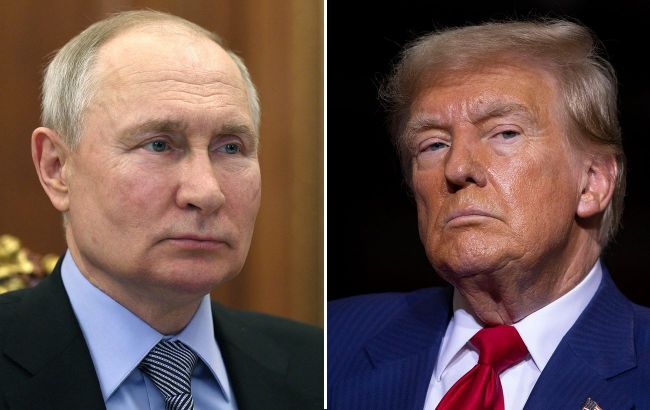 US President Donald Trump and Russian President Vladimir Putin (photo: RBC-Ukraine collage)
While US President Donald Trump views Greenland as a strategic target to strengthen national security, Russia already controls most of the Arctic region. Moscow owns half of the land above the Arctic Circle and accounts for two-thirds of the region's GDP, CNN reports.
Trump's claims over Greenland surprised the international community, but the race for influence in the region has been ongoing for decades. At present, Russia leads this confrontation: it controls half of the Arctic's maritime economic zone, and two-thirds of the region's population lives on Russian territory.
Military expansion and NATO bases
According to Canada's non-profit Simons Foundation, which specializes in security issues, there are more than 60 major military facilities in the Arctic, along with hundreds of defensive installations.
Thirty of them are located in Russia, while 36 are in NATO countries with Arctic territory: 15 in Norway, including one British base; 8 in the United States; 9 in Canada; 3 in Greenland; and 1 in Iceland.
The British think tank RUSI notes that the Kremlin has invested enormous resources in modernizing its nuclear submarines. In addition, against the backdrop of the war in Ukraine, Russia has significantly improved its radar and missile capabilities in Arctic latitudes.
How the Arctic became a zone of tension
After the end of the Cold War, the Arctic was one of the regions where it seemed that Russia and Western countries could realistically do business together.
The Arctic Council, established in 1996, sought to bring Russia closer to seven other Arctic nations and to promote closer cooperation on issues such as biodiversity, climate change, and the protection of Indigenous peoples' rights.
For a time, there were even attempts at cooperation in the security sphere, with Russia attending two high-level meetings of the Arctic Chiefs of Defence Staff Forum before being excluded from the forum over the occupation of Crimea in 2014.
Most forms of cooperation have been suspended since then, and relations between the West and Moscow reached a new low after Russia launched its full-scale invasion of Ukraine in 2022.
Finland's and Sweden's accession to NATO in 2023 and 2024 effectively split the Arctic region into two roughly equal halves: one controlled by Russia and the other by NATO.
Trump has repeatedly stated that the United States needs Greenland for national security reasons, pointing to the ambitions of Russia and China in the Arctic. He has argued that Denmark, which holds sovereignty over the world's largest island, is not strong enough to protect it from threats coming from those two countries.
Although China is not an Arctic country, it has not concealed its interest in the region. In 2018, China declared itself a near-Arctic state and outlined the Polar Silk Road initiative for Arctic shipping. In 2024, China and Russia began joint patrols in the Arctic as part of broader cooperation between the two countries.
However, security is not the only reason for the growing interest in the Arctic.
Economic factor and melting ice
Due to the climate crisis, the Arctic is warming four times faster than the rest of the world. This is opening up new logistical routes:
- Northern Sea Route: it shortens the route between Asia and Europe by almost half compared to the Suez Canal. Russia uses it to transport oil and gas to China while bypassing sanctions.
This sea route reduces transit time between Asia and Europe to approximately 2 weeks, about half the time of the traditional route through the Suez Canal.
- Northwest Passage: the number of vessels passing along the coast of North America has increased from isolated cases to 41 per year.
The passage has also become more viable, with the number of full transits rising from a few per year in the early 2000s to 41 in 2023.
After the conclusion of a special operation in Venezuela, Trump once again raised the issue of Greenland joining the United States. The American leader argues his position on national security grounds, saying the island is literally surrounded by Russian and Chinese submarines.
Despite Denmark and Greenland's own authorities previously rejecting the proposal, Trump continues to apply pressure. He has shifted from threats of a military scenario to economic leverage, including the introduction of tariffs on European countries that oppose US control over the island.
The most high-profile instrument of influence has been a financial offer to the island's population. According to the Daily Mail, Trump is considering paying each of Greenland's 57,000 residents $1 million (about €850,000).
This unprecedented sum is intended to incentivize people to vote in a referendum in favor of joining the United States.