American ex-congressman Gregg Harper slams attacks on Ukrainian advocates

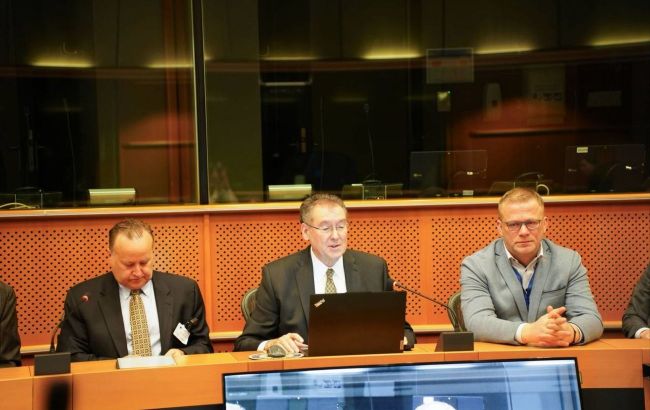 Photo: Former US congressman criticizes attacks on Ukrainian advocates (press service)
Former US Congressman and prosecutor Gregg Harper, during the presentation of an analytical study in Brussels, has warned against attempts to destabilize Ukraine's legal profession through so-called "shadow reports" and manipulations by external influence groups.
Harper, who represented Mississippi's 3rd congressional district from 2009 to 2019 and served on influential congressional committees, stressed the importance of protecting the constitutional status of the legal profession in Ukraine.
In particular, he sharply criticized groups attempting to undermine trust in bar self-governing bodies during wartime.
The congressman said that credibility should not be given to groups and publications whose goal is to destroy public trust in the profession. These self-interested and well-funded external groups manipulate information with little regard for the truth. Harper questioned the necessity to create confusion for more than 70,000 members of the legal profession by lending any weight to these so-called "shadow reports."
According to him, the independent legal profession and the protection mechanisms provided by the bar are primary targets of pressure.
"If this lawfare attack weakens the bar, it is not a reform. Everything that weakens the bar weakens Ukraine. Through the planned evolutionary process, we should make the bar stronger, more effective, and maintain its constitutional independence and self-government. And you will make Ukraine stronger," he stressed.
Risks of digital control and examinations
As a lawyer and former city prosecutor, Harper also addressed attempts to impose full digitalization of professional procedures.
"Legal practice is not just a procedure, but above all, communication. It is persuasion, working with evidence, clear psychology, and, of course, understanding human vulnerability. Therefore, the incorrect implementation of total digitalization risk produces formal competence without professional maturity and ethical responsibility with direct consequences to anyone interested in access to justice," Harper said.
Addressing proposals to introduce electronic voting in bar self-governing bodies, the former congressman called it a dangerous experiment during martial law.
"The requirement for electronic voting as standard is not a technical improvement but high-risk political engineering. It could undermine trust in self-government, create prolonged turbulence, and give the enemy additional tools to influence the legitimacy of an independent legal situation. That is why such a recommendation should be assessed by the EU, not as a sign of progress, but as a potential regression in stability and legal certainty," he emphasized.
Reform should be evolutionary
Harper concluded that implementing the reform roadmap within Ukraine's EU accession process does not envisage dismantling the current self-governance model.
The former congressman concluded that the document calls for evolutionary, not revolutionary reforms. None of its provisions gives individual NGOs or expert networks the right to impose a single model of self-governance or question the constitutionally guaranteed independence of the legal profession.
Earlier, we wrote that a study on the resilience of Ukraine's legal profession during the war was presented in Brussels yesterday.