AI may be rewriting human memories, MIT scientists warn

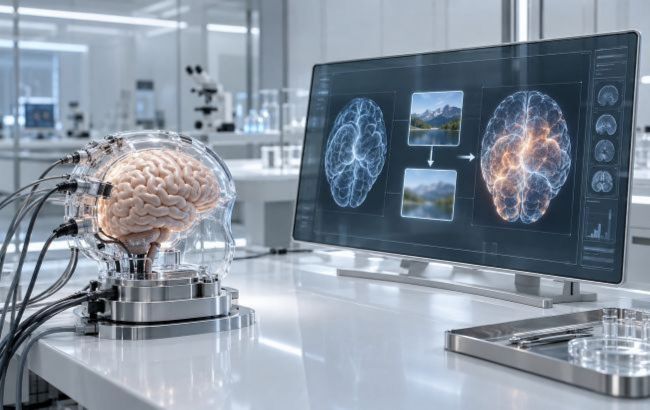 Artificial intelligence makes people believe in false facts (illustration: RBC-Ukraine)
AI can do more than create fake images. It can also change how people remember their own past. Researchers have found that AI-generated images and text descriptions can create false memories, making people doubt their own experiences, according to The Washington Post.
MIT experiment: Confidence in a false past
In an experiment led by Pattie Maes, participants were shown a series of real photographs. After a break, one group saw the same images again, while another saw AI-altered versions.
In a subsequent memory test, people who viewed AI-modified images not only made more mistakes recalling the original details but also expressed absolute confidence in their false memories.
Researchers believe deepfakes and AI-generated text can implant false memories of events that never happened, already influencing political preferences and reducing people's willingness to vote.
Blind trust in experts, AI hallucinations
Even without malicious intent, artificial intelligence poses a serious threat to objective truth through so-called hallucinations, when algorithms invent facts that do not exist.
Government agencies, banks, hospitals, and military organizations are adopting the "human-in-the-loop" principle. Under this approach, a specialist must verify AI-generated conclusions before making critical decisions.
However, research shows that people are poor at spotting algorithmic errors. When AI-generated information contradicts an expert's knowledge, people doubt their memory, and their assessment of a situation becomes distorted in favor of the technology.
Read also: AI and nuclear war aren't only dangers: Scientists warn of 17 threats to humanity
Cost of mistake: From attacks to full autonomy
Scientists are sounding the alarm: ordinary users can't distinguish AI-generated content any better than random guessing. Meanwhile, developers are trying to accelerate the rollout of fully autonomous AI agents, removing humans from oversight processes.
Delegating critical decisions to algorithms is already leading to tragic consequences.
According to an investigation by the US Department of Defense, an airstrike on an elementary school in Iran that killed more than 150 people occurred in part because of excessive reliance on an AI system developed by Palantir.
The system recommended a civilian site as a target based on outdated data, and human supervisors failed to question the decision.