AI-designed drug given to human for first time: What happens next?

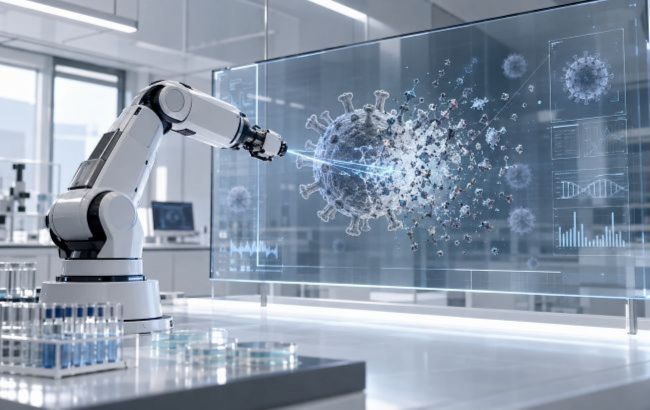 Artificial intelligence creates viruses to destroy bacteria (illustration: RBC-Ukraine)
US biotech company Radical Numerics has announced it administered a cocktail of entirely AI-designed bacteriophages to a patient for the first time, The Register reports.
Antibiotics alternative
Medics are looking for new ways to fight superbugs that are resistant to conventional antibiotics.
Researchers at a San Francisco biotechnology lab developed Omnii-1, an algorithm that designs artificial bacteriophages—viruses that destroy specific bacteria without harming beneficial gut bacteria.
Unlike standard broad-spectrum antibiotics, AI-generated viruses act with high precision.
From algorithms to lab: How the drug was developed
Using AI can significantly speed up the design of new viral agents.
Previous research by Harvard University and the Arc Institute has already shown that AI-designed phages targeting E. coli can significantly outperform their biological counterparts in effectiveness.
Building on these advances, the researchers used their own neural network to address a specific clinical case.
Before the procedure, specialists collected a bacterial sample directly from the patient's antibiotic-resistant infection and tested the AI-generated variants against it.
The cocktail designed by the Omnii-1 algorithm completely neutralized the resistant bacterial isolate in in vitro laboratory tests.
After positive lab results, medics used the experimental treatment on the patient under a special protocol.
(This procedure is used in medicine as a last resort when all other approved treatments have proved ineffective against a serious disease — ed.)
Privacy and limits of clinical conclusions
The developers have deliberately refrained from publishing detailed results of the human treatment, citing the strict need to protect the patient's personal data and privacy.
The researchers also stress that observing a single patient's treatment course cannot establish the treatment's overall safety or clinical effectiveness.
The patient's exact diagnosis and the nature of the infection remain confidential.
However, the report notes that the Omnii-1 AI model also successfully predicted that phages could infect the bacterium Pseudomonas aeruginosa. This bacterium often causes severe complications in burn patients and chronic lung infections in people with cystic fibrosis.
Custom biomedicine prospects
Growing antibiotic resistance is one of the biggest threats to global healthcare. It is already contributing to substantial mortality worldwide.
This case suggests that AI in biomedicine is moving beyond computer modeling and laboratory research toward direct use in patient treatment.
In the future, this approach could accelerate the development of personalized bacteriophage-based treatments tailored to fight specific bacterial infections.
Read also: AI models learned to lie to save their own kind: Why it's dangerous