3D printing breakthrough: New material could help create living organs

 Scientists learn to 3D-print living tissue in just minutes (Photo: Unsplash)
Scientists have unveiled a new 3D-printing material that mimics the properties of living tissue. It could be used to print organs, build neuron-based computers, and develop advanced industrial technologies, according to a study published in Nature Materials.
How does it work?
The new material, called JIBEs (Jammed Interconnected Bilayer Emulsions), functions as a selectively permeable membrane, closely mimicking the cellular structure of the human body.
To overcome challenges related to production speed and scalability, the researchers relied on simple mixing and centrifugation:
- Two oils with different solubility are mixed to form microscopic water droplets.
- A centrifuge compresses billions of droplets tightly together.
- The droplets connect through ultrathin membranes, creating a dense network.
The entire process takes just a few minutes to produce large quantities of the material. Each droplet remains coated with an ultrathin membrane, accurately replicating the way living cells are connected within human organs.
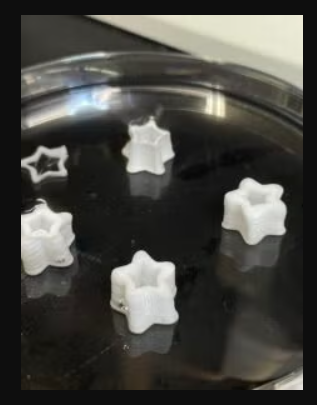
3D-printed tissue mimics the human body's ability to sort and filter molecules, allowing some to pass while blocking others (Photo: University of Texas at Austin)
Applications in medicine, computing, and environmental protection
The material's flexible, biocompatible structure makes it suitable for a wide range of applications.
In medicine and soft robotics, JIBEs could be used to grow implantable human organs and develop safer surgical and rescue robots.
By embedding specialized proteins into the material, researchers enabled it to conduct ionic currents, paving the way for neuromorphic computers that mimic the way the human brain processes information.
Modified versions of the material can also selectively filter substances, making it possible to extract lithium and rare earth elements, as well as remove ammonium from industrial wastewater.
Accessible production and patent
The manufacturing process does not require sterile laboratories or expensive laser equipment. According to the researchers, the technology can be implemented in virtually any laboratory with standard equipment.
Researchers Aida Fica and Manish Kumar have already patented the method. They are also collaborating with the U.S. Department of Energy's Advanced Research Projects Agency–Energy (ARPA-E) to develop technologies for lithium extraction.