10 Ukrainian scientific breakthroughs that Russia claimed as its own

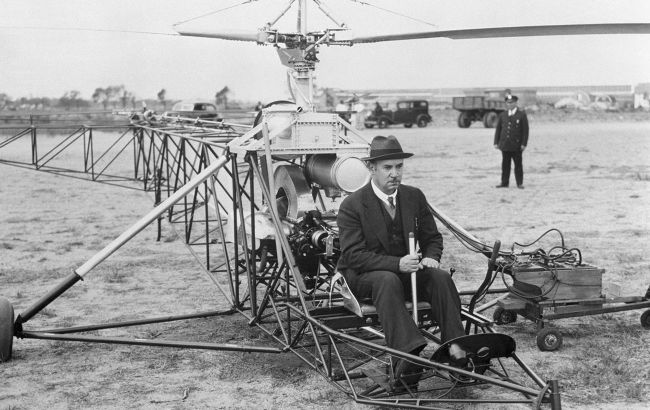 10 Ukrainian inventions Moscow shamelessly took credit for (photo: Getty Images)
For decades, the USSR systematically erased Ukrainian inventors and scientists from history, stripping them of credit, context, and rights to their intellectual work, either labeling their achievements as Soviet or removing them from the record entirely.
RBC‑Ukraine highlights 10 brilliant Ukrainian inventions that Moscow claimed as its own, without which the USSR could never have become a scientific superpower.
Helicopters and multi-engine aviation: Ihor Sikorsky
While still in Kyiv, Sikorsky built the world’s first serial multi-engine aircraft, the Ilia Muromets. The very concepts of multi-engine planes and vertical takeoff later became the foundation of helicopter engineering.
In Soviet textbooks, Sikorsky’s name was either omitted or presented as an emigrant who betrayed his homeland, deliberately ignoring the Ukrainian origins of a key 20th-century aviation technology.
Space rockets and human spaceflight: Serhii Koroliov
Korolev developed the architecture of Soviet rocket technology—from intercontinental missiles to the Vostok spacecraft. Born in Zhytomyr, he remained the secret chief designer until his death, with no public biography. This allowed Moscow to monopolize the image of space achievements as purely Russian.
Cathode rays and the prehistory of X-rays: Ivan Puluj
Puluj didn’t just experiment with cathode tubes; he produced images of bones and internal organs even before Röntgen’s publications.
His work was known in Europe, but in the USSR, it was deliberately marginalized to deny Ukrainian priority in this crucial medical discovery.
Automatic welding and industrial breakthrough: Yevhen Paton
The submerged arc welding method revolutionized shipbuilding, bridge construction, and the tank industry. Developed in Kyiv, it became a cornerstone of the Soviet military-industrial complex. Yet in official discourse, the technology was framed as a “common Soviet achievement.”
Cardiac surgery and biocybernetics: Mykola Amosov
Amosov was the first in the USSR to perform mass open-heart surgeries and developed models of artificial blood circulation. His ideas about health management were ahead of Western biomedical science.
Internationally, however, he was often presented as a Soviet doctor from Moscow, even though his entire school worked in Kyiv.
Moving images before Hollywood: Yosyp Tymchenko
In Odesa, Tymchenko created a mechanism capable of reproducing motion on screen even before the cinematic boom in Europe. Soviet film history ignored this fact because it disrupted the convenient narrative that cinema did not start in Ukraine.
Fundamental mathematics: Mykhailo Ostrohradskyi
Ostrohradskyi’s theorem is used in electrodynamics, hydromechanics, and field theory. Soviet references systematically labeled him as a “Russian mathematician,” even though he was from Poltava and established his own scientific tradition.
Bridges connecting continents: Borys Paton
The Welding Institute in Kyiv became a global center for engineering solutions. Paton’s technologies were used from Europe to Asia, but Soviet rhetoric framed them as evidence of the power of the center rather than Ukraine.
Jet engines for aviation: Arkhyp Liulka
Liulka developed the first turbojet engines that defined the development of Soviet military aviation. His Ukrainian origin was rarely mentioned publicly, preserving the myth of a Russian aviation school.
Vaccines against cholera and plague: Volodymyr Khavkin
Khavkin created vaccines that saved millions of lives in Asia and Europe. While internationally recognized, in the USSR, his work did not fit the ideological narrative, and the Ukrainian context was erased.
Why Moscow did this
These were not accidental omissions in textbooks but a deliberate state strategy of appropriation. The Russian Empire and later the USSR used Ukraine as an intellectual donor for decades, turning scientific plunder into a propaganda tool.
Moscow systematically built the myth of great Russian science because acknowledging Kyiv or Kharkiv schools would immediately undermine the image of Russia as the sole innovator. Centralizing success allowed the Kremlin to monopolize progress and present itself as the only actor on the global stage.
Erasing Ukrainian roots also acted as a safeguard against scientific separatism. A distinct intellectual tradition is a foundation of independence, so any breakthrough in Kyiv or Odesa was immediately labeled Soviet.
Inventors were lured to the metropole, where their names dissolved into the imperial narrative.
The Soviet system operated along a classic colonial model: complex products were created on the periphery, while the center stamped them with a Russian label, extracting the best talent to strengthen a system that erased their identity.
Today, restoring the names of Sikorsky, Koroliov, or Puluj in the Ukrainian context is an act of decolonizing our consciousness. By recognizing these inventions as Ukrainian, we take away Moscow’s main weapon, its false history of technological exceptionalism, and reclaim our place in the world’s intellectual heritage.
Earlier, we shared the story of why Ukraine’s inventor of X-rays didn’t get the Nobel Prize.
Sources: Institute of National Memory of Ukraine, Encyclopedia of Ukrainian History, Sergey Korolev Museum of Cosmonautics, Historical Truth