'Witnesses to Putin's oil schemes often 'fall out of windows,' Ukraine's sanctions chief Vladyslav Vlasiuk


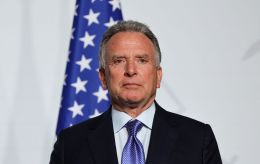
 Vladyslav Vlasiuk, Presidential Commissioner for Sanctions Policy (Photo: Vitalii Nosach / RBC-Ukraine)
The fight against Russia's oil tanker fleet often resembles a game of whac-a-mole — vessels appear faster than they can be shut down. Why is it so difficult to curb Russian oil sales, and which Western countries are helping Moscow? Vladyslav Vlasiuk, Presidential Commissioner for Sanctions Policy, explained the challenges behind enforcing sanctions on Russia's shadow fleet in a conversation with RBC-Ukraine.
Key points:
- The Kremlin's "black cash box." Money earned from oil sales through the shadow fleet is accumulated in foreign accounts and used to finance Russia’s military-industrial complex outside the official Russian state budget.
- Intelligence services and risks. Russian security agencies tightly control oil traders in the interests of a narrow circle close to the Kremlin. Those who attempt to expose these schemes can face direct physical threats.
- Constant game of hide-and-seek. Russia regularly changes company names and vessel ownership structures — as seen in the Coral Energy/2Rivers case — forcing Ukraine and its partners into nonstop tracking of new supply chains.
- Physical enforcement. Ukraine is urging partners to go beyond legal sanctions and physically stop sanction-violating tankers in international waters, drawing on precedents used against Iran’s fleet.
- Environmental blackmail. Russia's use of aging tankers — many over 20 years old — is a deliberate tactic. These vessels pose a serious risk of ecological disasters in EU territorial waters, creating additional pressure on Europe.
Russia is still able to sustain its war effort thanks to oil revenues. Despite 20 rounds of European sanctions, Moscow continues to exploit loopholes. One of the clearest examples is its shadow fleet.
Oil tankers continue to sail through international waters, enter ports, and sell Russian crude to countries that are less concerned with moral considerations. When relatively cheap energy resources are at stake, many governments choose economic benefit over helping a distant country they may barely have thought about before the war.
That is why efforts to counter Russia's tanker fleet and enforce sanctions are unfolding on several fronts simultaneously — and there have been tangible successes. In the interview with RBC-Ukraine, Vladyslav Vlasiuk discusses how Ukraine is pushing the world away from Russian oil — and how Vladimir Putin has managed to profit even from sanctions.
'New schemes emerge faster than old ones can be untangled'
– What's happening with sanctions against the 2Rivers/Coral Energy companies? We imposed sanctions on them, but this is hardly mentioned anywhere. The founders are believed to be Azerbaijanis, but the companies have close ties to Russia.
– Essentially, this is a Russian structure that previously operated through the UAE. Initially, it was Coral Energy, but after sanctions were imposed, the company changed its name to 2Rivers.
We then imposed sanctions on 2Rivers as well in July 2025. The company operated out of the Emirates and had connections in St. Petersburg. This is a typical story for networks like these. And the issue goes beyond Coral Energy/2Rivers alone. There are other companies as well: Zulu Ships Management And Operation - Sole Proprietorship LLC (sanctioned by Ukraine, the US, and the UK), Vigor Marine Services LLP, Atis Remote Solutions, and others. These are management companies and owners of shadow fleet vessels transporting Russian oil. Ukraine has provided the EU with information on these companies for sanctions consideration.
There are other companies from the same pool. For example, Nova Ship Management, which has been under EU sanctions since December 2025, as well as Swiss sanctions. Globally, this is an entire ecosystem involving ship owners, vessel agents, insurance companies, and traders. If you trace the connections, they lead back to Lukoil, which services a significant share of these shipments.
It is a whole ecosystem that constantly evolves, which is why new participants regularly appear on sanctions lists. After sanctions are imposed, they create new companies, bring in other vessels, ignore restrictions on the old ones, and continue using them.
– So, if I understand correctly, we imposed sanctions on Coral Energy/2Rivers back in July 2025, right?
– Sanctions against 2Rivers DMCC LLC and 2Rivers PTE Ltd were imposed by Presidential Decree No 554/2025 dated July 27, 2025.
– Are there European sanctions as well?
– Canada, the United Kingdom, the EU, and Switzerland imposed sanctions against Coral Energy DMCC/2Rivers DMCC. As for Coral Energy PTE Ltd/2Rivers PTE Ltd, sanctions were imposed by the UK, the EU, and Switzerland.
Globally, all of these companies have been under sanctions for quite some time. But that does not mean that each new sanctions package does not include additional individuals or legal entities connected to the same network.
– But formally, these companies are not Russian, correct?
– Correct.
– How does that work? Do they register in other countries?
– Of course. Mostly, the Emirates are convenient for taxes and for conducting international business. That is a major advantage for them.
A lot of Russian business connected to entities and sectors targeted by sanctions operates out of the Emirates.
– Are the owners of Coral Energy/2Rivers still operating? Or have we managed to neutralize them completely?
– The shadow fleet is still operating. Are people from the same ecosystem managing that fleet? More likely yes than no. But each case has to be examined separately — who owns the vessel, who operates it, and so on.
It is a complicated corporate world. There are always entire chains of connections that have to be untangled. This work is ongoing constantly, but it is impossible to cover everything. New schemes emerge faster than old ones can be untangled.
I'm now looking at the tankers we struck a few days ago: Aqualife and Camerun. They are under sanctions and have made 14 voyages to China and India. The owner and operator is a Marshall Islands company. Is it connected to Coral Energy / 2Rivers? It's unclear for now — that still has to be verified.
The tanker Torks — another one we struck — is also under sanctions, and its owner-operator structure involves the Seychelles and Singapore. Is it connected? Again, that requires separate investigation.
In any case, sanctions used to work faster and more effectively. For example, there was a major operator, Coral Energy, with a fleet of more than 100 vessels, while the Russian company Sovcomflot was listed as the owner. Once it was added to sanctions lists, the effect was immediately noticeable. That is no longer how things are done: nobody concentrates all assets in one pair of hands anymore. Vessels are distributed across different companies to minimize the impact of sanctions.
'Those who talk about it later 'fall out of windows'
– How does this happen? Is a company created abroad? Or, for example, there is already a foreign company, and the Russians more or less agree: can we take several vessels from your company and use them?
– The Russians create these companies themselves. Russian special services tightly control the entire activity of the shadow fleet. Why? Because it is carried out exclusively in the interests of Russia. And to be more precise, in the interests of Russia and a political-military circle of individuals, including Putin, the president of the state oil company Rosneft, Igor Sechin, and others.
There is a separate case here. There is an oil price calculated at the port of destination, but Argus quotations used in Russia differ from actual sale prices. In other words, there is a significant gap between their estimates and the real value at which oil is sold in India or other destinations. This is essentially how part of the revenue is concealed. We are talking about several billion dollars per month.
This is a so-called black or grey cash box, whatever you want to call it. These are funds that never return to Russia, that are accumulated abroad, and to which only a narrow circle has access. Part of these funds is used to purchase goods in the interests of the Russian military-industrial complex and to bypass sanctions.
The entire oil export ecosystem is under strict control. Companies are created, and partner figures are found. From the perspective of normal business operations, this is a problem for companies. But top managers who begin to speak about it later, under strange circumstances, "fall out of windows." We are talking about huge money: this is a key source of budget revenue and at the same time the basis for the enrichment of a narrow group of people.
– If we talk in general about the shadow fleet, what new restrictions were supported in the EU's 20th sanctions package?
– There is nothing fundamentally new there. Regarding the shadow fleet, there were expectations of a Full Maritime Service Ban – a complete ban on maritime services. But this provision did not appear in the package.
Right now, the main thing is that there is enough political will to enforce the sanctions already introduced, rather than increasing dependence on Russian energy resources. The market situation is difficult, and many countries that would like to increase pressure on Russia are, at the same time, dependent on oil. Because of this, decisions are not easy.
On the other hand, this creates additional opportunities. If we talk about financial and currency instruments, interest in their use has grown significantly now. This is a positive signal.
 Top managers who begin to speak about it later, under strange circumstances, "fall out of windows." – Vladyslav Vlasiuk (collage by RBC-Ukraine)
As for oil, around 600 individuals and companies are under European sanctions. The main focus now is on ensuring compliance with already imposed restrictions. We are paying separate attention to physical counteraction to the shadow fleet, and we consider this one of the key directions.
– How can we counter new shadow fleet vessels that keep appearing?
– On the one hand, in discussions with partners, there is often a comparison to a whac-a-mole game. It's a game where a mole pops out of different holes, and the player tries to hit it while it keeps moving. What we are doing really does resemble this game in many ways.
On the other hand, this is systematic work that produces results. The gradual introduction of restrictions against all entities – legal and physical – connected to the shadow fleet leads to their displacement into the black zone.
Secondly, it discourages those who try to work simultaneously with other markets and with Russia. In practice, the ability to sit on two chairs has sharply narrowed: the choice is either to operate in the shadow segment or to exit it.
At the same time, it is impossible to cover all companies with sanctions completely. But there are other points of pressure: individuals, vessels, operational chains. There are many tankers, and some of them continue to operate. The next step is to ensure their physical stoppage in case of violations.
We have already been talking for three years about sanctions on tanker fleet captains. Perhaps sanctions will become more personal after all. Then these will be direct consequences for specific individuals, not only for legal entities.
It is also difficult with insurance companies: they are added to sanctions lists gradually, one or two at a time. Formally, the market is regulated, but in practice, this does not stop adaptation. As in banking, a new structure can be created and part of the operations transferred to it to bypass restrictions.
– Is it more effective to impose sanctions on individuals?
– Everything needs to be done. Even formally, for partners, a common basis for sanctions is a connection to another sanctioned person. Therefore, the question of how to contact an insurance company is solved gradually. First, the shipowner is sanctioned. Then it is established that the insurance company works with this shipowner and services the shadow tanker fleet. In such a case, its activity is also considered participation in evading or violating sanctions.
'International waters are not a haven for evading our sanctions'
– How can companies that help these tankers change flags be tracked down and held accountable?
– Flags are more of a diplomatic matter. It depends on the governments of the countries that issue them. Every state has its own rules and authorities that register vessels under its flag, as well as requirements that determine who can be denied such registration.
In principle, under every international rule, you can't simply issue a flag to someone without justification. Both the condition of the vessel, the validity of the IMO number, and the documentation must be monitored. I would say that over the past few years, under diplomatic pressure from the British and Americans, many countries have reconsidered their willingness to grant flags to vessels that are part of the shadow fleet. And this is the result of systematic work.
– Regarding specific cases, the United Kingdom previously suggested focusing not on individual ships but on striking entire corporate networks. This was again the case with Coral Energy. Is such an approach possible?
– Initially, the approach was exactly that: take one key company and map out its entire ecosystem. For example, the parent structure and all affiliated companies - dozens of entities in total.
A similar approach was used by the Americans against Rosneft and Lukoil in October last year, when not only the companies themselves were sanctioned but also a significant part of their structure, which effectively paralyzed the entire system.
This model looks logical and is effective.
– Are we applying this approach in any way?
– We did even better. Take Alabuga as an example. There, we analyzed a special economic zone: who is responsible for what, and who provides services. You could say we were among the first to start working in this way.
– In your view, are there countries that deliberately profit from servicing these shadow fleet tankers?
– Some countries earn money by transporting Russian oil. Among them are Greece and Malta. On the one hand, they try to operate strictly within the "white zone," meaning they do not violate sanctions restrictions. In the case of Greek companies, it is really about their integration into these schemes. If oil is sold within the price cap, then formally, they are not violating sanctions.
In reality, we would prefer they not participate in transporting Russian oil at all. And we also suspect they do not always comply with the price cap.
Obviously, India and China openly buy Russian oil. That is direct profit.
– Do we understand which countries provide crews, fuel supply, repair services, and insurance companies?
– For each fleet, we either already have or can obtain almost complete information - from crew lists to insurance companies, owners, and operators. So for vessels that may be subject to additional sanctions, the data is also comprehensive.
– Are these roughly the same countries, or it varies?
– It varies. Each tanker can have a different story. I would say there are many citizens of China, India, and Indonesia.
– Was there any case in the shadow fleet that surprised you?
– What has really surprised me recently is how the Americans detained an Iranian shadow fleet tanker and wrote on X that international waters are not a haven for evading our sanctions.
 Many countries that would like to increase pressure on Russia are, at the same time, dependent on oil. – Vladyslav Vlasiuk (collage by RBC-Ukraine)
Why is that phrase important? Because most countries assume that international waters remain international waters. That is, even if vessels violate sanctions there, enforcement options are limited. But the American position is different: if there is a sanctions violation, that alone is sufficient grounds for action.
For us, this is great. I try to use this argument. Of course, most countries have a slightly different understanding of how stable international law enforcement is.
'And what will you do to us?'
– Transponders. You said they turn them off in the open sea. Is there any practice to counteract disabling them?
– It's almost impossible to track. If they've switched off their transponders, then they've switched them off. However, in our view, such regular actions should entail consequences for those who do them. But who exactly should systematically monitor this is still an open question.
– Is there any practice to counter the use of outdated vessels?
– In general, vessels should be operated for up to 20 years. This especially applies to tankers. It's a higher-risk category. Do they use outdated vessels? Yes, they do. Are these grounds to stop a vessel? Yes. The Swedes, for example, detained one tanker precisely on technical grounds.
– We are talking about the fact that outdated vessels pose an environmental threat, first and foremost. Are there countries that actually respond to this?
– All countries understand this quite well. The other question is whether they are ready to act afterwards. The Estonians have not yet stopped a single tanker. The Germans haven't done so for a long time. France and Sweden do stop them. But they could do more.
– Do we speak with countries that do not stop them? Do we ask why?
– This is a top topic for discussion. Of course, we do. We understand the reasons why not everything happens immediately. We want this to happen faster.
The Germans have specific reasons related to the fact that vessels must be stopped by police authorities. And police structures differ across federal states along the coast, so all of this needs coordination.
In the UK, there has been a long process of adapting legislation to grant the relevant authorities the necessary powers. As I understand it, this work is almost complete, so practical action should follow. The Netherlands is also preparing legislative changes to expand powers. So everyone wants to act, but within their own legal procedures.
Each country may have its own reasons. Could France have fears of escalation? Probably not. Do the British have concerns? Also, rather not, but they are trying to regulate procedures. Does Estonia have concerns? Yes, quite strong ones. What about Denmark? Significant ones, because they have the world’s largest maritime carrier.
– Which countries' participation is critically important for us in sanctions due to their geographic position?
– Germany, France, and even Spain, which has a long coastline.
– What about the Baltic states? Can shadow tankers, departing from Baltic countries, completely avoid EU ports and not use the services of Western countries that have joined sanctions?
– They are essentially trying to operate that way: going from port to port, not stopping anywhere along the route, and trying not to use European services at all. But systematically avoiding this is quite difficult, because insurance, technical maintenance, and many other services are still required.
– In early April, information began to appear that tankers would be escorted by Russian naval vessels. What is that about?
– It's mostly for intimidation. They don't have the capacity to escort tankers with their own ships at scale. It's more an element of pressure and a show of force.
– In other words, if you stop us, we will use force?
– Yes. But the Americans calmly stopped a vessel in international waters, despite the presence of a Russian naval ship nearby. The position was essentially: "And what will you do to us?" And there was no reaction at all.
That is why we say that fear of such situations is often exaggerated.
– Regarding the recent case in Israel, when grain from Russia arrived there from the occupied Ukrainian territories. Israel refers to a lack of evidence from our side — did we provide it?
– We have all the capabilities to track vessel movements. We understand the origin of the grain not through Russian documents, but factual data, and we have the tools to obtain this information. We pass all this data to partners.
This is not the first example of such interaction. But it is the first media-highlighted case. We hope it will have the right consequences and discourage potential buyers.

India and China openly buy Russian oil. That is direct profit. – Vladyslav Vlasiuk (collage by RBC-Ukraine)
This story is also relevant for Syria, Algeria, Türkiye, and Egypt.
Indeed, implementing sanctions against both the vessels, the so-called shadow grain fleet, and the buyers of such grain, operators, and owners of such ships is absolutely possible for Europe and us as well. So there is still work to be done.
– Did Israel ignore this evidence, or was there some dialogue?
– It's a situation where everyone is trying to demonstrate their position, but the main thing is that everyone agrees that buying stolen grain is wrong. In the end, we reach some understanding at this stage.
– Sometimes tankers are released after detention because they are expensive to maintain. Have we proposed any solution?
– There is such an argument, and it reflects a broader feature of European governments that is generally worth respecting. They try to approach any issue comprehensively. Sometimes it slows things down, but decisions are thoroughly worked out and implemented systematically.
In particular, they say: Okay, we detain a vessel, what next? It needs to be maintained. Could these costs be charged to the owner? I believe yes. And this is definitely one of the options they are considering.
Also, if a vessel is detained due to poor technical condition, it cannot be released until that condition is fixed. Those costs, in my view, should also fall on the owner.
Another alternative we propose to partners is confiscating the cargo or part of it. That could partially cover detention costs. The issue of maintaining arrested vessels is real and actively discussed. At the same time, we believe it can be solved.