'Kill zone at the front could reach 30 km by year's end.' Interview with Brigadier General Yevhen Lasiichuk


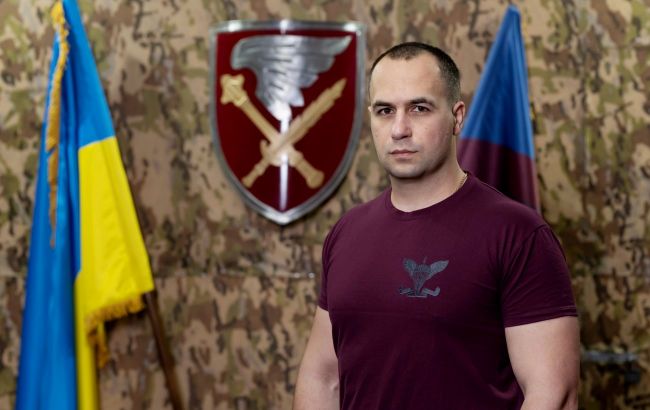 Photo: Yevhen Lasiichuk, Brigadier General, 7th Rapid Reaction Corps of the Air Assault Forces
Despite staggering losses and mounting logistical problems, Russia has not given up its attempt to seize the entire Donetsk region. Defending one of the hottest sectors of that front falls to Ukraine's 7th Rapid Reaction Corps of the Air Assault Forces — and to its commander, Brigadier General Yevhen Lasiichuk, a Hero of Ukraine, who has watched the battlefield transform almost beyond recognition since the war's early months.
In an interview with RBC-Ukraine, Lasiichuk described a front that has become faster, more automated, and far more lethal than the one Ukrainian troops faced in 2022 — one shaped as much by drone feeds and digital command systems as by soldiers on the ground.
Key points:
- Battlefield in 2022 vs. today. The war has become far more technology-driven. Large armored columns are largely gone. Instead, Russian forces advance in small infantry groups, with more than 70% of strikes carried out by drones and up to 30% by artillery.
- Pokrovsk front. The 7th Corps continues to hold the northern outskirts of Pokrovsk despite facing Russia's largest force grouping, Center, along with the Rubicon drone units.
- Russian losses are mounting. More than 20,000 Russian troops have been eliminated within the corps' area of responsibility. Ukraine's Defense Forces are inflicting casualties faster than Russia can replace them through mobilization. Even so, Russian forces continue trying to push forward.
- Strikes deep behind enemy lines. Medium-range strike capabilities are being used to target Russian logistics, command posts, and troop movement routes toward Pokrovsk and Myrnohrad. The reach of these strikes now extends up to 100 kilometers from the frontline.
- Frontline kill zone. The scorched-earth gray zone now stretches roughly 20–25 kilometers on both sides of the front. By the end of the year, it could expand to as much as 30 kilometers in each direction.
- Military reforms. The transition to a corps-based command structure has already improved battlefield command and control. The current phase of military transformation is expected to boost volunteer recruitment and encourage the return of soldiers who left their units without authorization. The next step will be digitizing the mobilization process.
A different kind of war
Lasiichuk doesn't hesitate when asked how the battlefield in 2022 compares to today's. "This is a very broad question," he said, "but these are genuinely different periods, different stages of the war."
In the war's first year, he said, operations were carried out "with a paratrooper's daring." Air assault units were thrown into the toughest sectors of the front, often simply to deny the enemy room to advance. He recalled cases when a single air assault platoon held off an entire Russian battalion column advancing on armored vehicles trying to force its way into combat formation.
What followed, he said, was a steady evolution — the growing use of 155-millimeter artillery, HIMARS rocket systems, and airpower — that has, by 2026, turned the war into something almost unrecognizable. Ukrainian commanders once coordinated over radios or watched the battlefield firsthand from forward positions, scanning the horizon for the enemy. Now they track the fight through drone feeds and live video streams, watching in real time as Russian forces try to maneuver and deploy.
The most consequential change of the past year, Lasiichuk said, has been organizational rather than technological: a sweeping restructuring of how Ukraine's army is commanded. Temporary troop groupings — task forces cobbled together from ground forces, marines, and air assault units — have given way to permanent corps commands, each overseeing its own subordinate brigades continuously. "This is a stable unit that manages its subordinated brigades all the time," he said. "This is probably the main difference. And it has led to more effective, higher-quality command of our forces."
Holding the line at Pokrovsk
In the Pokrovsk-Myrnohrad sector, the 7th Corps' mission has not changed: hold the ground and grind down every Russian assault. "The enemy tries to advance, to storm our positions, to press with active operations, and it hasn't given up," Lasiichuk said. "But I can't say it's succeeding. Every day we destroy enemy forces and prevent them from advancing deeper into our territory."
Ukrainian troops still control the northern outskirts of Pokrovsk itself, despite facing what Lasiichuk described as Russia's largest troop concentration on the entire front — the "Center" grouping, built around the 41st and 51st Armies, reinforced by drone units from the elite Rubicon formation. The sector has effectively become a proving ground for new Russian weaponry, Lasiichuk said; nearly every new system Moscow fields shows up here first, sometimes within days of its debut. Recently, his troops spotted a BM-35 drone — a smaller cousin of Russia's Shahed attack drones — attempting to strike Ukrainian equipment far behind the front line, guided in part by a Starlink connection. Such cases aren't common, Lasiichuk said, but "the Russians are resourceful — they try to hack accounts, or maybe buy access from someone. One way or another, they still manage to use Starlink occasionally."
The character of the Russian assault itself has changed just as dramatically. Armored columns carrying twenty or thirty soldiers toward Ukrainian lines are largely a thing of the past — "too easy a target for us now," Lasiichuk said. In their place, Russian forces have adopted infiltration tactics, sending small groups of two or three soldiers to slip through gaps in Ukrainian positions under cover of terrain and bad weather, trying to dig in deep behind the line. It doesn't always work, he said, and he's skeptical it's even especially effective — but it's now the Kremlin's primary method of attack.
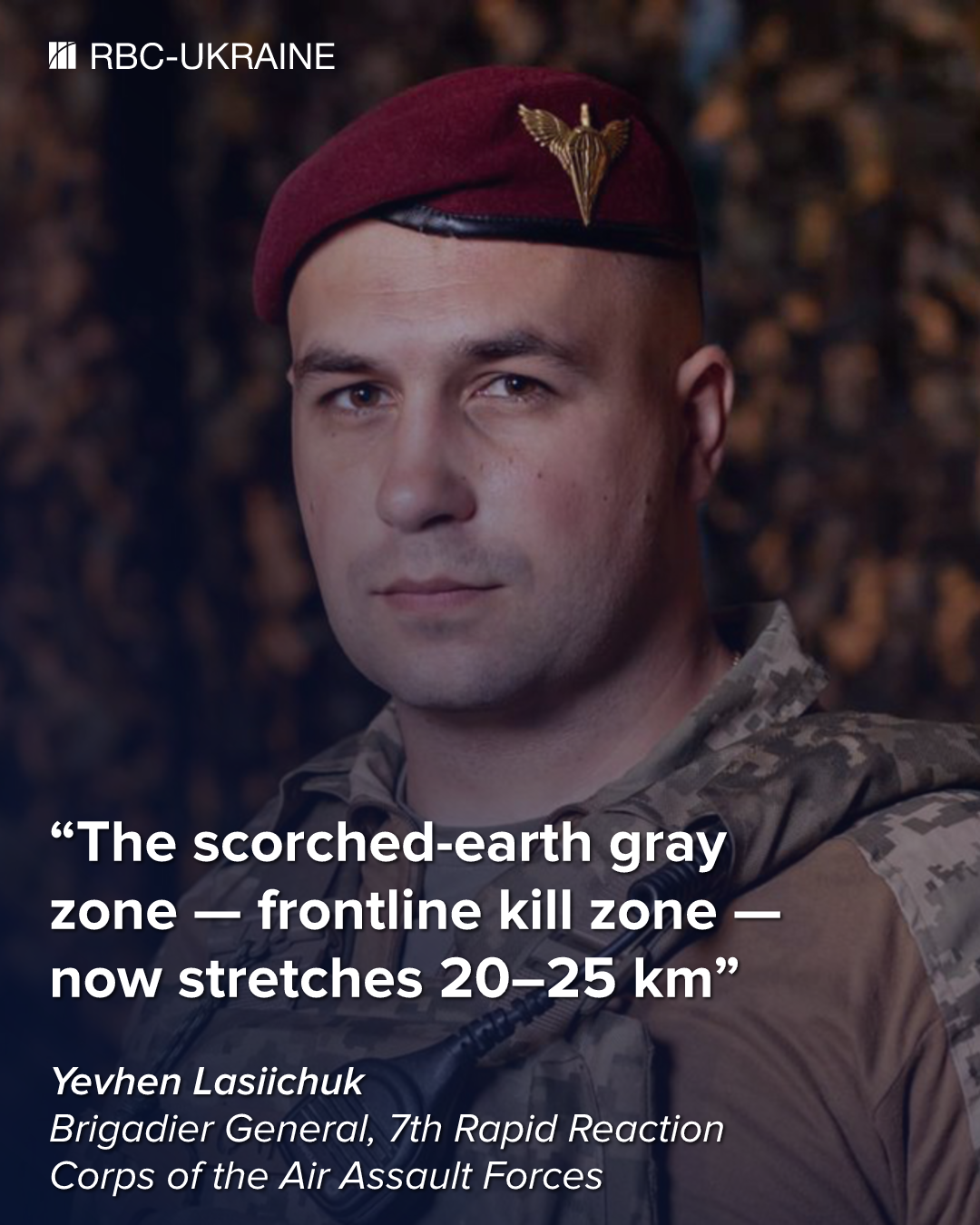 Photo: Yevhen Lasiichuk on the frontline kill zone (RBC-Ukraine infographic)
The toll on Russian forces, according to Lasiichuk, has been severe. Since the 7th Corps took responsibility for its current sector, it has killed roughly 20,000 enemy soldiers, destroyed more than a thousand pieces of equipment, and eliminated over 150 distinct types of weapons and systems — without slowing the pace of Russian assaults. Even amid reports from OSINT trackers and military analysts of a broader slowdown in Russian advances in recent months, Lasiichuk was careful not to call it a turning point. Moscow, he said, is still trying to preserve its offensive potential. What has shifted, he argued, is the math: Ukrainian forces are now killing more Russian soldiers each month — more than 30,000, by his account — than Russia can mobilize to replace them.
That math is intentional. Lasiichuk said he has set his brigade commanders a daily target: fifty enemy soldiers killed. "That's the target I gave the brigade commander, and he's working to hit it," he said. "These are substantial numbers." To hit them while conserving Ukrainian lives, the corps has leaned heavily into drone warfare — a single brigade now burns through roughly 500 drones for reconnaissance and strikes in its sector alone.
Still, Russian commanders show no sign of easing off. Lasiichuk believes Moscow is eyeing the Pokrovsk-Myrnohrad agglomeration as a stepping stone toward the Dobropillia direction, and from there, toward the larger prize of the Sloviansk-Kramatorsk agglomeration further north.
Behind the battlefield numbers, Lasiichuk credited the corps reform with much of the improvement — not just in command structure, but in the tools available to Ukrainian units. The corps has added a dedicated artillery brigade, which recently received a HIMARS battery, and is rapidly expanding its air defense formations. It has also leaned into digitization, particularly through Delta, a battlefield management application that Ukrainian forces use to track enemy movement, choose targets, and plan operations.
Striking deep
Beyond the immediate front line, the 7th Corps has increasingly turned to what Ukrainian forces call middle-strike drones — weapons capable of hitting Russian targets far behind the line of contact. "Moscow is burning — and that's a good thing," Lasiichuk said, referring to Ukraine's longer-range deep-strike campaign against targets inside Russia. But for his own corps, the relevant tool is the mid-range strike: standard-issue equipment now used to hit Russian command posts, troop concentrations, and ammunition depots along the routes leading toward Pokrovsk and Myrnohrad.
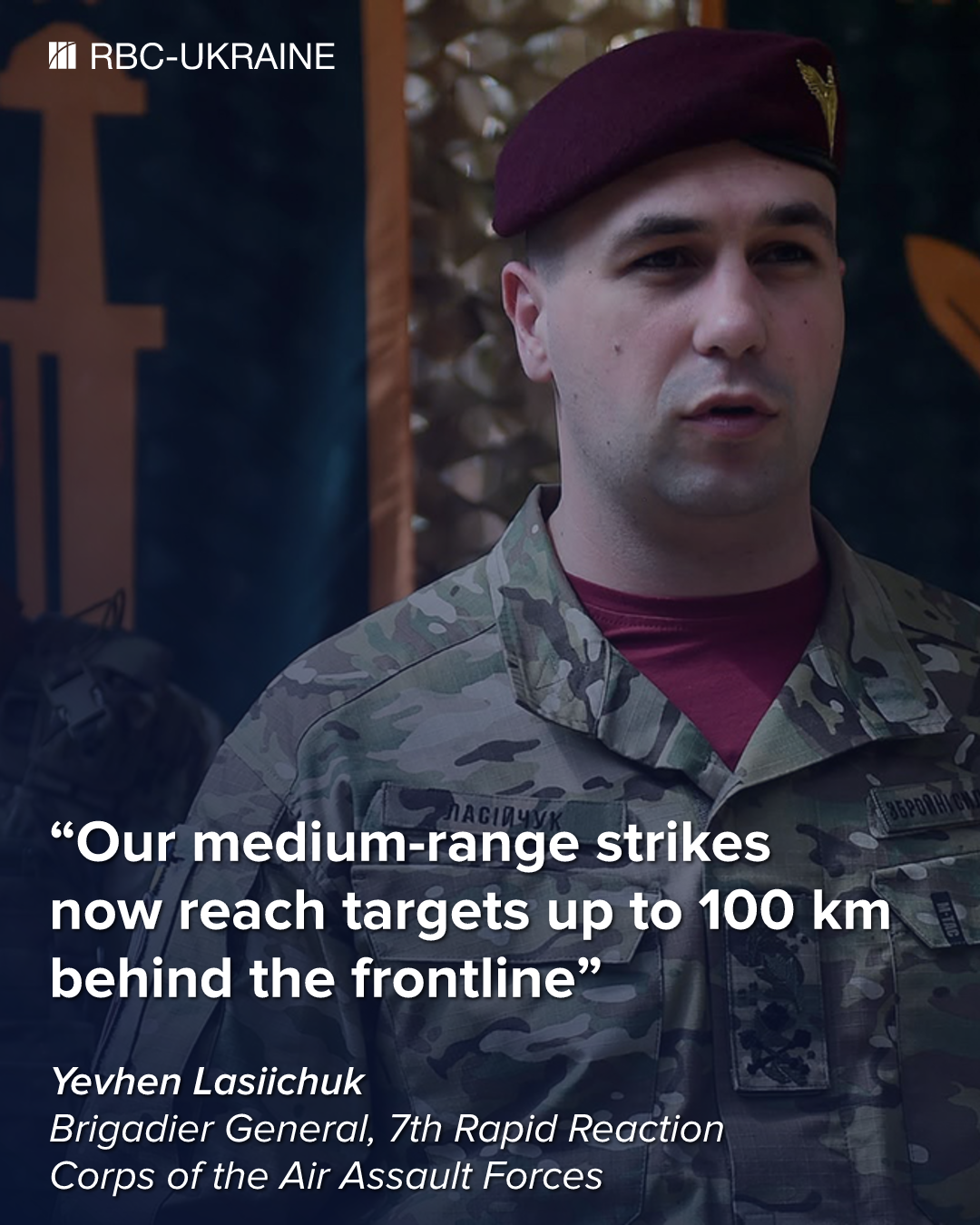 Photo: Yevhen Lasiichuk on medium-range strikes (RBC-Ukraine infographic)
The 147th Separate Artillery Brigade recently used several types of these drones to strike exactly those kinds of targets, he said. The strikes now reach roughly 100 kilometers behind the front line — deep enough, Lasiichuk said, to blanket the enemy's staging areas and supply routes with near-constant surveillance and fire. Asked which specific systems the corps uses for these strikes, Lasiichuk declined to say. "We keep a few small secrets," he said with a smile.
He doesn't expect Russia's inability to counter the campaign to last. "Nothing stays static," he said. "We keep evolving — these are the next turning points of this war." He expects Moscow to eventually respond with electronic warfare or expanded air defenses, though he isn't convinced the Russians are close to solving the problem yet.
For now, Lasiichuk said, the single most important factor in the fight is control of the sky. Denying Russian drones and aerial reconnaissance the ability to observe Ukrainian positions, he said, is the precondition for nearly everything else — holding ground, protecting troops, keeping supply lines open. Ukrainian air defense units work daily to shoot down Russian fixed-wing drones, ordinary quadcopters, and every class of Shahed-style attack drone operating in the sector.
Drones, not artillery, now account for the majority of casualties on both sides, Lasiichuk said — roughly 70 to 80 percent of losses inflicted by the enemy come from drone systems, with the remainder from artillery fire. That balance shifts somewhat in bad weather, when Russian forces lean more heavily on artillery barrages against known troop concentrations. "But again, that cuts both ways," he said. "We do the same to him."
The result, Lasiichuk said, is a front line that no longer resembles the trench-and-position warfare of 2022 and 2023. The kill zone now extends roughly 20 to 25 kilometers on the Ukrainian side of the line, and he expects it to grow to nearly 30 kilometers by the end of the year. Because the same conditions apply in reverse on the Russian side, he said, the effective no-man's-land now stretches 50 kilometers or more in total — territory where troops on both sides can only move safely under electronic-warfare protection or physical cover.
Rebuilding the ranks
Away from the front line, Lasiichuk is also grappling with the more mundane, and in some ways harder, problem of keeping his corps staffed. Troop rotations, he said, remain difficult and depend heavily on circumstances — the corps can typically only rotate personnel out when Russian forces aren't actively engaged, or, somewhat counterintuitively, during stretches of bad weather, when reduced visibility makes it safer to move troops without risking their lives.
Bringing soldiers back after unauthorized absences — a persistent problem across Ukraine's military — has proven similarly difficult. However, Lasiichuk said the corps is part of a new pilot program to address it.
The corps' overall manpower still leans heavily on mobilization rather than voluntary enlistment: roughly 85 to 90 percent of new troops arrive through the draft, with only 10 to 15 percent signing on as volunteer recruits. Lasiichuk said the corps is trying to shift that balance by building out a network of civilian-facing recruitment centers.
Why Russia keeps pushing
Asked what Moscow is counting on, given slow, costly advances and no apparent appetite for negotiations, Lasiichuk pointed to sheer manpower. Russia's core asset, he said, remains its ability to mobilize soldiers — a resource Ukrainian forces are determined to keep destroying faster than it can be replenished. Whether Russia is using that manpower effectively, he was skeptical: "Are they using that resource effectively? Probably not."
In the meantime, he said, Russia has increasingly turned to striking Ukrainian cities far from the front, hitting civilian infrastructure and homes in an apparent effort to break Ukrainian morale where it cannot break Ukrainian lines. "They are trying to demolish our homes and our military positions," Lasiichuk said. "But they won't break our spirit. He won't achieve his goal."
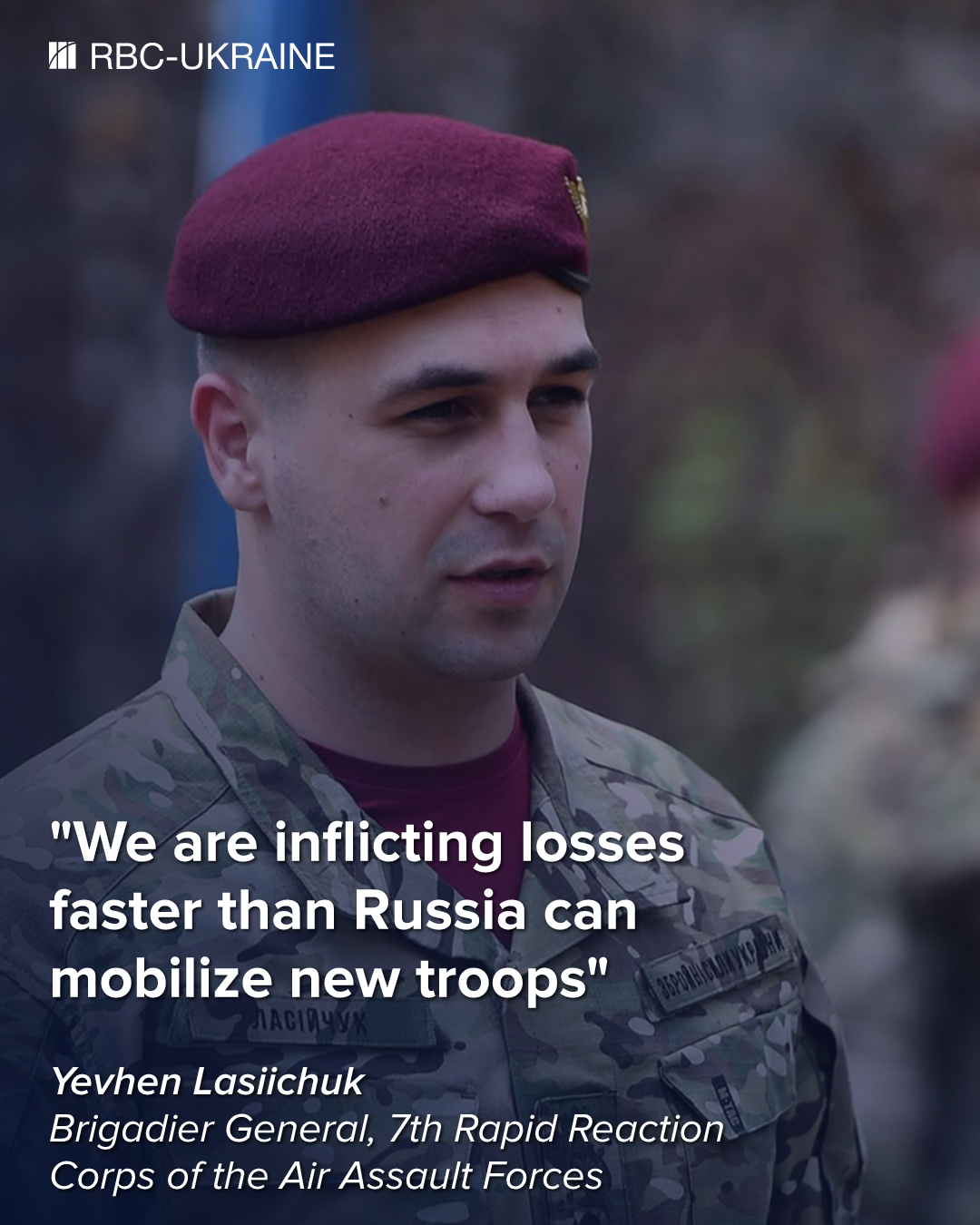 Photo: Yevhen Lasiichuk on eliminating Russian troops on the frontline (RBC-Ukraine infographic)
The central Russian failure, in his view, is a willingness to treat soldiers as expendable. "They are simply throwing men forward, trying to achieve their objective at any cost," Lasiichuk said, arguing that more careful use of Russia's mobilized manpower could have produced better results for Moscow. Instead, Ukrainian forces are killing more Russian troops each month than Russia can mobilize to replace — the underlying reason, he believes, that the Russian advance has slowed. Whether Moscow fully understands that dynamic, he said, he couldn't say.
Asked to imagine the battlefield a year from now, assuming the war remains as intense as it is today, Lasiichuk predicted more of the same trajectory: deeper digitization, more automated combat-management systems, and a kill zone that keeps expanding on both sides of the line — potentially past 30 kilometers by his estimate. Drone warfare, already dominant on the ground, will keep extending into the air as well, he said, a race neither side shows any sign of abandoning.
"We understand this, and we're finding new solutions and new ways to strike the enemy," Lasiichuk said. "We're not standing still either. We keep moving forward."