Polls don't tell full story: Where real battle between Orbán and Magyar will unfold


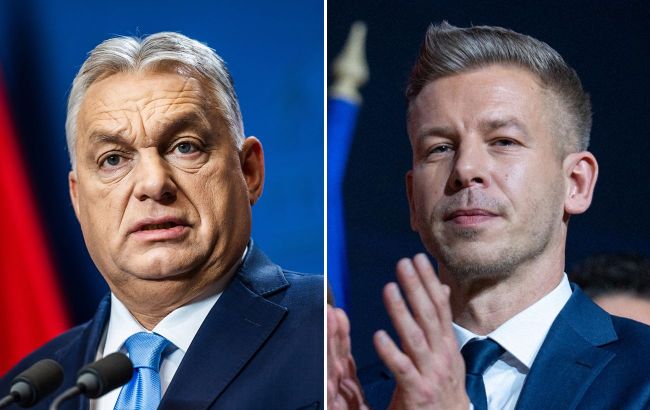 Photo: Hungarian Prime Minister Viktor Orbán and opposition leader Péter Magyar (RBC-Ukraine collage)
The ratings of the party led by Hungarian opposition leader Péter Magyar are 10% ahead of Prime Minister Viktor Orbán's Fidesz. However, the real battle will take place in individual constituencies, where the balance of power is very different, said Tibor Dessewffy, the Director of the Digital Sociology Research Center at Eötvös Loránd University in Budapest, in a comment to RBC-Ukraine.
Why polls aren’t completely reliable
Many factors make any forecast unreliable, from the specifics of the electoral system to limitations in sociological studies in particular districts.
One thing is certain: Tisza poses a more serious challenge to Orbán than previous opposition forces, as the party remains unified.
Fidesz’s controversial strategy and Ukraine's role
"The real question is whether Fidesz’s scandal strategy — pushed to quite extreme levels and including the elements mentioned in the question — will actually work. At the moment, the effect is not yet visible. My personal view is that it will have some impact, but the scale of that impact is impossible to predict," Dessewffy said.
Separately, he highlighted Ukraine’s reaction. "It is also somewhat unfortunate — even if understandable — that the Ukrainian side is now responding and striking back. That dynamic gives Orbán an opportunity to present himself as the defender, even the protector," he noted.
What is the main uncertainty
According to Dessewffy, the key battleground will be individual constituencies. In provincial towns, Tisza is already showing better results than the opposition did previously. But in villages and small settlements, the situation is completely different.
There, Fidesz has spent decades building networks of influence and controls most local resources. This is the main uncertainty.
"For that reason, I would advise caution when interpreting polling data or the speculations built on it. The simple truth is that at this stage no one knows the outcome with any certainty," Dessewffy concluded.
Earlier, RBC-Ukraine reported that Orbán turned Zelenskyy’s statement about the address of the Hungarian Prime Minister for Ukrainian Armed Forces soldiers into a campaign tool, portraying it as proof of external pressure on Hungary and the need to protect the country from being dragged into the war.
At the same time, Budapest blocked an EU €90 billion loan to Ukraine, connecting it to the resumption of Russian oil transit through the Druzhba pipeline.
However, according to Slovak expert Rasto Kuzel, this time the strategy may not work—some Hungarians are already tired of the constant confrontational rhetoric.