Middle East war pushes Russia’s oil prices? Expert sets the record straight


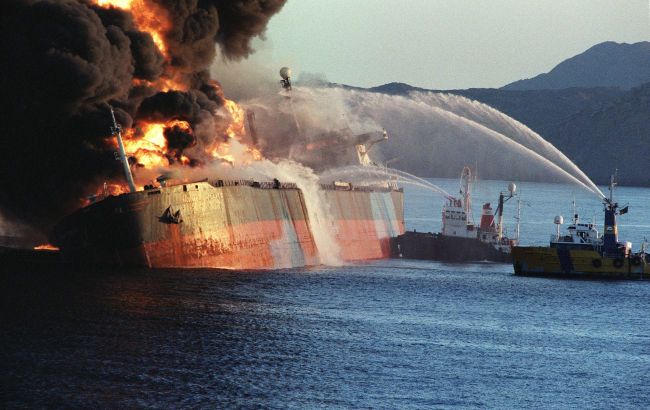 Illustrative photo: the war in the Middle East is unlikely to help Russia profit from oil (Getty Images)
Reports of Russian Urals oil rising above $70 per barrel amid the Middle East crisis have shaken the media. However, the actual figures are in fact lower, this was explained in a comment to RBC-Ukraine by Hennadii Riabtsev, Director of Special Projects at the Psychea Research and Technology Center.
Key points
-
Reality: In Russian ports (Novorossiysk, Primorsk), shipments are either stalled or selling at prices well below $70 due to massive discounts.
-
Expert skepticism: There is effectively no market price for the Russian Urals grade, as it is excluded from global trading.
-
Price anomaly: Amid the Middle East war, Trading Economics recorded the price of Urals oil supposedly "above $70 per barrel" for the first time since 2025.
Russian oil 'at $70': Real price or a 'bubble'?
Reports are rapidly spreading in the media that the price of Russian Urals oil has risen above $70 per barrel for the first time since 2025. Media outlets and social networks cite data from the analytics platform Trading Economics.
The increase is said to be occurring amid escalating conflicts in the Middle East and the blockage of the Strait of Hormuz.
According to Bloomberg, India is reportedly preparing to take delivery of 1.4 million barrels of oil that have shifted course from East Asia.
However, Hennadii Riabtsev, Director of Special Projects at the Psychea Research and Technology Center, urges caution before drawing conclusions about the Kremlin "profiting" from this situation.
The expert notes that there is effectively no market quotation for Russian Urals oil. It is excluded from global trading operations, making it difficult to determine its exact market price.
The value of the Urals can only be assessed based on port shipment indicators:
-
In Novorossiysk, nothing is currently being shipped, so no price can be formed.
-
In Primorsk, oil is selling at prices far below the supposed $70, even accounting for large discounts.
"Where the $70 price came from is unclear to me. It cannot be that high given the discounts observed recently," the specialist notes.
Will Russia benefit from rising oil prices?
As is known, the aggressor country’s state budget for 2026 is based on a price of $59 per barrel, but the reality is even worse.
Due to low revenues, the Russian government is preparing to revise compensation conditions for oil producers, and these adjustments will not favor business, Ryabtsev emphasized.
Despite temporary price fluctuations, the expert considers it wrong to claim that Russia benefits from the situation. He explains:
-
Iran is unlikely to maintain long-term influence on the oil market.
-
Assessing a country’s revenue based on one or two higher-priced shipments shows a misunderstanding of how the market works.
"Of course, Russia might make a gain tomorrow or the day after, if one shipment of oil costs slightly more than another shipment from two or three weeks ago. But evaluating Russia’s oil and gas revenues based on just one or two shipments can only be done by people who don’t understand how the oil market operates," Ryabtsev concluded.
Thus, despite the "attractive" figures on the charts, the aggressor’s oil and gas revenues remain under pressure due to the lack of real markets for high-priced sales.
Global prices and sanctions pressure on Russia
Recently, global oil prices have risen due to renewed tensions in the Middle East. Iran threatened attacks on vessels in the Strait of Hormuz — one of the world’s key maritime routes.
About one-fifth of all seaborne oil passes through this narrow strait, so any threat to shipping immediately impacts global markets.
Currently, Brent crude is trading at around $83 per barrel.
At the same time, Western media note that Russia has been unable to fully benefit from the price increase, in part due to Ukrainian attacks on energy infrastructure and logistics.
Moreover, Moscow’s revenues continue to be pressured by sanctions. The G7 countries have set a price cap on Russian oil, limiting its profits.
Another blow has been a reduction in purchases from India. In recent weeks, Indian refineries have begun buying less Russian oil, fearing it could complicate trade negotiations with the US.
As a result, Russia has had to seek new buyers. Some volumes have been redirected more actively to China, with larger discounts offered.