Far-right AfD election win could change Germany’s aid to Ukraine, expert says


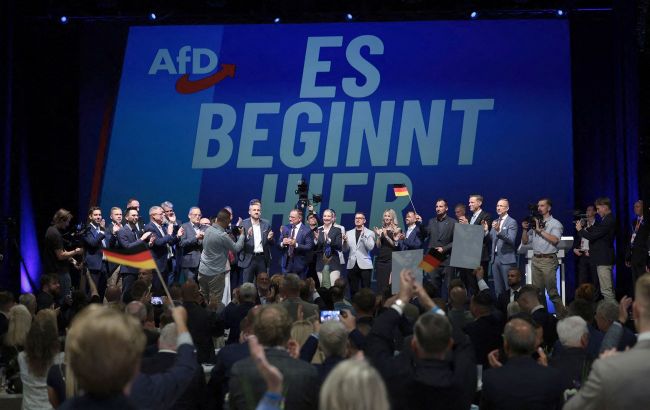 Photo: the far-right Alternative for Germany (AfD) party won the election in Saxony-Anhalt (Getty Images)
The victory of the right-wing Alternative for Germany (AfD) party in the local elections could eventually lead to changes in Berlin’s aid to Ukraine and Ukrainians, Dmytro Shevchenko, Ukraine’s former consul in Munich and chancellor of the Ukrainian Free University, said in a comment to RBC-Ukraine.
What the AfD victory could mean
According to the expert, there are two dimensions to consider: assistance to Ukrainian refugees in Germany, while the more critical issue is aid to Ukraine as a state — assistance provided at the federal government level.
"On the one hand, we have to understand that a federal state has no direct influence over either issue. On the other hand, the election results have undoubtedly served as a litmus test, including concerning these two Ukraine-related issues," Shevchenko said.
Friedrich Merz’s government has made only minor adjustments to the current policy, which the far right has used to criticize the authorities.
"As for assistance to Ukraine, it is directly linked to Germany’s economic crisis and social spending: people have less cash left from the amount they receive as wages," the expert said.
This is driving backlash at a time when the government is funding projects abroad, particularly in Ukraine.
"It is difficult to say today to what extent this will lead to changes at the federal government level. But if the government takes this election litmus test into account, changes are inevitable. Unfortunately, corruption scandals in Ukraine are only worsening the outlook for aid approval," Shevchenko said.
Snap elections
At the same time, the expert noted that the threat of snap elections in Germany is currently low, as they would benefit no one in German politics except the AfD.
All other parties, apart from the far right, would receive fewer votes in an election than they currently have.
"The position of the Federal Chancellor (Merz — ed.) is weakened by these election results. There is talk that the government could be reshuffled, including a possible change of federal chancellor. But this is also a very difficult issue because there is no clear alternative to Merz," he stressed.
At the same time, local elections in other German states will influence the further course of events. A consensus still exists among Germany’s major political parties not to cooperate with the Alternative for Germany, but with each new victory by the far right, that consensus is weakening.
RBC-Ukraine previously reported that in late December 2025, German Chancellor Friedrich Merz’s government hit a record low in public trust. Against this backdrop, pro-Russian parties became significantly more active, including the Alternative for Germany.
In addition, in November 2025, AfD politicians were banned by their own party from meeting with former Russian President Dmitry Medvedev in Sochi.
It was also reported that in September of the same year, AfD co-leader Alice Weidel unexpectedly criticized Russian leader Vladimir Putin’s policies during a speech in the Bundestag.