War of attrition and pressure talks: What Kremlin's planning for Ukraine in 2026


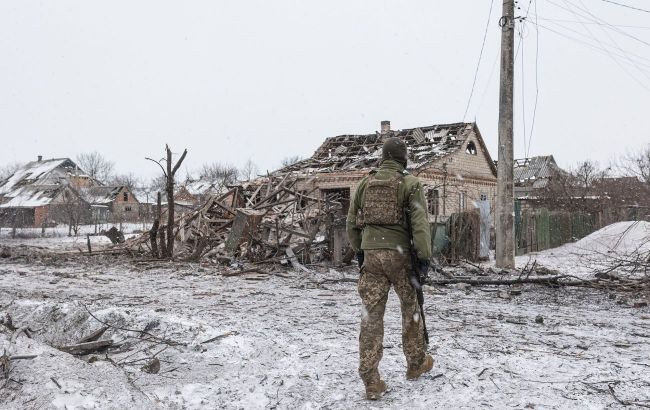 In 2026, Russians want to drive the Ukrainian Defense Forces out of Donetsk region (photo: GettyImages)
Despite the lack of rapid breakthroughs, Russia is not stopping its offensive on the front lines. Moscow has two priority goals for 2026: to use them in the negotiation process or to seize what it wants by force. RBC-Ukraine discusses Putin's plans and war scenarios for this year.
Key questions
- What is Russia's main goal on the front in 2026?
- Why have the Russians become more active in the Zaporizhzhia region?
- What is Moscow's plan?
- What scenarios for the course of the war are possible in 2026?
The Kremlin views 2026 as crucial to achieving its maximalist objectives in the war against Ukraine. The Russian offensive does not look like a breakthrough. Despite the enemy maintaining the initiative on the front for two years in a row, its advance is a slow, exhausting pressure that does not stop, even when it yields no quick results.
It is this inertia — not the pace of advancement — that will determine the nature of combat operations in 2026. Moscow will try to convert slow tactical gains into strategic ones — both on the battlefield and through coercion in the negotiation process.
Russia's priority No. 1: Donetsk region
In 2026, Russia's number one priority on the front will remain the capture of the entire Donetsk region. To this end, Russia will focus on several areas and the achievement of several objectives. First and foremost is the completion of the occupation of the Pokrovsk and Myrnohrad areas.
Currently, infantry activity on both sides has decreased somewhat due to weather conditions. The Armed Forces say that they still hold separate areas in Pokrovsk and Myrnohrad. A significant part of the supply of Ukrainian military in the agglomeration is carried out by drones.
The epicenter of the fighting in this direction has shifted towards Rodynske and Krasnyi Liman, north of Pokrovsk. According to DeepState maps, these settlements are located along the last corridor for Ukrainian forces defending Myrnohrad.
At the same time, Russia is trying, without much success, to infiltrate its personnel into the villages of Nove Shakhove and Sofiivka to expand the so-called Dobropillia salient. At the same time, Russia is gathering forces to storm Hryshyne, west of Pokrovsk.
If they achieve their objectives and completely capture Pokrovsk, the Russians will most likely try to advance westward to the administrative border with the Dnipropetrovsk region and northward to support the offensive on the Kramatorsk-Kostiantynivka agglomeration, the most fortified belt of Ukrainian defense (Druzhkivka-Kostiantynivka - Kramatorsk - Sloviansk).
Russia is already approaching or trying to approach this agglomeration from different sides. One of them, north of Sloviansk and Kramatorsk, is the entire bridgehead on the left bank of the Oskil River, which is located within both the Kharkiv and Donetsk regions. The main battles in this area are concentrated around Kupiansk, which the Russians have allegedly taken several times, and Lyman.
Although the Ukrainian military managed to regain control of Kupiansk, Russia received orders to return to their positions and even deployed additional forces for this purpose, including the Rubicon drone unit. However, all their attempts have been unsuccessful so far. In the Lyman direction, the Ukrainian Defense Forces have managed to stabilize the situation, primarily east of Lyman, from where Russian soldiers are trying to infiltrate.
At the same time, Russia wants to approach Sloviansk and Kramatorsk from the east – from the direction of Siversk, from where the Ukrainian Defense Forces withdrew at the end of December. From this area, the Russians are moving not only directly west, but also northwest, attempting to cross the Siverskyi Donets River – again, to capture additional square meters in the north of the Donetsk region and get as close as possible to Sloviansk.
Russia has come closest to this agglomeration from the direction of Kostiantynivka, gradually accumulating personnel on the eastern outskirts of the city. At the same time, Russian troops want to approach the city from the north and south to effectively surround it from several sides. There, a number of villages separate the Russian positions from the city. At the same time, Russia is striking the road supplying Kostiantynivka from the direction of Druzhkivka.
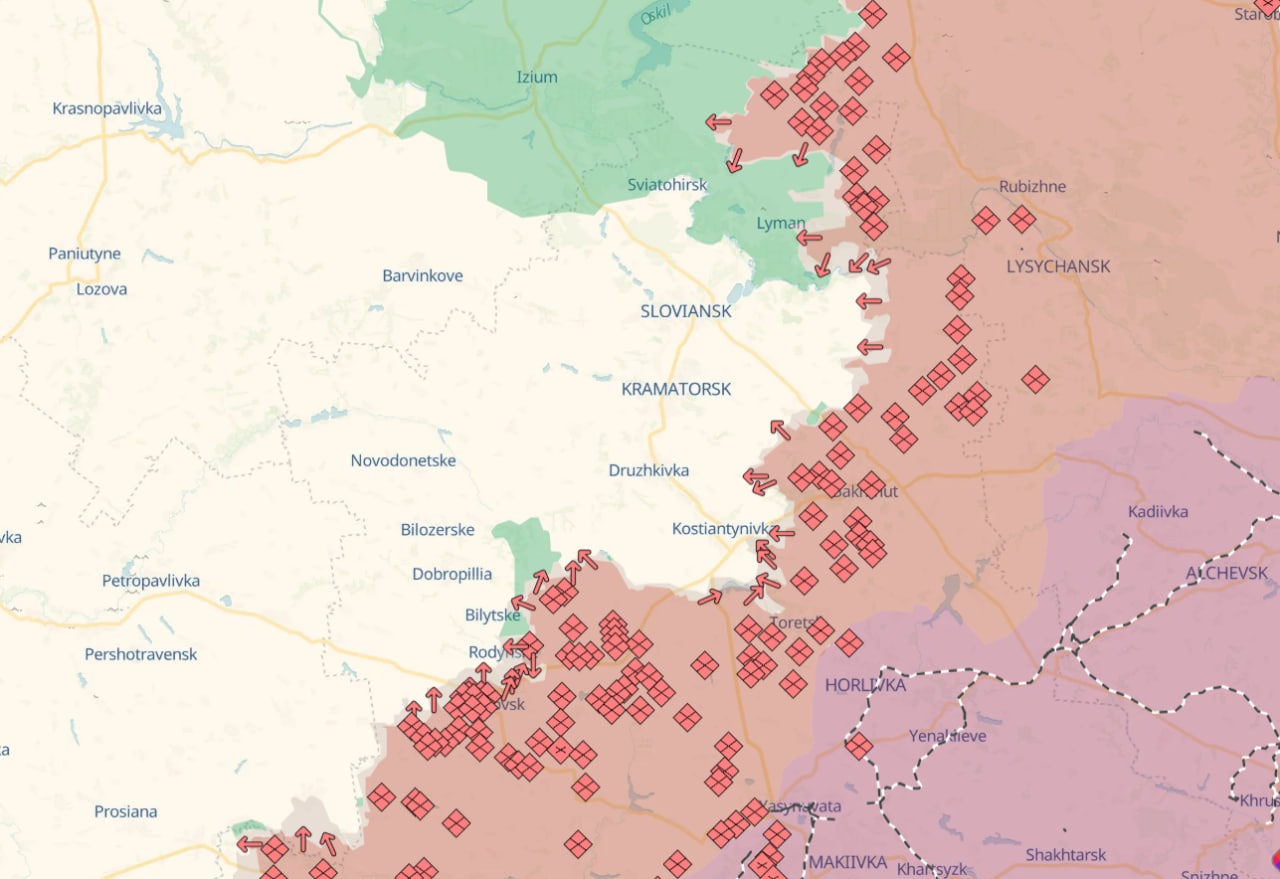 Kramatorsk-Kostiantynivka agglomeration (map: DeepState)
"Currently, a major problem on the front line is that the Russians have learned to cut off our logistics at a depth of tens of kilometers using FPV drones, drops, and so-called waiting drones," explains one of the agency's interlocutors.
Cutting off logistics is one of the components of the Russians' current tactics on the front line for capturing large settlements. This tactic can be most clearly seen in the battles in Pokrovsk and Myrnohrad. Russia no longer attacks cities head-on.
"The current tactic has three components. The first is to bypass cities, surrounding them on three sides. The bulk of the troops remain outside the city, while a smaller force begins to infiltrate and engage in combat—this is the second component. And the third is to cut off logistics using drones," adds another source from RBC-Ukraine.
It is with this tactic that the Russians plan to fight for the Kramatorsk-Kostiantynivka agglomeration, bypassing fortified cities and trying to create a threat of operational encirclement for our units that are defending.
According to RBC-Ukraine sources, Moscow plans to occupy the entire Donetsk region by April 1. Of course, the agency's interlocutors do not consider such deadlines realistic. Estimates from various analytical centers, including ISW, suggest that Moscow is unlikely to achieve this goal even by the end of 2026, provided that Western support for Ukraine continues.
Priority No. 2: Zaporizhzhia region
"The Huliaipole area is currently the only section where the Russians are on track with their plans and deadlines. They took advantage of the weakness of our defenses in this area, where there were brigade units that had not participated in combat for years, some of them without normal combat experience. When the Russians saw that they were successful here, they began to transfer reserves here, in particular from the 76th Airborne Assault Division," says one of RBC-Ukraine's informed interlocutors.
Ukrainian Defense Forces claim that fighting in Huliaipole is still ongoing, even though the city has turned into a large gray zone. At the same time, the Russian troops are conducting offensive operations north of the city, all the way from the junction with the administrative border of the Donetsk region, heading west. This concerns the settlements of Pryluky, Varvarivka, and Dobropillia in the Zaporizhzhia region.
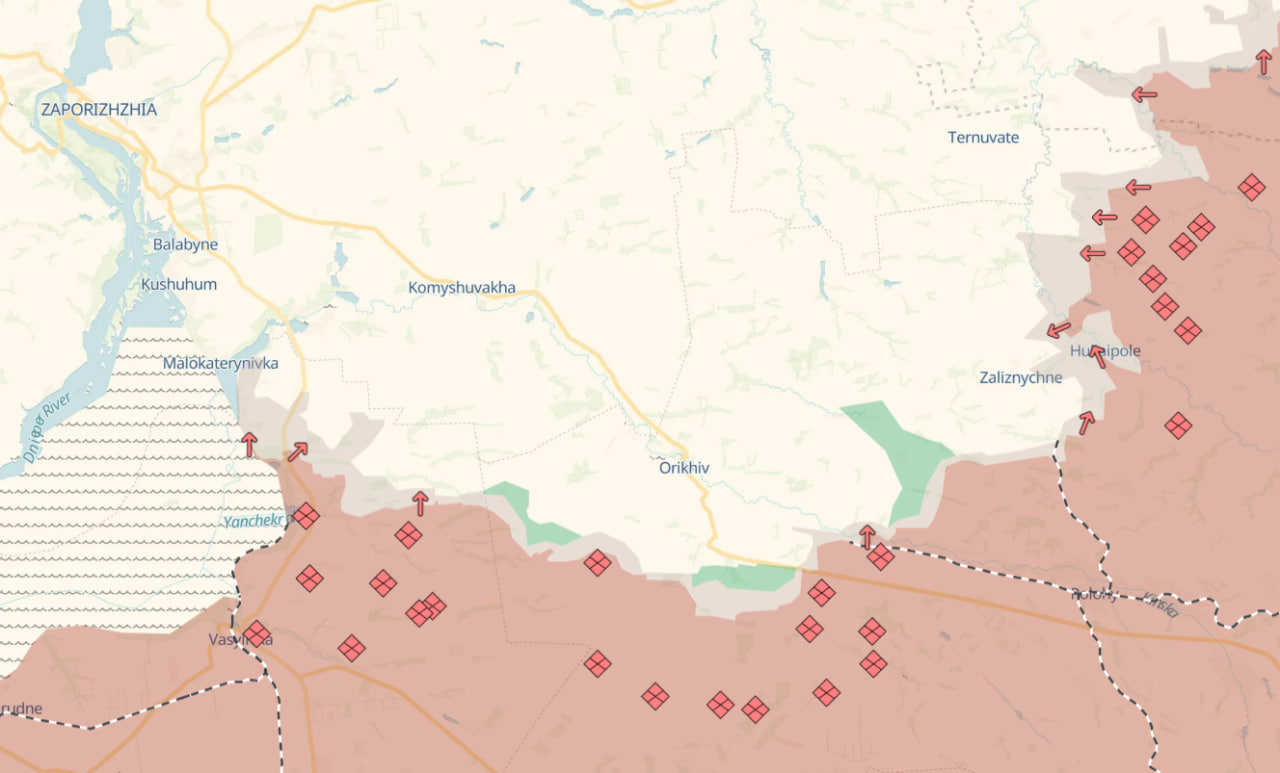 The front line in the Zaporizhzhia region (map: DeepState)
At the same time, Russia has become more active in two other areas of the Zaporizhzhia region, where it is attempting to advance from south to north: the Verbove and Orikhiv areas, as well as Stepnohirsk and Primorske (near the former Kakhovka Reservoir).
The Russians' overall plan for the Zaporizhzhia region, as explained by RBC-Ukraine sources, is as follows. From Prymorske, the Russians plan to advance along the Konka River to Komyshuvakha, thereby attempting to cut off the logistics route leading to Orikhiv.
At the same time, Russia will move towards the Orikhiv defense area from the northeast, i.e., from the Huliaipole area. The next stage of the plan is to attempt to storm Orikhiv itself from several directions. After that, according to the agency's sources, the Russians want to get as close as possible to the city of Zaporizhzhia from the southeast.
Such an operation will require significant forces and resources from Moscow. Given the priority of the Russians' tasks on the front and their desire to capture the entire Donetsk region, it is unlikely that they will be able to accomplish everything at once. Currently, expanding the occupied territories in the Zaporizhzhia region is Russia's second priority. This operation should rather be seen as an attempt to disperse Ukrainian forces and as additional leverage in the negotiation process.
"Putin demands the entire Donetsk region from us. At the same time, he is launching active fighting in Zaporizhzhia. Their plan is as follows: while you are resisting and do not want to give up Donbas, I will advance in the Zaporizhzhia region, so choose what to defend," says one of RBC-Ukraine's interlocutors.
However, Russian plans for 2026 are not limited to these regions. Interlocutors in the Ukrainian Defense Forces suggest that Russia may resort to sabotage or provocative actions in other areas of the front.
"Every commander in their army has the task of advancing. They don't have a situation where some can sit back and only two or three carry out operations. Another thing is that some are given more forces and resources for this, while others are given less, depending on priorities. So we expect that the Russians may resort to some provocations in the direction of the islands near Kherson, in the direction of Nikopol, and in our border regions in the north – Sumy and Kharkiv, where Putin has given instructions to create a so-called buffer zone," another source notes.
Scenarios
In 2026, we are unlikely to see a sharp change in the nature of the war. The only variable in this formula is the negotiation process, which could either lead to a climax or come to nothing. If it does not produce real results, the war in 2026 will follow the most inertial scenario. And it is this scenario that should be considered first.
The first scenario is that the United States fails to bring Ukraine and Russia to a common ground: Putin continues to insist on maximalist conditions that remain unacceptable to Ukraine. The White House reduces the frequency of meetings with both sides and does not use any instruments of coercion.
In this scenario, Russia intensifies its military operations in the spring after a seasonal lull and continues to slowly nibble away at Ukrainian territory, but still fails to capture all of the Donetsk and Zaporizhzhia regions. The war continues into 2027. This scenario is possible, but it is not one of the most likely, as further developments could take a tougher or, conversely, a more favorable trajectory for Ukraine.
"Russian offensive actions on the front line exist in parallel with the negotiation process. Russia has formulated tasks on the front line, which are already ready. And they will continue to advance until Putin himself tells them to stop," shares one of RBC-Ukraine's high-ranking military sources.
The second scenario looks even more threatening, but it cannot be ruled out either. Unable to break the Ukrainian army on the front lines or Ukrainian society through shelling and terror, Russia may decide to raise the stakes.
According to various estimates, Moscow currently controls about 75% of the Zaporizhzhia region. After a series of operations and advances there, the Kremlin may extend its claims to this region as well. Such demands will be unacceptable. Therefore, Ukraine will most likely have to continue the war.
The third scenario, which is also worth considering honestly, looks like this: the negotiation process reaches its climax, the United States and Russia force Ukraine to withdraw its troops from the Donetsk region. Hostilities cease, and at the same time, the parties finalize all other parameters for ending the war. In this scenario, the war formally ends, but it does not eliminate the long-term risks for Ukraine.
The fourth scenario is that Trump manages to force Putin in 2026 to freeze hostilities along the current front line, from which the parties begin to agree on all other aspects of a peace agreement. In this scenario, Ukraine would still have a chance to keep part of the Donetsk (and Zaporizhzhia) regions under its control, both de jure and de facto.
"Right now, Putin would not be opposed to stopping, but only on his own terms, the withdrawal of Ukrainian troops from the Donetsk region. Is this the only prospect? No. Because he will be able to stop either when he gets the terms he wants, or when he is put in a dead end when continuing the war becomes unjustifiable and too expensive for him," believes one of the interlocutors.