Trump's simple solutions fail? Fears rise of new Middle East war


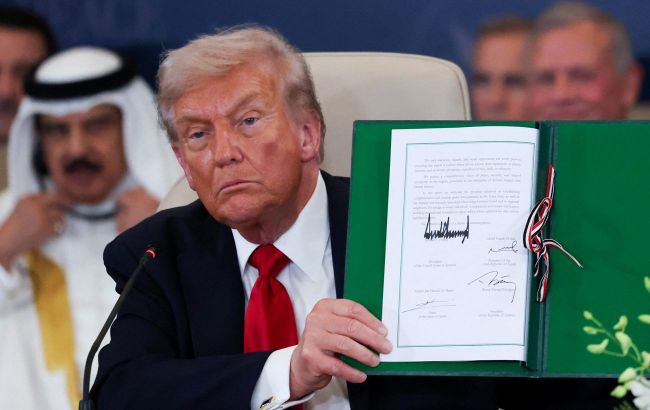 Donald Trump with the Gaza Strip agreement (photo: Getty Images)
While Donald Trump is trying to end the Russia-Ukraine war, difficulties have arisen with another peace agreement promoted by the US – this time in the Middle East. RBC-Ukraine analyzes the possibility of renewed fighting between Israel and Hamas and Hezbollah, and the lessons Ukraine can learn from this situation.
Key questions:
- What is happening between Israel and Hamas?
- What stage is the agreement between them at?
- What can Israel do in this situation?
- Why is there a renewed risk of escalation between Israel and Hezbollah?
US President Donald Trump is once again trying to end the Russian-Ukrainian war. Every few days, his emissaries travel to Kyiv or Moscow or hold talks on neutral territory. However, despite the so-called productivity of such meetings (according to almost all of their participants), the negotiations are still far from complete.
Moreover, difficulties may arise even after the agreement is concluded. This is especially true given the Trump team's tendency to simplify complex conflict situations and create constructs that are far from the realities on the ground. What this may mean in practice is already evident from the example of another peace agreement under the auspices of the US.
On October 9, Donald Trump announced the end of the war between Israel and Hamas in the Gaza Strip. With the mediation of the US and many other countries, both sides signed a multidimensional agreement on the cessation of hostilities, the return of Israeli hostages, and the restoration of the Gaza Strip. It was supposed to put an end to the escalation that began in 2023. At that time, Hamas carried out a terrorist attack on Israel and, in response, received a military operation in the Gaza Strip, which dealt a severe but not fatal blow to the terrorists.
On the American side, the process was moderated by US President Donald Trump's envoys – Steve Witkoff and Jared Kushner, who are now also involved in peace talks on the Russia-Ukraine war.
"The Gaza agreement is instructive for other future agreements, including those relevant to Ukraine, although, of course, the situations are different," Israeli military expert David Sharp says in a comment to RBC-Ukraine.
Plan with gaps
The agreement provided for several phases. In the first phase, Hamas was to release the hostages captured during the attack on October 7, 2023. In exchange, the Israeli army was to withdraw from part of the Gaza Strip and release many militants who were in Israeli prisons.
Further, according to the agreement, the Gaza Strip was to be placed under the control of a Palestinian technocratic committee for a transitional period, which would operate under the supervision of an international Peace Council headed by Donald Trump and with the participation of other world leaders, until the reformed Palestinian Authority was ready to take full control of the enclave.
Under the agreement, international stabilization forces will be deployed in the Gaza Strip. In coordination with Israel, Egypt, and Jordan, they will be responsible for securing the borders, demilitarizing the territory, and destroying all terrorist infrastructure. A special economic zone will also be created there to attract investment and rebuild the Strip.
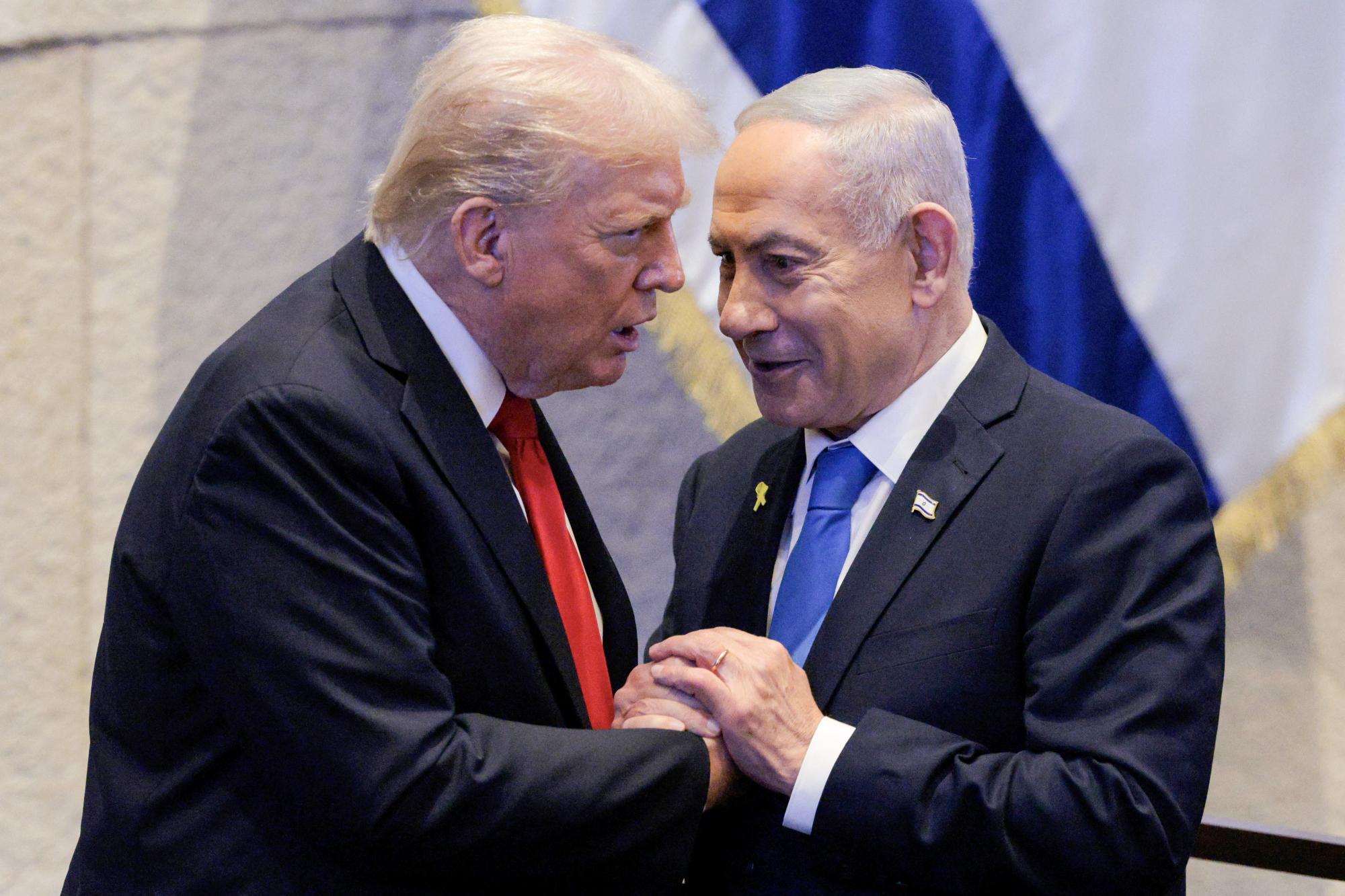 US President Donald Trump and Israeli Prime Minister Benjamin Netanyahu (photo: Getty Images)
Some of the points of the agreement have already been implemented – those that were most clearly and specifically spelled out. In particular, Israel has returned all living hostages and almost all the bodies of those killed. Some of the militants have also been released. Israeli troops have withdrawn from part of the Gaza Strip, but still control about half of the enclave's territory. However, problems have already arisen with other provisions.
Hamas previously agreed to the deal for several reasons. Among the main ones were the depletion of its military resources and the understanding that it would not get better terms from Israel. However, the group is now refusing to surrender its weapons. The militants insist that any decisions on this issue must be discussed within the framework of an intra-Palestinian dialogue.
Hamas leaders, including Hazem Qassem and Khalil al-Hayya, link their disarmament to the end of the Israeli occupation. They also threaten to fight international stabilization forces as foreign occupiers. In addition, there are occasional attacks by militants on Israeli soldiers.
"This is a classic example of a situation where something is stipulated in the agreement, but there is no clear mechanism, and it remains to be seen whether it will be developed or shelved," says David Sharp.
Israel, in response, insists on the immediate disarmament of Hamas by force if the group fails to fulfill its obligations. Prime Minister Benjamin Netanyahu has stated that this will happen the easy way or the hard way.
"For Israel, there is no other outcome possible except the surrender of Hamas, simply because we have the very painful experience of the massacre they carried out in Israel on October 7, 2023. We have seen that if you allow fanatical gangsters to stay right on your border and accumulate weapons, sooner or later they will not only rattle them in your direction," Israeli Cabinet member Ze'ev Elkin said in an interview with RBC-Ukraine.
Fork in the road for Israel
If Hamas continues to delay disarmament, Israel does not rule out resuming military operations in the Gaza Strip. Importantly, the US does not object to this option. Donald Trump has threatened to respond to Hamas with swift, fierce, and merciless force if it refuses to proceed to the next stage of the agreement. However, the White House, as usual, is showing some flexibility regarding the timing of its implementation.
Other mediators, including those from Egypt, Qatar, and Türkiye, are holding regular meetings in Cairo to overcome obstacles. They are trying to limit the number of ceasefire violations and ensure stability, but acknowledge that key differences remain.
For now, the Israeli army is limiting itself to isolated harsh responses to sporadic attacks by militants. However, this cannot continue indefinitely, and sooner or later, Israel will have to decide on Hamas.
"Israel will have to make a choice, but there are also half-measures. If the ceasefire agreement is terminated, even positional combat operations will continue, there are variations of air strikes, there are options for some advancement and occupation of additional territories, so as not to go all the way, but still put pressure on Hamas, raids, etc.," David Sharp explains.
If Israel does resume military operations, the situation for Hamas will be worse than before. First of all, the group no longer has a human shield in the form of Israeli hostages. It was this factor that largely restrained the Israeli army's activity – it had to act cautiously so as not to harm the captives.
On the other hand, the actions of the Israeli military may be complicated by the fact that a large part of the civilian population, partly loyal to Hamas, remains in the controlled part of the Gaza Strip.
"It is clear that this is an exceptional crisis for Hamas, but it has been similar before. In principle, the group has been around for many years and is capable of recovering. It should be borne in mind that it has a fairly broad social base," Oleksandr Bohomolov, director of the National Institute for Strategic Studies, tells RBC-Ukraine.
The plan is to take away this social base from Hamas by providing the population of the Gaza Strip with normal living conditions after reconstruction. According to the agreement, this should happen after the removal of Hamas from power. So for now, the situation is going around in circles. Meanwhile, Netanyahu is soon going to visit Trump again and spend all the New Year holidays in the US, discussing the future of Gaza and the region.
Escalation in the North
Tensions are also rising on Israel's border with Lebanon, where the Hezbollah group operates with Iran's support. For decades, it has posed a threat to Israel, regularly shelling and terrorising the north of the country.
Last year, Israel inflicted significant losses on the organisation by conducting a military operation in southern Lebanon. Most of Hezbollah's political and military leaders were eliminated. As a result, Israel and Hezbollah, with the mediation of the United States, concluded an agreement under which the militants would gradually disarm, the Israeli army would withdraw, and the Lebanese army under the leadership of the central government would take its place.
This was compounded by the collapse of the Assad government, which was allied with Hezbollah. However, the organization still receives support from Iran, albeit to a lesser extent than before. It also has the support of the Lebanese Shiite community, which makes up a significant percentage of Lebanon's population.
"On the one hand, there is Iran's proximity and influence, but on the other hand, there are local stakeholders who are not necessarily on friendly terms with Israel, but who are interested in the same thing—the disarmament of Hezbollah," says Oleksandr Bohomolov.
The fact is that the group is not only a military force but also a political one, with its own representatives in the Lebanese parliament.
"In fact, Hezbollah has almost destroyed the Lebanese state from within. It had carte blanche to use violence, and now there is a fairly intense political debate on this issue," the expert stresses.
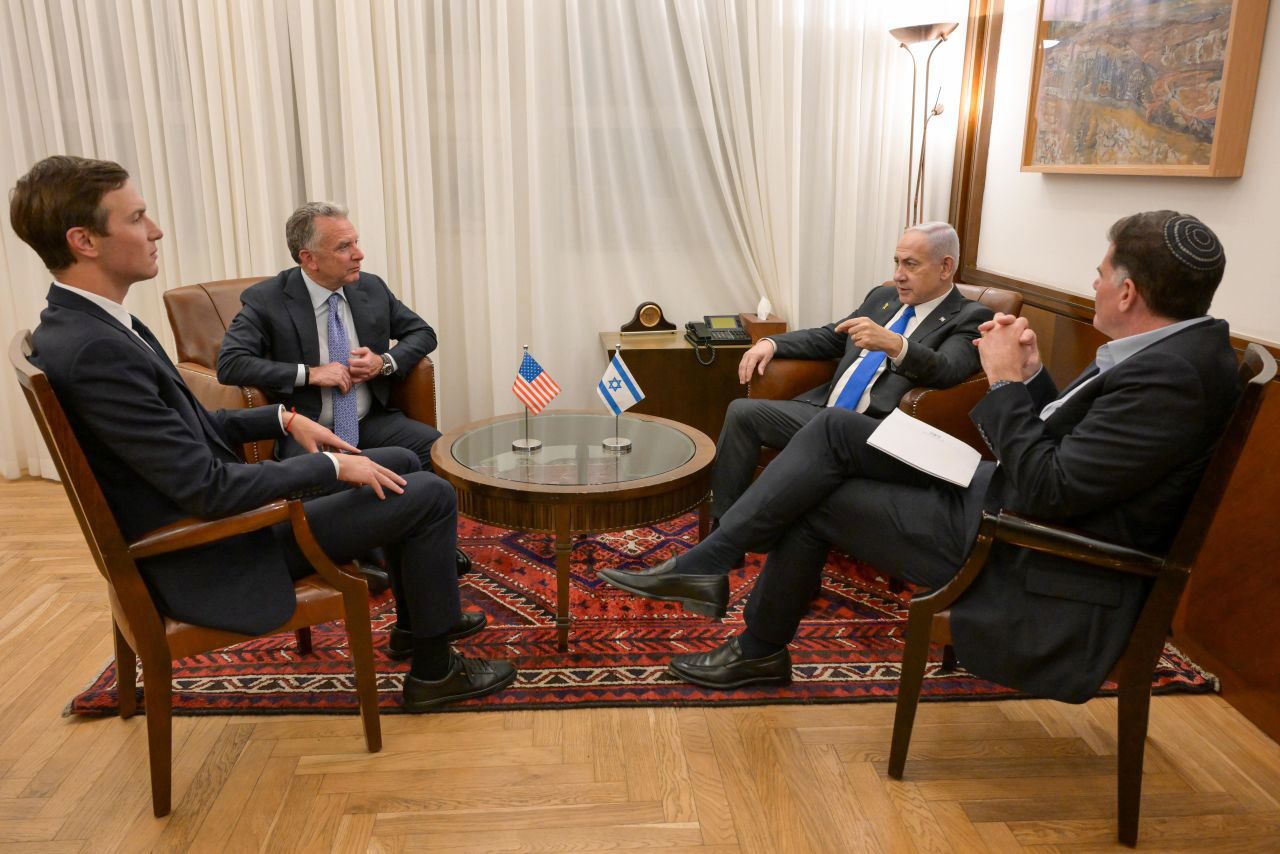 Steve Witkoff and Jared Kushner at a meeting with Benjamin Netanyahu (photo: Getty Images)
Not wanting to openly conflict with Hezbollah, the central government of Lebanon is acting extremely indecisively. The final disarmament of the militants has not taken place. So Israel has taken the initiative again.
"Israel has been putting pressure daily for almost a year, killing one or two Hezbollah terrorists and striking identified weapons storage sites, but in a limited manner. In the last month or two, Israel has decided to raise the bar of pressure on the Lebanese government and Hezbollah to speed up the process," David Sharp notes.
Moreover, on November 23, Israel eliminated the head of Hezbollah's so-called general staff, Ali Tabatabai. This approach must find support from the US, Saudi Arabia, and other leaders in the region who are concerned about Iran's influence. According to Bloomberg, the US is ready to provide support to the Lebanese army.
The group's response to Tabatabai's elimination was only verbal. However, David Sharp does not rule out escalation in this direction. The Lebanese leadership has stated that it plans to completely disarm Hezbollah by the end of this year, but it is already clear that this is unlikely. Therefore, at the beginning of next year, Israel may again take active measures.
Ultimately, the experiences of Gaza and Lebanon demonstrate that Trump's simple solutions are confronted with reality: the absence of clear enforcement mechanisms, the stable social base of terrorists, and resistance from key parties such as Hamas and Hezbollah.
For Ukraine, this is an instructive example: negotiations with Russia, even if they show progress on paper, risk following the same vicious circle scenario without guarantees of demilitarization and security, despite pressure from Washington.
Sources: statements of Israeli and American politicians, and representatives of Hamas, The Times of Israel, Al-Monitor, and The Middle East Eye, and comments by David Sharp and Oleksandr Bohomolov.