Trump's new war? Why White House is targeting Cuba and how it connects to Ukraine


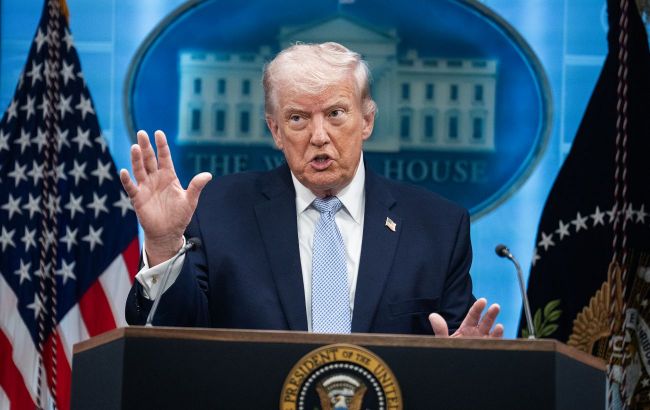 Photo: US President Donald Trump (Getty Images)
US President Donald Trump has once again turned his attention to Cuba. And this time, the threat to the island, where socialism is still being built, may be more real than before.
RBC-Ukraine explains why the United States is preparing for a potential strike on Cuba and what the chances are that an intervention could actually take place.
Key points:
- Threat of invasion: Donald Trump’s administration is seriously discussing the scenario of a military attack on Cuba.
- Electoral reasons: The White House is seeking a quick victory amid the risk of a Republican defeat in the November 2026 midterm elections.
- Economic blockade: Since January, Washington has imposed a naval and energy blockade on the island, causing economic difficulties.
- Backlash effect: US pressure is pushing Cuba to strengthen military cooperation with Russia and Iran, creating a new threat near American borders.
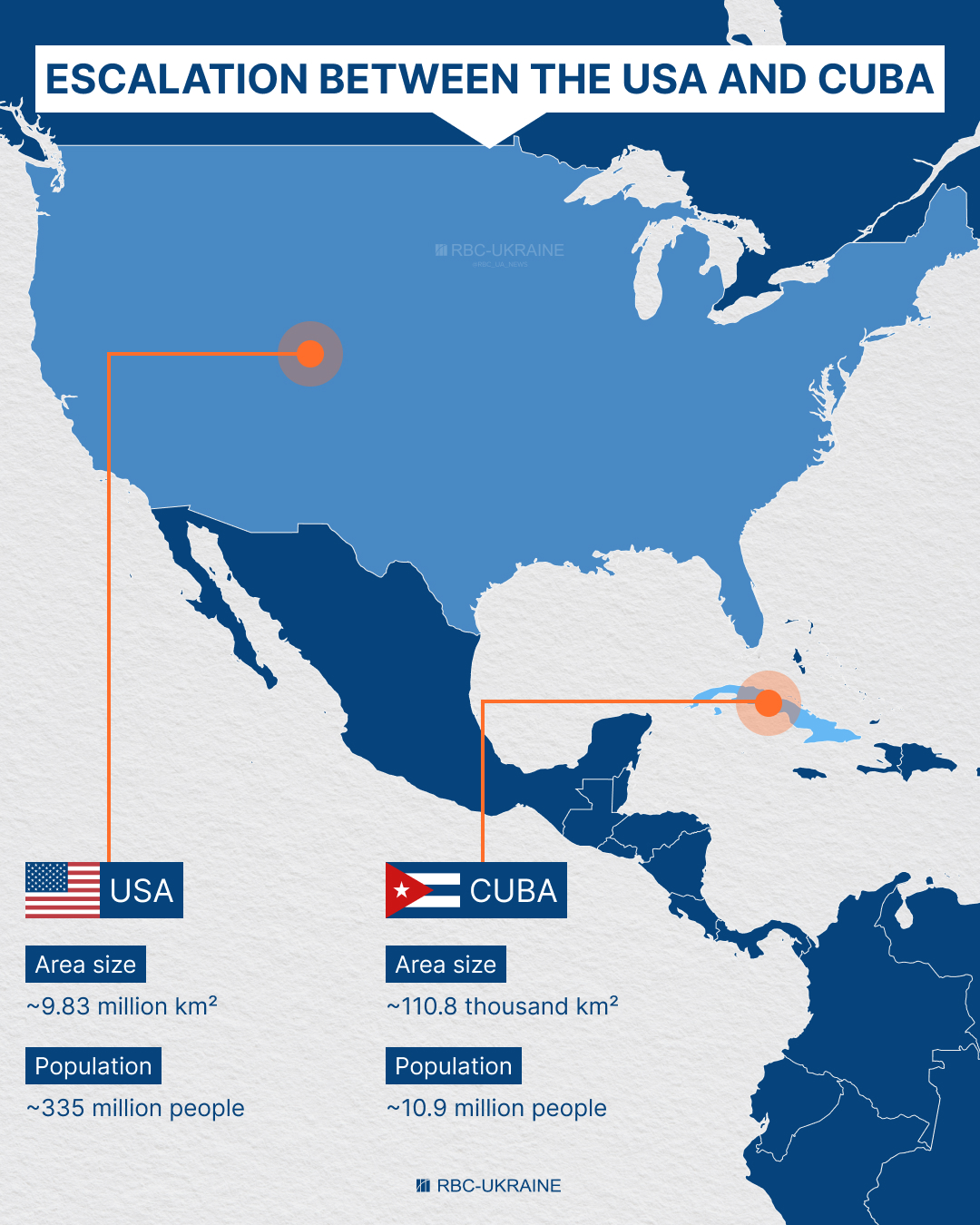 Photo: Escalation between the US and Cuba (Infographic by RBC-Ukraine)
Donald Trump has so far failed to end either Russia’s aggression against Ukraine or the US conflict with Iran, but is already planning an attack on Cuba. Such a scenario is now being seriously discussed in the White House.
According to Politico, a few months ago, the US administration was mainly focused on sanctions and economic pressure on Cuba, but sentiment has shifted due to a number of factors.
Cold War relic
Cuba is an island in the Caribbean Sea, close to the US coast. For a long time, it had a pro-American government and served as a hub for mafia money laundering and gambling businesses oriented toward the US.
In 1959, communist rebels led by Fidel Castro and Che Guevara seized power on the island. The communist regime in Cuba survived the collapse of the Soviet Union and remains in place today.
However, like in China or Vietnam, the government has undergone several transformations after Fidel Castro stepped down in 2006 and his brother Raúl two years later. A deep crisis forced the new leadership to take unprecedented steps for orthodox communists.
In 2021, small and medium private businesses were finally legalized on the island, and the domestic market was partially opened to foreign investment, including from China and Russia.
Today, the Cuban regime is a classic authoritarian one-party dictatorship, where the Communist Party tightly controls political sphere, while security forces and the military manage key financial flows and tourism assets.
Why Trump is threatening Cuba
Trump’s team has become more active on the Cuban issue for several reasons. In November, the US midterm congressional elections will take place in November. According to current polling, a series of Trump’s miscalculations has left Republicans facing a major defeat — at minimum, they are expected to lose the House of Representatives and may also lose the Senate.
To improve his party’s position, Trump needs to deliver a quick, high-profile, and convincing victory. In this context, Cuba appears to be an ideal target.
In addition, a hardline policy toward Havana traditionally ensures Trump strong support from the wealthy and politically active Cuban diaspora in Florida, a key state for Republicans.
At the same time, this is part of a broader doctrine aimed at restoring US leadership in the Western Hemisphere and pushing out Chinese influence from the region. As part of this strategy, at the beginning of January, Washington conducted an operation to capture Venezuelan President Nicolás Maduro.
The United States has also launched a campaign to push Chinese influence out of the Panama Canal area. In this geopolitical puzzle, Cuba is viewed as just another front.
There are also subjective factors. The main advocate for a tougher policy on Cuba is US Secretary of State Marco Rubio, an ethnic Cuban and staunch anti-communist.
Cuba’s response
Cuban President Miguel Díaz-Canel stated that any possible US attack on his country would lead to a "bloodbath" with unpredictable consequences.
“Cuba poses no threat, nor does it have aggressive plans or intentions against any country. It has none against the US, nor has it ever had any — something the government of that nation knows full well," he wrote on social media platform X.
At the same time, Havana has already begun large-scale defense preparations. In response to the threat of invasion, the country’s leadership has declared general mobilization.
More than 6 million Cubans have signed official commitments to defend their homeland under the Soviet-style "War of all the People" concept, which envisions turning every civilian facility into a resistance point.
The leadership is focusing on an asymmetric response. The Cuban military is actively studying Iran’s experience. Iranian military advisers have already been spotted in Havana.
Moreover, the Cuban military leadership is using the experience of around 5,000 of its citizens who were recruited into the Russian army and trained in modern drone warfare in Ukraine. Havana plans to apply this experience in the event of a confrontation with the United States.
Meanwhile, contacts between the US and Cuba have not stopped. Last week, CIA Director John Ratcliffe made a secret visit to Havana. His goal was to hold talks with Cuban security structures and intelligence services.
According to the Financial Times, Ratcliffe issued an ultimatum: stop the transfer of power and cut cooperation with Russia and Iran in exchange for lifting sanctions. The Cuban side rejected the ultimatum.
At the same time, a humanitarian crisis has begun on the island. It was triggered by a naval and energy blockade imposed on Cuba by Washington starting in January. Diesel and fuel oil reserves have been completely exhausted, oil refineries have shut down, and the power grid has experienced a series of blackouts.
Also in early May, Washington imposed crippling sanctions on GAESA — a giant Cuban military conglomerate that controls up to 70% of the country’s economy. Importantly, the new sanctions are secondary. This means the United States now penalizes any foreign companies from third countries that trade with Cuba.
Main scenarios
Further developments will depend on how far the White House is willing to go to score political points. In American media, three main scenarios are being discussed, and Washington is already preparing the groundwork for each of them:
Strangulation through blockade. This is a continuation of Trump’s current strategy. The United States does not engage in direct military confrontation but tightens the naval and energy blockade.
The logic is simple: through a total blackout, shortages of medicine, and hunger, Cuban society is expected to erupt from within, leading to the collapse of the regime without a single shot by the US.
Targeted strikes. This scenario would be activated if Trump needed a quick and high-profile victory for American television audiences.
The Pentagon could carry out limited air and missile strikes on key Cuban military targets — communication centers, supply bases, or intelligence infrastructure. This would allow the White House to claim it has "punished the dictatorship" while avoiding a ground operation.
Full-scale invasion. The most radical option, involving an amphibious landing and a complete regime change in Havana. However, this carries enormous risks for the United States.
Cuba’s promised "War of all the People" threatens Washington with a prolonged conflict and heavy losses right in its own backyard.
The key question is what exactly would trigger this scenario. Clearly, the White House could use a national security threat as a formal pretext for an attack, and its outlines are already emerging.
Recently, Axios reported, citing US intelligence, that Cuba has accumulated more than 300 combat drones received from Russia and Iran.
Washington is already beginning to promote the narrative that these drones pose a direct threat to the US base in Guantánamo, American naval vessels, or even cities in Florida. Thus, any incident in the Caribbean Sea could be interpreted as crossing a red line.
Trump’s Cuban campaign is an attempt to quickly compensate for failures in other areas. The White House has not managed to end Russia’s aggression against Ukraine or the war with Iran, and is therefore seeking a weaker target close to home to demonstrate a decisive victory to voters.
However, in doing so, Washington is pushing Havana into a corner and forcing it to seek protection from Moscow and Tehran. As a result, the United States risks creating yet another crisis — this time near its own borders.
Quick Q&A
– Why is Donald Trump planning a military operation against Cuba?
The main reason is the White House’s attempt to boost Republican approval ratings ahead of the November 2026 midterm congressional elections amid domestic political setbacks.
This move is also part of a broader US strategy to push Chinese and Russian influence out of the Western Hemisphere. In addition, a hardline policy toward Havana ensures Trump strong support from the influential Cuban diaspora in Florida.
– How is Cuba preparing for a possible US invasion?
The country’s leadership has declared general mobilization and is implementing the Soviet-style defense concept of "War of all the People," under which more than 6 million citizens have signed commitments to defend the country, turning civilian infrastructure into resistance points.
The Cuban military leadership has also engaged Iranian military advisers and is adopting the experience of around 5,000 Cubans who took part in the war in Ukraine within the Russian army and learned modern drone warfare tactics.
– What possible US scenarios regarding Cuba are being considered?
Three main scenarios can be identified.
The first is economic strangulation through an intensified naval blockade intended to trigger internal social unrest.
The second involves targeted missile and air strikes on communication centers and intelligence infrastructure to produce a visible victory for media consumption quickly.
The third is a full-scale amphibious invasion aimed at regime change in Havana, which carries the highest risk of a prolonged guerrilla war.