Trump's era shadow: How Ukraine lived through 2025 and what comes next


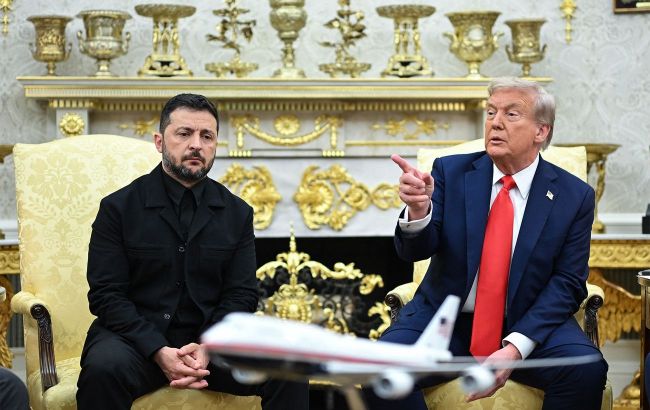 Volodymyr Zelenskyy, President of Ukraine, and Donald Trump, President of the United States (photo: Getty Images)
How talk of victory shifted to talk of peace, albeit just peace, how Donald Trump set the pace for the entire 2025 for Ukrainians, and why 2026 is unlikely to be calmer — read analysis by RBC-Ukraine.
"May the coming year be the year of victory!" — during the first half of the full-scale war, this was the main New Year's wish among ordinary Ukrainians. It was actively echoed by President Volodymyr Zelenskyy and his entire team, as well as by numerous experts and commentators. All rhetoric, official and unofficial alike, revolved around that same victory.
At the turn of 2025–26, almost nothing is heard about victory anymore. Even using this word in the context of the war feels like an archaic faux pas, akin to songs about the Bayraktar (a Turkish-made unmanned aerial vehicle, a symbol of early Ukrainian resistance) or the adventures of the dog Patron (a Ukrainian search-and-rescue dog).
Now, the item on the agenda is peace. But necessarily just peace. It seems that this has now become a real red line for all Ukrainian decision-makers. Simply, peace is unacceptable to either the Ukrainian authorities or — judging by everything — Ukrainian society.
If there will be no parade through Red Square, Russia is in no hurry to collapse, and the 1991 borders are about as unattainable as the borders of February 23, 2022, then, at the very least, peace must not be humiliating for Ukraine and must be durable. And Ukraine is ready to continue fighting for this.
What happened this year? First and foremost, Donald Trump happened. Who knows — if the US Democratic Party had timely and soberly assessed the condition of Joe Biden and nominated a more vigorous candidate, if Biden himself had not made so many mistakes in domestic and foreign policy, and finally, if the bullet aimed at Trump had flown a few centimeters to the side — then for Ukraine, for the United States, and for the entire world, 2025 would have unfolded very differently.
Ukraine's readiness to fight "until victory" was built mainly on the Western formula "we will support you for as long as it takes" and on the Western consensus that only Ukraine, represented by its leadership, would decide how, when, and on what terms to end the war.
With Trump's arrival, both of these changed. US assistance turned out to be far from guaranteed and was not free. And most importantly, using the full weight of his political influence, Trump immediately began pressing Kyiv to conclude a peace agreement with Moscow.
The moral component of the war — an innocent victim versus a frenzied aggressor — which had always helped Ukraine, instantly lost its significance in relations with the United States.
As one representative of the Ukrainian authorities once told RBC-Ukraine, "we had only just learned how to speak to Americans in the required way, to press on values, freedom, civilizational choice, and so on — when we had to relearn everything again; for this administration, all of this does not carry the same weight."
As a result, throughout the year, Trump took Ukrainians on a roller coaster, provoking a storm of emotions.
To avoid ending up in the role of those "who do not want to end the war," Ukrainian negotiators led by Volodymyr Zelenskyy had to learn on the fly the golden rule of diplomacy in Trump's times: never publicly argue or express dissatisfaction, even when having to listen to stories about how Vladimir Putin wants Ukraine's success.
Even if Donald Trump demonstratively equates victim and aggressor, Ukraine and Russia, thanks to his efforts — often clumsy and inconsistent, yet still highly energetic — the peace process has at least been somewhat nudged off dead center. At least formally, various documents are being prepared at full speed, and postwar Ukrainian life is being discussed and planned with security guarantees and a prosperity package.
But even Trump has failed to remove the main obstacle on the path to peace — Russia's unwillingness to end the war. The Kremlin still believes that by the fourth winter of the full-scale war, it will finally be able to break Ukraine, both on the battlefield and from within. As long as this conviction persists, numerous negotiators from all sides are doomed to go around in circles.
Whether this circle will be broken in 2026 — no one knows. On the one hand, forecasts that Russia will finally be overtaken by a severe economic crisis next year look quite convincing and are backed by figures. On the other hand, similarly convincing calculations were made, for example, for 2023. And many can recall equally persuasive predictions of Russia's inevitable collapse back in, say, 2015.
If Trump was the primary external source of stress in the outgoing year, corruption and the anti-corruption struggle shook Ukraine hard from within. First, in the summer, during the story about the restrictions on the powers of the National Anti-Corruption Bureau of Ukraine (NABU) and the Specialized Anti-Corruption Prosecutor's Office (SAPO), when the first protests since the start of the full-scale war took place in the country.
And then Mindichgate (investigation of large-scale bribery in the energy sector of Ukraine - ed.) erupted — unquestionably the biggest corruption scandal in recent years. So large-scale that it managed to drag down the number two person in the state, Andriy Yermak, who had seemed to rule everything since time immemorial — not even since pre-war times, but since pre-COVID times.
As officials told RBC-Ukraine, despite all the negative consequences, the scandal also brought a particular benefit: improving the overall political atmosphere. Perhaps that is for the better, since the coming year promises to be no less turbulent.
The possible finalization of peace talks, a nationwide referendum, and elections — Ukrainians were able to turn even in calm, pre-war times, an ordinary process of expressing their will into an earthquake with a simultaneous volcanic eruption. Let alone a country exhausted by four years of a full-scale war. As sociologist Oleksii Antypovych told RBC-Ukraine, "we will shake from within."