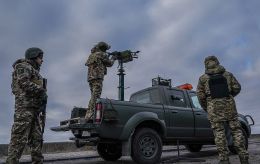
EW dome or firepower? How Ukraine protects trains and trucks from Russian FPV drones


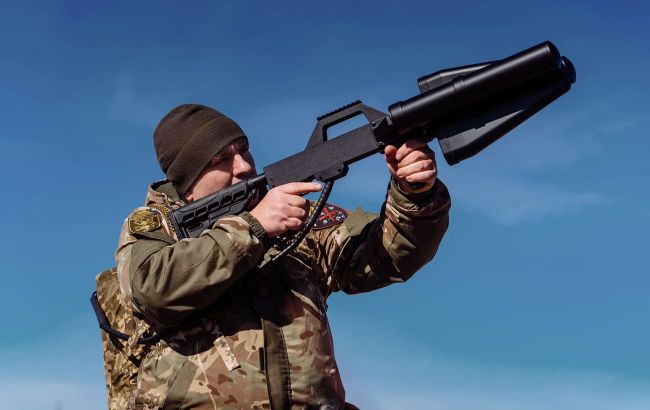 Electronic warfare does not always stop enemy drones (photo: Getty Images)
Attacks by Russian drones on transport are forcing Ukraine to change safety rules even for passengers. Ukrainian Railways (Ukrzaliznytsia) has already introduced evacuation procedures directly during train movement. Not only is transport coming under attack, but the entire logistics system, from military transport to grain exports.
Why Russians are shifting to logistics, which regions are at risk, and whether it is possible to protect trains and trucks from first-person view (FPV) drones – in the article by RBC Ukraine.
Key points:
- Drones against logistics. Russian FPV drones are increasingly attacking trucks, supply convoys, and even railway trains.
- Strikes on railways. The enemy targets locomotives and cars of freight, passenger, and suburban trains.
- Intelligence assessment. Large frontline cities such as Kharkiv, Sumy, Sloviansk, Kramatorsk, Zaporizhzhia, and Kherson may be under drone strikes.
- Economic impact of attacks. The National Bank of Ukraine estimated losses in export revenues in the first quarter of 2026 at about 1 billion dollars.
- Comprehensive protection. Experts stress that transport requires a comprehensive protection system: electronic warfare, surveillance, route management, and physical measures.
Ukrainian Railways has introduced new safety rules for passengers: in case of a threat of an attack, a train may be stopped directly on the route, and people evacuated from the cars. This concerns changes in action procedures during potential drone or missile strikes. In effect, passengers are being prepared for a scenario in which a train is no longer a safe space.
But the issue is much broader than passenger safety. Railways in Ukraine are not only about transporting people, but also a key artery of the economy and one of the basic elements of military logistics. They are used to transport equipment, fuel, ammunition, as well as a significant share of exports, including grain.
That is why attacks on trains are not isolated strikes on transport, but an attempt to affect the entire supply system of the country.
Russia is systematically attacking Ukrainian logistics – from ports and airfields to railways and road routes. Maritime logistics is under constant pressure: the ports of Odesa, Chornomorsk, and Izmail are regularly hit by missiles and drones, directly affecting exports.
Similar logic can be seen in the air component: strikes on airfields back in 2022 were an attempt to quickly limit mobility. All of this together represents one large logistics system that bypassed dangerous routes and adapted to wartime conditions until drones appeared.
The mass use of light and maneuverable kamikaze drones has made it possible to attack not only infrastructure, but also moving transport. As a result, logistics is gradually ceasing to be a rear area and is becoming part of the combat zone.
Under attack – trains and trucks
In the new realities of war, attacks on trains and trucks are becoming a trend. Ukrainian Railways records strikes on rolling stock.
"We are recording an increase in attacks by Russia on railway infrastructure, in particular on rolling stock. Targets of the enemy include locomotives, freight, passenger, and suburban trains, and special equipment used for railway infrastructure repair," the company said.
Nova Poshta (the largest private postal and delivery company in Ukraine) confirms that risks are also growing for civilian logistics.
"Vehicles used for logistics transport, as well as other civilian transport on roads, are increasingly becoming targets of Russian FPV drones," the company reported.
In effect, this means that logistics is moving out of the rear category and becoming part of the risk zone.
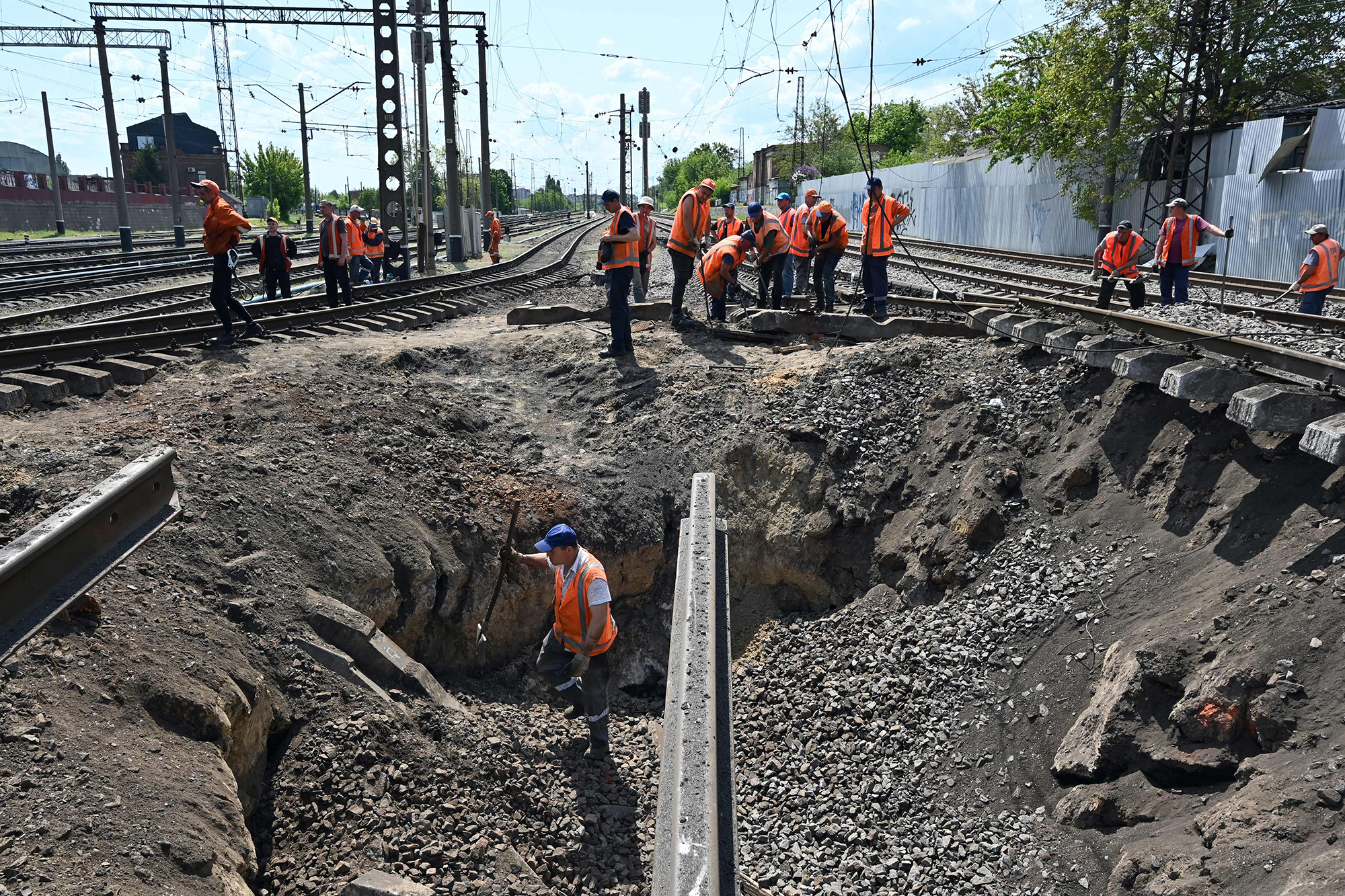 Consequences of enemy attacks on railway infrastructure (photo: Getty Images)
Which frontline regions and cities are under threat of drone attacks and why?
The Main Intelligence Directorate of the Ministry of Defense of Ukraine confirms that the use of FPV drones against logistics is increasing.
"Russian forces mainly use FPV drones to strike personnel and military equipment of the Defense Forces of Ukraine directly on the line of combat contact (frontline). At the same time, an increase in the number of attacks using FPV drones on transport logistics facilities in border and frontline areas is being recorded," intelligence said.
This concerns a wide geography – Chernihiv, Sumy, Kharkiv, Luhansk, Donetsk, Dnipropetrovsk, Zaporizhzhia, Kherson, and Mykolaiv regions. At the same time, the limited range of FPV drones creates a clearly defined risk zone.
"Given the limited range of such drones – up to 40 kilometers – expansion of strikes on transport infrastructure beyond frontline regions is unlikely," the Main Intelligence Directorate noted.
This means that cities near the frontline are primarily under threat: Kharkiv, Sumy, Sloviansk, Kramatorsk, Zaporizhzhia, and Kherson.
At the same time, Russians also use other means, such as Shahed drones (long-range loitering drones) or Molniya drones (attack drones with extended range), which have greater strike distance and are also used to attack Ukrainian logistics.
Spokesperson of the Joint Forces grouping Viktor Trehubov links the change in enemy tactics in frontline regions to the activity of the Russian unmanned systems unit Rubicon (drone warfare unit), which is expanding its zone of influence.
"Over the past year, we have observed certain stabilization of tactics: there is a large 'kill zone' (area heavily covered by fire), and Russians moving through it on foot. This allows trading manpower for territory, but at a very unfavorable ratio. So they are looking for alternatives and, among other options, testing strikes on logistics routes," he said.
According to him, if this tactic proves effective, Russian forces may try to systematically block supplies to the Defense Forces.
Attacks on logistics have economic consequences
In addition to passenger transport, railways also carry economic cargo. Head of the Center for Transport Strategies (transport policy think tank) Serhiy Vovk, in a comment to RBC-Ukraine, speaks about the formation of a new risk management logic in case of attacks.
"Systematic work is currently underway to determine the priority of objects. In effect, a certain priority framework has been formed: which nodes are critical and which are less important. For example, if an energy node supports a section that directly affects key logistics routes, its protection priority is significantly higher than that of individual generation facilities," he said.
In addition, solutions are being prepared in parallel to reduce damage from attacks. This primarily concerns the adaptation of logistics routes and increasing system resilience.
The expert also draws attention to the time factor: "It is important to understand that the current period is not a peak. If we talk about grain transport, this is one of the relatively low seasons. The main load will begin to grow closer to August and beyond. Therefore, the key task is to prepare and minimize risks before this peak period."
In case of repeated enemy attacks on railway transport, in particular on railcars, there is no critical problem with replacement, Vovk says. Ukraine has production capacity, as well as access to purchases abroad. Moreover, in the segment of freight railcars, there is currently even a certain surplus of fleet (more railcars than needed), he added.
However, a key limitation remains finances: Ukrainian Railways is in a difficult financial situation, and strikes on infrastructure only increase the need for compensation and recovery. Therefore, the creation of separate financial mechanisms and funds to cover such costs is already being discussed.
Senior economist at Center for Economic Strategy, Nataliia Kolesnichenko, in turn, notes that attacks on logistics wheels (transport system) cause direct losses in freight transport: according to the State Statistics Service, in January–February 2026, volumes of freight transport decreased by 6.4 percent compared to the same period last year. This, in turn, limits the revenues of carriers.
She also points to exports: "National Bank estimated losses in export revenues in the first quarter of 2026 at about 1 billion dollars precisely due to intensified attacks on port, energy, and industrial infrastructure."
Logistics risks also affect production: potential disruptions in the transportation of goods may force enterprises to limit the use of production capacity in order not to accumulate finished products in warehouses.
At the same time, business is partially adapting and has significant successful experience of quickly redirecting transport flows – from Black Sea ports to Danube ports and to the western border, and from railway transport to road transport, the expert adds.
Can logistics transport be covered by an electronic warfare dome?
There is already a long-standing system of electronic warfare (technology used to jam or disrupt drones and communications) that is actively used on the frontline. The question is whether it is enough to cover transport only with electronic warfare. Deputy director of BlueBird Tech, Borys Budeianskyi, answers:
"Electronic warfare systems significantly increase protection of railcars and transport from FPV, but they are not a 'magic button'. This works only as part of a comprehensive system that combines electronic warfare, surveillance, route organization, and physical measures."
He explains that the effectiveness of electronic warfare depends on the scenario of use. Properly selected systems can reduce the probability of being hit. They can create a kind of dome or corridor that makes it harder for drones to approach a target, for example, near stations or logistics hubs.
However, technological changes complicate protection: "Enemy actively uses FPV drones on fiber optic control (wired drones), and electronic warfare against radio signals has almost no effect on them."
The military also confirms that only a combination of methods works. Battalion commander of Rubizh brigade (Ukrainian National Guard unit), Viacheslav Pyrohivskyi, adds:
"It is possible to protect equipment from FPV attacks only in a comprehensive way. In our case, this includes additional armor on vehicles, electronic warfare, and most effectively, soldiers moving alongside in another vehicle or truck who can shoot down enemy drones with weapons."
Anti-drone nets, which cover frontline areas, also help. This does not fully solve the problem, but all these measures together significantly reduce risks.
***
In conclusion, attacks on transport are changing the very logic of war. Logistics is becoming a separate target, and its resilience is a key factor for defense capability and the economy. Main question now is not only how to counter drones, but how to ensure the uninterrupted operation of the supply system under constant threat.
Quick Q&A:
Which cities and regions are in the highest risk zone?
Border and frontline regions (from the Chernihiv region to the Kherson region) are under threat of FPV drone attacks. Due to the limited flight range of drones (up to 40 kilometers), cities under direct threat include Kharkiv, Sumy, Sloviansk, Kramatorsk, Zaporizhzhia, and Kherson.
Why did Russian forces change tactics and start targeting transport?
The enemy is looking for an alternative to exhausting infantry assaults. Systematic strikes on trains and trucks are an attempt to block supplies to the Defense Forces of Ukraine and paralyze the economic life of the country, turning logistics into part of the combat zone.
What economic damage has Ukraine already suffered in 2026?
According to estimates of the National Bank of Ukraine (central bank), in the first quarter of 2026, Ukraine lost about 1 billion dollars in export revenues. Volumes of freight transport in January–February decreased by 6.4 percent compared to last year.
What new safety rules has Ukrainian Railways introduced for passengers?
Railways are no longer considered a safe rear. Now, in case of a threat of attack, trains can be stopped directly on the route, and passengers can be urgently evacuated from the cars. This is a new action procedure to protect people from drone and missile strikes.
Can electronic warfare fully protect transport from drones?
No, electronic warfare is not a panacea. It is effective against radio-controlled drones, but powerless against fiber optic drones (controlled through cable). Therefore, protection must be comprehensive: a combination of electronic warfare domes, anti-drone nets, route maneuvering, and physical escort by armed groups.