BlueShadow unveils sea drone system designed to stop Shahed attacks on Odesa


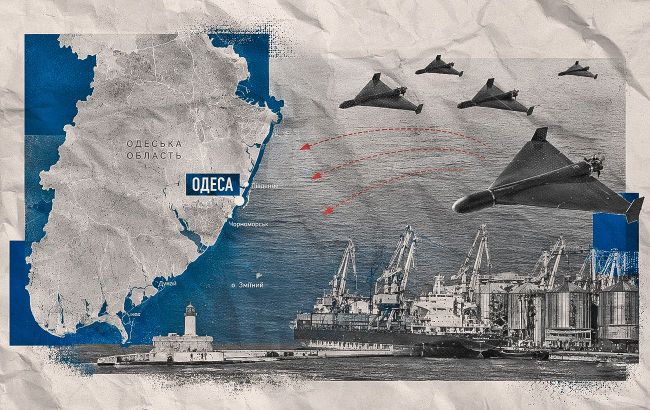 Photo: How the Danish startup BlueShadow is building defense for Odesa (collage by RBC-Ukraine)
Danish company BlueShadow has developed the Blue Dragon system – a swarm of autonomous unmanned surface vessels designed to destroy Shahed drones at a distance of up to 20 kilometers from the coast. The system is intended to protect Odesa and its port infrastructure from regular Shahed attacks launched from the sea, where air defense capabilities are limited.
At the final event of the Defence Builder, BlueShadow founder and CEO Charles Maher told RBC-Ukraine how the system works and when the first combat vessels could appear off Ukraine's coast.
Key points
- Danish company BlueShadow has developed the Blue Dragon system. It is a swarm of autonomous unmanned surface vessels that will destroy Shahed drones at a distance of 10-20 kilometers from the coast.
- Each vessel is equipped with modular weapons – interceptor quadcopters, missiles, machine guns, and eventually electronic warfare systems. The swarm operates as a single system: the vessels exchange data in real time and independently decide which one will engage the target.
- The system is planned to be deployed in squadrons of 12 vessels, with just five people on shore able to operate one squadron. BlueShadow expects to receive certification from Ukraine's Ministry of Defense and deploy its first unit in the spring of 2027.
- Even if the enemy disables one of the vessels, the swarm has a self-healing capability – the remaining vessels continue carrying out the mission independently. The company estimates the cost of the first squadron at approximately €10-12 million, including the shore-based command center and integration into the national defense platform.
About the Blue Dragon technology and the need to protect Odesa
– Could you tell us about your technology, about your startup and its mission?
– My background — I'm a submarine officer in the United States Navy, so I have deep experience in operating at sea and a passion for maritime security.
Our technology is designed to protect the people in the coastal areas of Ukraine, especially Odesa — both the cities, the infrastructure, but also, importantly, the commerce.
By being able to protect those key aspects of the coastal area of Ukraine, it allows the freedom to overcome the pressures of Russia and to be able to restore even after hostilities happen in a hybrid warfare situation.
The technology itself has two parts. One is a technology platform, C4ISR, which connects the swarms of vessels operating offshore together with higher-level command and control capabilities such as Delta, Kropyva, SkyMap. So we have information coming from those systems, and we also feed information to those systems through the sensors and activities that we generate.
We also have a technology called BlueShadow Edge, which is an edge autonomy module that goes on each unmanned surface vessel. That allows them to operate as a squadron of vessels, all tied together with a common operating picture, and able to make decisions to optimize the engagement. So if they sense that Shaheds are coming from a certain direction, they can move either individual units or the whole swarm to a location.
It's optimized for intercepting. Each vessel that has contact then determines its probability of kill, and then the swarm decides how different vessels within it will actually engage — detect, track, classify, and then do battle damage assessment to see if a re-engagement is needed.
 Photo: Charles Maher (Defence Builder)
– Does this technology have successful tests?
– We're in development right now. The core technology, the platform, is live, and we're using it for internal beta testing — so that part is demonstrated and working.
However, there's an artificial intelligence aspect to this, and what we're doing now is training those models to increase their effectiveness and make sure they're reliable every time.
For the edge autonomy piece, there's an existing hardware platform we're using, and we're integrating partners' software into it. We're the ones bringing all that software together and building the layer on top — the autonomous mission management layer.
That process is in progress. We haven't gone live with BlueShadow Edge yet, but that's expected in the next month or two.
About the system's effectiveness and uniqueness
– Could you tell us what number of drones this system can destroy?
– Theoretically unlimited. The vessels will carry multiple interceptors, and our design for the vessels is modular — the payload will be modular, so we can have modules for interceptor quadcopters, or rockets, or machine guns, and in the future possibly jammers or other energy-type interceptors.
The real limitation would ultimately be how many vessels you have out there and how many interceptors each carries. As for the number of tracks the software can handle, it's virtually unlimited, thanks to distributed sensing and distributed compute with very powerful edge compute capability in BlueShadow Edge.
– What's the advantage of the technology?
– This is a step forward in the technology. Think of it as the next step in the progression — from individual drone operators, to individual drone operators with shared information who can coordinate to hit a target, to what we're building now: distributed sensors combined with distributed shooting platforms, managed by a small number of people, to create security across a broad area.
This creates scalability — it enables defense of large areas with fewer people, much more effectively, because engagements are comprehensively managed across the whole battle space using swarm technology.
About the system's vulnerability, survivability, and cost
– Could the Russians destroy this system using Shaheds or missiles?
– We certainly know that once we prove ourselves effective, we'll become a target ourselves — but we're designing the system with that in mind already. Our approach is target prioritization: if our platforms are being targeted, we prioritize intercepting the incoming drones that are actually targeting us, in order to ensure mission survival.
But even if we are hit — which is possible in battle — the nice thing about the swarm is that it's self-healing. If we lose one unit, the rest of the units take over the mission and continue it, so there's resilience on the battlefield over time.
– How many people are needed to operate it?
– We're planning to deploy in squadrons of 12 vessels. The idea is that approximately 10 would be at sea at any time, two would be in maintenance, and the vessels at sea would operate 24/7, 365 days a year.
We'd have a shore-based team managing that squadron — we believe five people can handle that. Replenishment would happen on a rotational basis: bring one vessel offline, refuel it and reload interceptors, send it back out, and keep rotating.
So we have continuous defense with a low manpower requirement to maintain it.
– And what's the price of the system?
– We're still determining that, because R&D in the early stages naturally takes more effort. But we expect the first squadron to cost around 10 to 12 million euros — that covers the shore-based command and control, integration into the national platform, plus spare parts for sustainment. Once the design is locked down and supply lines and production capabilities are in place, we expect the price to come down from there.