Wi-Fi and 5G coming to Moon: What is planned for future space bases

 Astrolab rovers to build a power grid on the Moon (photo: Astrolab)
Future lunar bases could feature their own mobile infrastructure for power supply, communications, and computing. The American company Astrolab has developed a system scheduled for testing on the lunar surface as early as 2028, according to Astrolab.
Solar towers instead of nuclear reactors
Astrolab has unveiled a specialized infrastructure module called the Lunar Utility Module for Industrial Services (LUMIS).
The system is designed to provide power, data transmission, and local communication services for commercial and scientific missions on the Moon.
Key features of the LUMIS technology:
- The initial demonstration modules will each generate 2 kilowatts of power, with scalability up to 20 kilowatts.
- Linking multiple units will allow for the creation of a unified network with a capacity exceeding 100 kilowatts.
- The design incorporates a vertical solar tower, batteries, transceivers, and a wireless power transmission system.
- The internal battery reserve ensures over 400 hours of autonomous operation during the long lunar night.
The company asserts that this approach will provide substantial energy availability well before the deployment of the first compact nuclear reactors.

Astrolab rovers to build a power grid on the Moon (photo: Astrolab)
Mobile delivery of essential infrastructure
The primary advantage of this development is the flexibility in equipment placement. LUMIS modules will be delivered via a landing module, after which Astrolab’s proprietary FLEX rovers will transport them over distances of tens of kilometers to the most strategic locations on the Moon.
Near the lunar south pole, even a shift of 50 meters can deprive equipment of sunlight or a direct line of sight to Earth. The rovers will position the towers on the Malapert Massif or Mount Mouton, ensuring continuous communication with Earth.
Arranged along the terrain, the modules will form a relay network, providing local Wi-Fi and 5G coverage for machinery and astronauts.
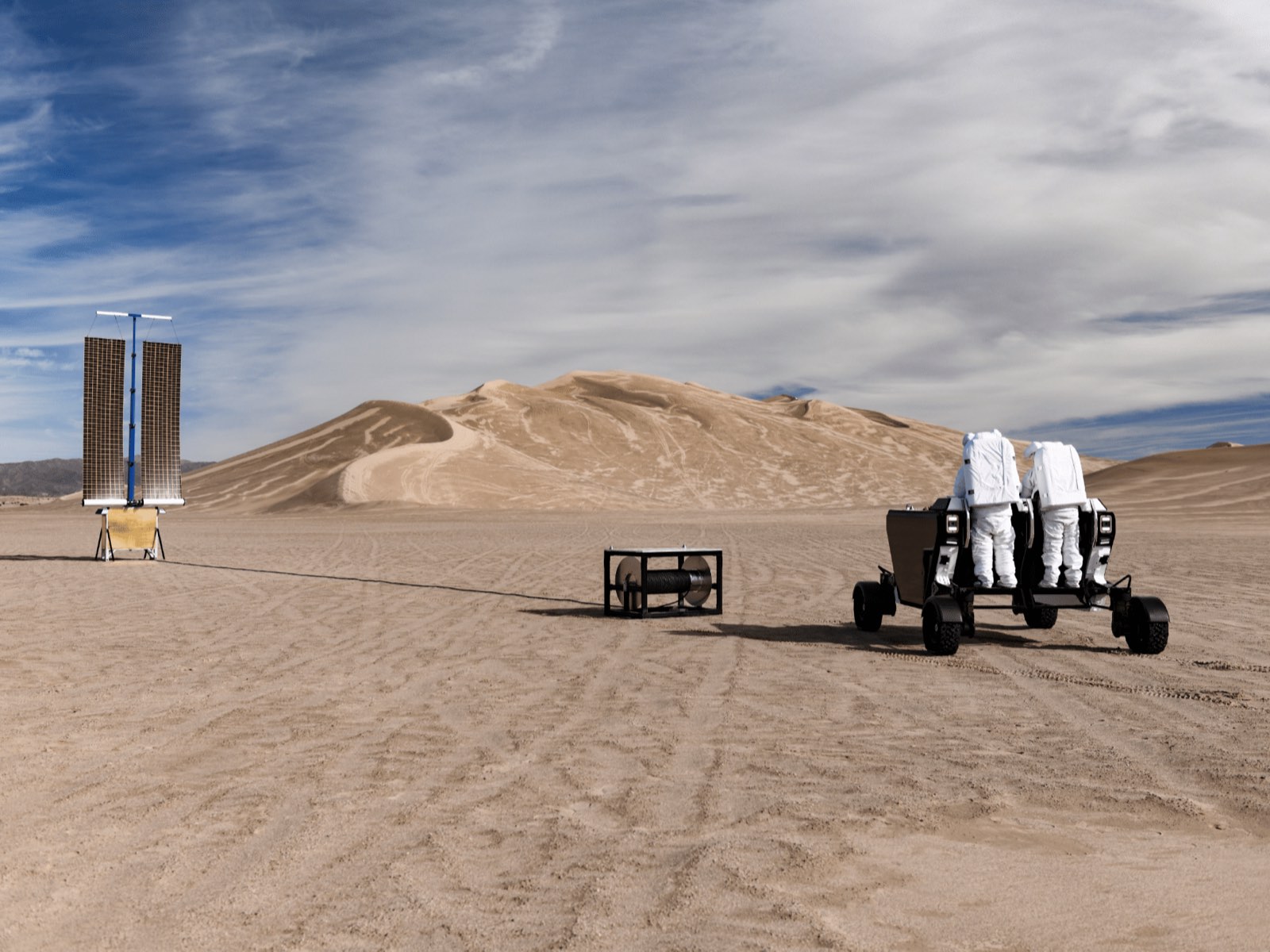
Astrolab to unveil the powerful LUMIS network (photo: Astrolab)
LUNAR OS launch and commercial model
Astrolab plans to offer these services under an "infrastructure-as-a-service" model via its LUNAR OS operating system.
Clients will pay only for the electricity and data they actually use, eliminating the need to build their own infrastructure on the Moon.
The first LUMIS system is scheduled for delivery to the Moon in 2028 as part of the commercial FLEX mission, utilizing SpaceX’s Starship spacecraft.
The company is also preparing the FLIP platform, which is set to be launched aboard the Griffin-1 lander as part of NASA’s Artemis lunar program.