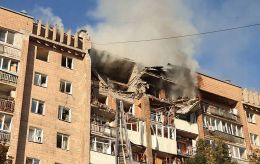
Why Russia using Zircon and Oreshnik missiles: Air Force colonel explains


 Photo: Yurii Ihnat (Getty Images)
Colonel Yurii Ihnat, head of the Communications Department of the Air Force Command of the Armed Forces of Ukraine, in an interview with RBC-Ukraine, stated that Russia is using new types of missiles against Ukraine — the Zircon and the so-called Oreshnik — but launches them not in massive strikes, instead firing them one by one. This tactic is primarily demonstrative and psychological, aimed not only at Ukraine but also at Western partners.
According to him, these are distinct weapons that serve different purposes and pursue objectives beyond the usual large-scale missile attacks.
Oreshnik is an unofficial name and a signal to the West
Ihnat emphasized that the Air Force does not officially use the name Oreshnik. It refers to a medium-range ballistic missile that Russia labels this way, but which is actually a modernization of the Soviet-era Rubezh missile.
It was this missile that Russia used to strike Dnipro and Lviv. The main goal of such launches is not military impact but demonstration.
"This is a signal to Western partners. Lviv is geographically very close to NATO borders, and the Russians are showing that they have such a weapon that is impossible to shoot down," Ihnat explained.
According to him, the Kremlin is attempting to exert psychological pressure on the West in order to influence support for Ukraine and push partners toward concessions in negotiations.
What is known about the Zircon missile
Ihnat also commented on the use of the Zircon missile. It is an anti-ship missile that Russia is using in an unconventional way — to strike land targets.
Zircon launches were carried out from temporarily occupied Crimea toward the Kharkiv, Kyiv, and Vinnytsia regions. At the same time, the number of such launches has been limited.
Can Zircon missiles be intercepted?
According to the Air Force representative, the Zircon rises to an altitude of more than 40 kilometers and attacks along a ballistic trajectory, similar to Kh-22 missiles. However, these missiles have already been intercepted multiple times by Ukrainian air defense.
"Of course, to intercept it, the Patriot system must be in the right place at the right time," Ihnat stressed.
Use of Oreshnik and Zircon missiles
On January 20, it became known that during a nighttime attack, Russian forces launched a hypersonic Zircon missile from temporarily occupied Crimea. According to available information, the missile was heading toward the Vinnytsia region.
Earlier, on November 14 last year, a powerful explosion was heard in Sumy, where the use of a Zircon hypersonic missile was also not ruled out. A similar strike on the city was recorded on August 21: after analyzing debris, experts confirmed the use of a 3M22 missile.
In addition, Russia claimed it had used the Oreshnik missile once during a strike on Dnipro on November 21, 2024 — a topic that became central to Russian propaganda.
Meanwhile, on the night of January 9, 2026, Russian forces struck the Lviv region with a medium-range Oreshnik ballistic missile.