War approaching: The Atlantic details Baltic states’ preparations for defense

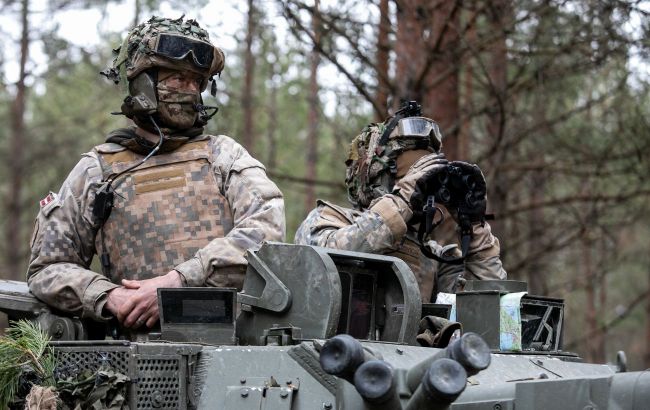 Illustrative photo: Baltic states prepare for defense in case of war with Russia (Getty Images)
Lithuania, Latvia, and Estonia are preparing for a possible Russian attack while strengthening their own defense capabilities and considering scenarios in which US assistance could be limited or not arrive at al, The Atlantic reports.
Journalist Isaac Stanley-Becker spent a month in the Baltic states, observing military exercises and speaking with political and military leaders.
One such exercise was a large-scale simulation in the Lithuanian village of Bezdonys. Members of the Lithuanian Riflemen’s Union practiced attacking positions held by a simulated Russian adversary, evacuating the wounded, transmitting intelligence, and carrying out other actions under wartime conditions.
Commander of the Lithuanian Armed Forces General Raimundas Vaikšnoras explained that the country seeks to demonstrate its readiness to resist a potential adversary.
"The enemy has to know that if they step one foot in our territory, we will strike back," he said.
The material notes that even a limited Russian invasion could create a serious crisis if NATO is unable to quickly fulfill its commitments under Article 5.
When asked whether he was confident that US President Donald Trump was ready to defend the Baltics, former NATO Secretary General Jens Stoltenberg replied, "We base our security on that."
The Baltic states are already building their defenses around the ability to resist from the first hours of a potential conflict.
Lithuania is fortifying its border with Belarus with anti-tank ditches and concrete barriers known as "dragon’s teeth." A network of infrared cameras and acoustic sensors is also planned, with data potentially analyzed using artificial intelligence.
At the same time, the armed forces of all three countries are actively developing the use of drones, drawing in part on Ukraine’s experience.
According to the scenario described by The Atlantic, if Russia attacks, the first 72 hours could be critical for holding back Russian forces until reinforcements arrive.
The Baltic states do not have enough forces to wage a prolonged war of attrition without allied support, so they are trying to make the adversary’s advance as difficult as possible.
At the same time, Lithuania is already conducting exercises designed for a situation in which US assistance is delayed or does not arrive.
European allies are increasing their presence in the region, but, as the author notes, replacing some US capabilities, particularly satellite intelligence and long-range weapons, would be difficult.
At the end of the material, Stanley-Becker notes that the Baltic states have not abandoned their reliance on the US, but are simultaneously preparing to act on their own.
"They believe that war with Russia is coming. They would prefer to have American backing when it does. But they’ll fight without the United States if they need to," the journalist writes.
Threat from Russia to European countries
Recently, Russian Foreign Minister Sergei Lavrov said that calls by European leaders to prepare for a possible armed confrontation with Russia could allegedly provoke a war.
Earlier, Russian Security Council Deputy Chairman Dmitry Medvedev threatened to destroy Lithuania if nuclear weapons were deployed on its territory.
Kremlin spokesperson Dmitry Peskov said that if a nuclear arsenal were deployed in Lithuania, the country could come under the sights of Russian nuclear weapons.
And on September 21, it was reported that intelligence officials from three EU countries suspected that Russia could intensify provocations against NATO in the coming months.
At the same time, Lithuania has prepared a plan to evacuate residents of Vilnius in the event of a military threat or serious crisis. One of the three main routes out of the capital will lead toward the Polish border.