US seizes Russian tanker linked to Venezuela: What is known about operation

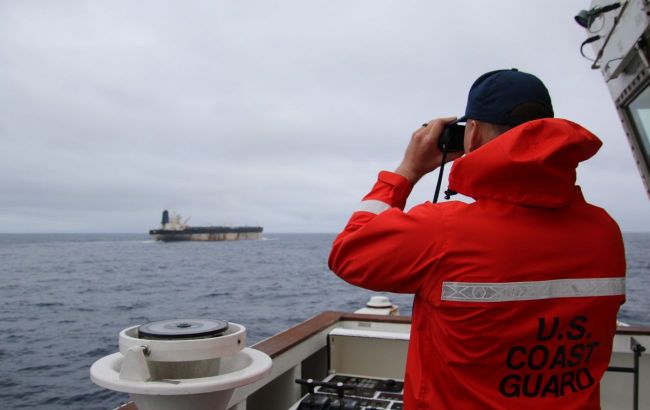 Photo: The US seized the tanker Marinera (x.com/US_EUCOM)
US military forces have seized the Russian oil tanker Marinera in the Atlantic Ocean. The vessel is linked to Venezuela.
Everything known about the Marinera tanker and its seizure by US forces is detailed in the RBC-Ukraine report.
The history of the tanker dates back to August 2025. According to available data, the vessel, then sailing under the name Bella 1, was in Iran before passing through the Mediterranean Sea and the Atlantic Ocean. Officially, it was traveling without cargo, but it was under US sanctions due to previous shipments of Iranian oil.
At the time of subsequent events, the ship was heading to Venezuela, sailing without a flag and regularly turning off its AIS transponder or transmitting false coordinates, which made tracking it difficult.
Attempted boarding in the Caribbean Sea
Around the second half of December 2025, the US Coast Guard attempted to board Bella 1 in the Caribbean Sea. US authorities had a court order to seize the vessel for violating sanctions.
After the failed boarding attempt, Bella 1 was pursued for over two weeks by a US Coast Guard Legend-class ship. This pursuit was part of a broader campaign by the administration of US President Donald Trump to pressure Venezuela, under which the United States enforces a maritime blockade of sanctioned tankers.
Change of identity: From Bella 1 to Marinera
On December 30, 2025, the ship’s crew made a dramatic change in status. A Russian flag was displayed on board, and the vessel was officially renamed Marinera and registered in the Russian ship registry.
A new route was also announced — to the port of Murmansk. During the same period, according to The New York Times, the Russian government sent a diplomatic note to the US demanding that the pursuit of the tanker be stopped.
After the vessel sailed under the Russian flag, Russia dispatched warships to escort Marinera, including a submarine. This was reported by US officials and media outlets, including CBS News.
At that time, the ship was not carrying cargo and was in international waters of the North Atlantic, between Scotland and Iceland. According to estimates, weather conditions and the long distance complicated any potential seizure operation.
The Russian side stated that it was monitoring the situation around the vessel carefully and with concern, emphasizing its "peaceful status" and its right to freedom of navigation.
Large-scale US military activity
As the tanker approached Europe, the US deployed significant forces in the United Kingdom. This included the arrival of military transport aircraft, helicopters, and specialized units.
In the airspace, active flights were recorded by US Navy P-8 Poseidon patrol aircraft, American AC-130J Ghostrider gunships, as well as British reconnaissance RC-135W Rivet Joint aircraft and Typhoon fighters with aerial refueling. An Irish C-295W aircraft was also involved in the patrols.
The activity indicated not only surveillance of the tanker itself but also monitoring of Russian military forces in the region.
Seizure of the Marinera tanker
On January 7, Reuters, citing anonymous US officials, reported that US military forces, together with the US Coast Guard, boarded the oil tanker Marinera in the North Atlantic after more than two weeks of pursuing the vessel. Russian warships, including a submarine, were nearby during the operation.
Later, the US European Command stated that the seizure was carried out under a US federal court order for sanctions violations and was coordinated with the US Department of Justice and the Department of Homeland Security.
According to US media, the tanker’s crew did not offer any resistance.
At the same time, Russian media released blurred photos of a helicopter approaching the vessel, claiming the start of the operation.
According to The Wall Street Journal, the US deployed several helicopters and at least one Coast Guard ship to gain control of Marinera, also using aviation assets, including P-8 Poseidon maritime patrol aircraft and AC-130J gunships.
What the US says
The US Department of Homeland Security stated that, in two dawn operations, the US Coast Guard carried out successive and carefully coordinated boardings of two so-called shadow fleet tankers — one in the North Atlantic and another in international waters near the Caribbean. These were the oil tankers Bella 1 and Sophia, which had either recently visited Venezuelan ports or were heading in that direction.
According to a DHS representative, Coast Guard tactical units acted in close coordination with other US government agencies, including the Department of Defense, the Department of Justice, and the State Department. The statement emphasized that, under the leadership of President Donald Trump, both operations were conducted safely and efficiently, with minimal time between them.
The US also stressed that these operations are meant as a signal to participants in illegal activities: the United States will not back down from efforts to protect national security and combat the financing of narco-terrorism.
Sources: The New York Times, Reuters, BBC, and The Wall Street Journal.