US captures Venezuela's president: Will it turn into a full-scale war?


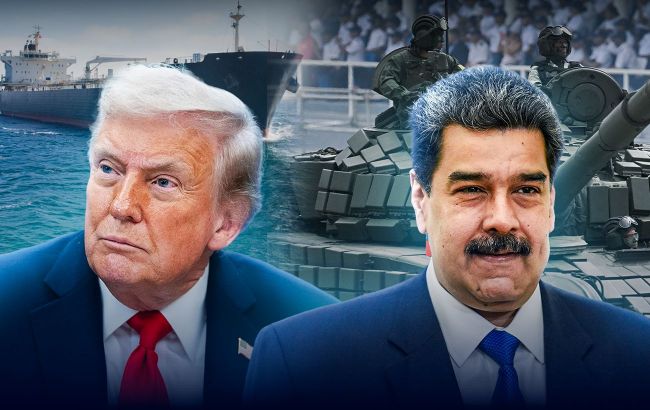 Donald Trump and Nicolás Maduro (collage: RBC-Ukraine)
The United States has carried out a military operation against Venezuela. Military facilities were attacked, and President Nicolás Maduro was captured.
RBC-Ukraine explains whether the operation could escalate into a full-scale war and why it is bad news for Russia.
Key questions:
-
How did the US carry out the operation?
-
What is being said in Venezuela?
-
What scenarios lie ahead for the US?
-
What impact could the operation have on oil prices?
On the night of January 3, what many had expected from Trump for months finally happened. The United States struck Venezuela.
So far, the operation appears to be limited in scope. At around 2:00 a.m. local time, aircraft were spotted over Venezuela’s capital, Caracas, followed by explosions.
The strikes targeted military infrastructure. Attacks were reported on the Fort Tiuna military base and the Generalissimo Francisco de Miranda Air Base. The US also struck the building of Venezuela’s parliament and the residence of Defense Minister Vladimir Padrino López.
The sound of military helicopters was heard over Caracas. In particular, CH-47 Chinook and MH-60 Black Hawk helicopters were identified—aircraft associated with the US Army’s 160th Special Operations Aviation Regiment, an elite unit that provides aviation support for special operations.
Donald Trump later effectively confirmed that this was not a full-scale invasion of Venezuela.
"The United States of America has successfully carried out a large scale strike against Venezuela and its leader, President Nicolas Maduro, who has been, along with his wife, captured and flown out of the Country," Trump wrote on Truth Social.
Venezuela’s response
For now, it is too early to speak of a change of power in Venezuela. The US had been deploying forces near Venezuela’s coast for an extended period, and Maduro and his inner circle were actively preparing to repel an attack.
These preparations included intensified repression, mobilization of nationalist sentiment, arming paramilitary groups and criminal networks, as well as seeking additional support from external patrons such as China, Russia, and Iran.
Earlier that night, Foreign Minister Yván Gil Pinto said that Maduro had declared a nationwide state of emergency, ordered all national defense plans to be activated, and initiated the mobilization of the population, armed forces, and political structures. These statements were made before Trump announced Maduro’s capture.
Venezuela’s Defense Minister Vladimir Padrino López said resistance would continue.
"We will not negotiate, we will not surrender, and we will ultimately triumph," López stated.
However, it remains unclear how decentralized the system built by the regime is, and whether it will be paralyzed by Maduro’s removal.
In addition, Venezuela’s current authorities retain significant social support, while most opponents of the regime have left the country. According to a TruthOut poll from September last year, 65% of Venezuelans rated Maduro’s governance positively, while 28% rated it negatively.
At the same time, a CiberCuba poll from January 2 shows that 64% of Venezuelan migrants support a US intervention to overthrow Maduro, while inside the country only 25% support such an option.
Objectives of the operation and what comes next
Donald Trump previously stated that the US had deployed a fleet near Venezuela’s coast to combat “narco-terrorism.” More recently, he also demanded that Maduro return nationalized assets belonging to American companies.
Both objectives are currently unattainable without a change of regime in Venezuela. The Trump administration maintains close ties with Venezuelan opposition leader María Corina Machado.
For a power transition to begin, she would at least need to be brought into Venezuela with security support. Otherwise, Machado would quickly be eliminated by regime forces. In practice, this would mean expanding the American intervention.
Notably, the current operation (at least so far) mirrors another historical case. In 1989, the US carried out a similar intervention in Panama to remove President Manuel Noriega, but was later forced to expand its presence. Unlike Panama, however, Venezuela is much larger and has powerful allies.
That said, Trump is known for his pragmatism, so another scenario—more in line with his style—is also possible. After a high-profile trial of Maduro, the US could quietly reach an agreement with his successors. This would allow Trump to once again present himself as a strong leader while avoiding being drawn into a new conflict. Sources cited by Sky News within the Venezuelan opposition believe the operation against Maduro was a “negotiated exit”—a backroom deal.
Ultimately, how the situation develops will depend on which scenario Trump chooses. This includes what may be most interesting for Ukrainians—oil prices. Since the US carried out the operation over the weekend, markets have not yet reacted. There are nearly two days before trading begins, during which much could change. But if Venezuelan oil ultimately flows freely onto global markets, it would be yet another piece of bad news for Moscow.
Sources: statements by American and Venezuelan politicians, reporting by Reuters, EFE, Bloomberg, Sky News, and polling data from TruthOut and CiberCuba.