US Army tests tethered drone designed to keep flying through electronic warfare


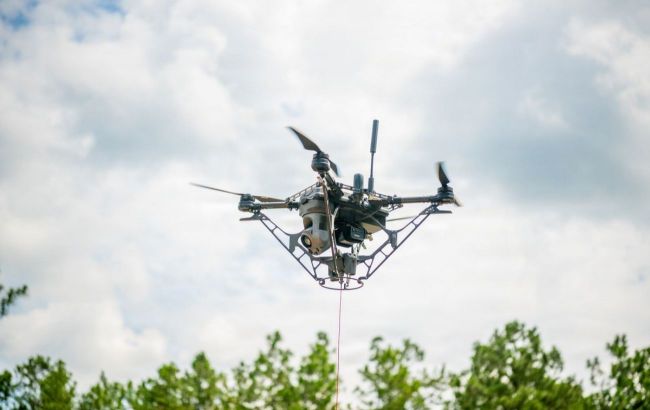 Tethered drone (photo: US Army website)
The US Army has completed testing of tethered unmanned aircraft systems (Te-UAS) mounted on Infantry Squad Vehicle-Utility (ISV-U) light infantry vehicles, according to an official statement from the US Army.
What exactly was tested
At the McKenna Field Landing Site, two commercial tethered drones were mounted on a five-seat ISV-U, a modification of the standard nine-seat infantry vehicle (M1301) with a cargo platform. Operators practiced launching and lowering the drone, static operation, follow mode behind a moving vehicle, and emergency scenarios, recording the time required to launch and recover the aircraft.
The military used continuous power and a physical data cable to bypass radio jamming, extend the range of line-of-sight radio communications, and detect targets at greater distances without the limitations of battery-powered drones.
The Maneuver Battle Lab (MBL) tests took place from July 27 to August 7 together with the Strategic Spectrum Warfare and Maneuver Future Capability teams. The goal was to determine whether a light vehicle could carry a stable elevated reconnaissance and communications node across rough terrain under enemy electronic warfare conditions.
Why a "mast on wheels" is needed
Tethered drones differ significantly from conventional quadcopters in terms of operating time. While battery-powered aircraft can remain airborne for 20–60 minutes, a power cable allows some systems to operate for dozens of hours at a time. For example, the Orion 2, manufactured by Elistair, is designed to operate for up to 50 hours.
By comparison, a drone with a 30-minute endurance would require at least 48 flights per day to provide round-the-clock coverage.
Strategic Spectrum Warfare lead Mark Pagliaro compared the effect to placing a sensor on a very tall tower, with the difference being that such a "tower" can change altitude and move with the unit.
Why a physical cable protects against jamming
A tether also changes a drone's vulnerability to electronic warfare. Conventional small unmanned aircraft systems typically depend on radio links to transmit commands, telemetry, and payload data, and often rely on GPS/GNSS navigation. All of these create channels that can be jammed, spoofed, intercepted, or detected.
A physical cable can transmit control commands and large volumes of sensor data directly between the drone and the ground station, reducing dependence on radio frequencies and allowing video and other sensor traffic to remain on the cable.
A similar approach is also used by Russian and Ukrainian forces. They are increasingly using fiber-optic-controlled strike drones to avoid electronic warfare, with the difference that such drones travel kilometers to their targets, while Te-UAS does not go beyond the length of its own cable.
What this provides for communications and reconnaissance
A tethered drone can lift radio or network equipment dozens of meters above a vehicle and move with it, unlike ground-based systems such as the OE-254, which require time to deploy and a fixed position.
Depending on the payload, such a system can support software-defined radios, Wi-Fi, LTE, MANET, and other protocols, transmitting voice, data, coordinates, and images between dispersed units.
How many people are needed to operate it
Sarah Runion, MBL Live Experimentation Branch executive officer and assessment participant said she was able to launch the tested aircraft within minutes and recover it with a single command. According to Pagliaro, once airborne, the aircraft largely required no operator intervention.
Earlier, the UK Ministry of Defense launched Project PANOPTES, the development of an autonomous laser air defense system mounted on armored vehicles to counter swarms of inexpensive drones.