Unidentified drones uncover hole in Germany’s air shield built to counter Oreshnik missile

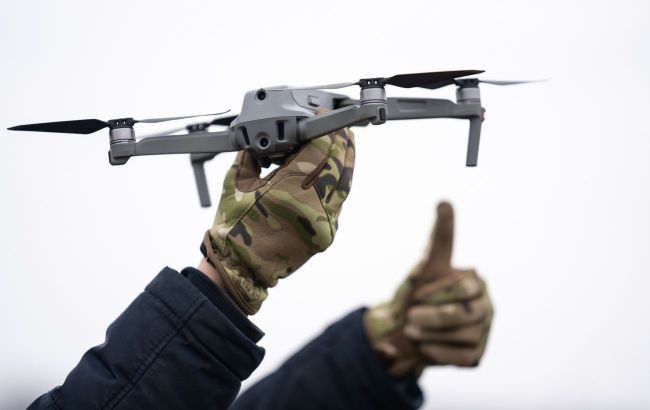 Illustrative photo: Unknown drones have discovered a gap in Germany's air defense system, which is supposed to shoot down the Oreshnik (GettyImages)
Germany has discovered a security vulnerability during the deployment of one of Europe's key missile defense systems, the Israeli Arrow 3. It is also designed to intercept Russian ballistic missiles, including the Oreshnik complex, according to Defense Romania.
Unknown drones over the Arrow 3 radar
Two days before the system was officially put into initial combat readiness, three unknown drones were spotted over the Arrow 3 radar station deployed at an airbase near Annaburg in the federal state of Saxony-Anhalt.
The drones flew at an altitude of about 100 meters directly above the radar station, a key element of the entire missile defense system.
Bundeswehr was unable to shoot down the drones
A Bundeswehr rapid response unit quickly arrived at the scene of the incident. The military established visual contact with the drones using their own drone and attempted to intercept them.
They used G27P assault rifles equipped with Israeli Smash X4 smart sights, which are positioned as a means of combating drones. However, none of the drones were shot down — they disappeared from the area.
The incident was classified as espionage
After the investigation, German counterintelligence and military police classified the incident as deliberate espionage. Experts note that this is a system worth more than $3.5 billion, which is one of the few elements of Europe's defense against intercontinental ballistic missiles.
Analysts note that at the time of the incident, the facility's multi-layered air defense system was probably not yet fully deployed, as the system was only just coming into operation.
Risks for the entire European air defense system
Experts warn that if the Arrow 3 anti-drone protection is not significantly strengthened, the system could become one of the first targets in the event of a direct conflict with Russia. It may not take expensive missiles to disable it, but rather a few cheap drones.
The risk is exacerbated by the fact that the Arrow 3 radar station is stationary and its coordinates are well known.
When will Arrow 3 be fully combat-ready?
Despite its initial deployment in 2025–2026, the Arrow 3 system is not expected to be fully combat-ready in Germany until 2030. At the same time, Berlin plans to establish local production of interceptor missiles and purchase several more such systems for approximately €3 billion.
Oreshnik missile strike on the Lviv region
On the night of January 9, a series of explosions were heard in the Lviv region after reports of missile launches from the Kapustin Yar test site in the Arkhangelsk region of Russia.
Local authorities later confirmed that a critical infrastructure facility had been hit, resulting in a partial suspension of gas supplies.
The Western Air Command reported that the ballistic missile that struck the region was traveling at a speed of about 13,000 kilometers per hour. The type of missile will be determined after analyzing all of its debris.
Russia confirmed the launch of a ballistic missile in the Lviv region, while again spreading fake news about an “attack on Putin's residence” in an attempt to justify another missile strike.
The Ukrainian Air Force did not confirm the use of the Oreshnik missile, but noted that the launch was carried out from the Kapustin Yar test site, where missiles of this type are based.