Ukrainian forces strike bridge in Crimea and 50 fuel trucks

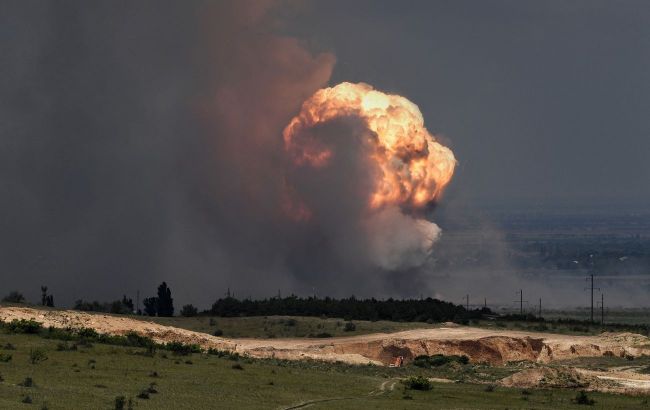 Illustrative photo: The Ukrainian Armed Forces have released footage of the destruction of an enemy supply route in Armiansk (Getty Images)
What is known about the strike on Russian logistics
According to the military, a series of precision strikes hit the facility overnight into June 11.
At the time of the attack, up to 50 enemy trucks loaded with ammunition and fuel were concentrated near the bridge in Armiansk. The vehicles were reportedly being prepared for deployment to the Huliaipole direction.
The bridge itself was completely put out of action using FirePoint systems. No additional strikes are required, as the enemy’s key logistics route has now been fully paralyzed.
Who carried out the operation
The strikes were the result of coordinated efforts by the joint multi-domain center Phalanx, the 1st Separate Assault Regiment named after Dmytro Kotsiubailo, the 475th Separate Assault Regiment CODE 9.2, and the Alpha Special Operations Center of the Security Service of Ukraine.
According to the military, the operation was aimed at weakening Russia’s 37th and 64th Motor Rifle Brigades, which Ukrainian forces are currently fighting against.
Ukrainian servicemen emphasized that territories are being reclaimed through coordinated operations rather than at the cost of soldiers' lives, and they signaled that further strikes are planned.
Russia's logistics blockade
Recently, Ukraine’s Defense Forces have significantly increased attacks on Russian supply routes deep behind the front lines. Russian forces have already acknowledged that fuel convoys failed to reach Crimea because of large-scale and highly accurate Ukrainian drone attacks.
In particular, the strategically important R-280 Novorossiya highway along the Sea of Azov coast, connecting Rostov-on-Don with occupied Mariupol, Melitopol, and Crimea, has effectively become a "highway of death."
Due to round-the-clock hunting by Ukrainian drones, Russian military cargo traffic through this land corridor has dropped by more than 70%. The route had served as Russia’s primary alternative to the vulnerable Kerch Bridge, but traffic there is now largely paralyzed, leaving dozens of destroyed fuel trucks scattered along the road.
According to Ukraine’s Ministry of Defense, artificial intelligence has played a key role in helping Ukrainian forces bypass Russian air defense and electronic warfare systems. The ministry says the disruption of the route to Crimea was achieved using AI-enabled drones equipped with specialized onboard computers and optical cameras. The neural network scans terrain in real time and compares it with satellite imagery, allowing drones to navigate independently even when navigation systems are fully jammed.
In addition, AI can identify specific enemy military equipment, distinguish real targets from decoys, and automatically guide drones onto targets for precision strikes. According to the report, American-made Hornet drones equipped with AI, new Ukrainian Morrigan drones, and remote mining technologies are currently being actively used for such operations at distances of up to 150–200 kilometers.