Ukrainian forces hit high-value Russian target in Crimea

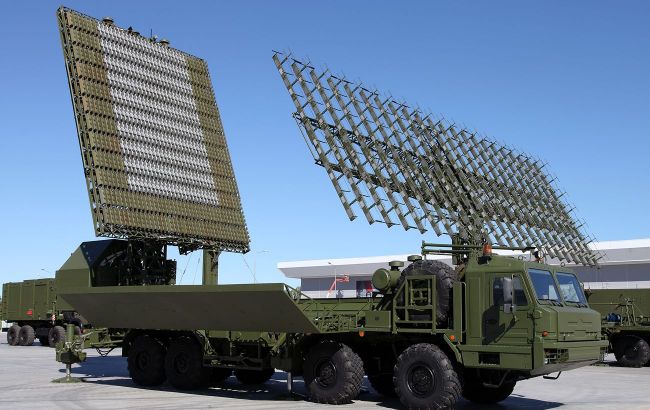 Photo: Ukraine’s Armed Forces strike Russia’s Nebo-U radar in Crimea (Russian Defense Ministry)
Ukraine’s Defense Forces struck the Russian 55Zh6U Nebo-U radar system in Crimea, along with several other enemy targets in temporarily occupied territories, according to the General Staff of the Armed Forces of Ukraine.
Read also: Ukraine hits key Russian military sites, including major ammo depot
“As part of systematic efforts to reduce the offensive potential of the Russian aggressor, units of Ukraine’s Defense Forces on the night of February 13 carried out strikes on a number of key enemy facilities in temporarily occupied territories of Ukraine,” the statement said.
In particular, concentrations of enemy personnel were hit near Solodkovodne and Liubymivka in the Zaporizhzhia region. Drone operator deployment points were struck near Tokmak and Mykhailivka.
A logistics warehouse was hit near Selydove in the Donetsk region.
In addition, yesterday, near Yevpatoria in Crimea, the 55Zh6U Nebo-U radar station was struck.
Enemy military equipment concentrations were also hit near Komyshuvakha in the Donetsk region.
Enemy losses and the scale of damage are being clarified.
What is known about the Nebo-U radar
According to Militarnyi, Nebo is a family of Russian meter-band radar systems. The first serial radar system was produced in 1995.
The Nebo family includes two branches — for air defense forces and for ground forces air defense units. The latter have smaller, simpler antennas, enabling faster deployment and redeployment.
The first version, the 55Zh6 Nebo, can detect a fighter-type target at a distance of up to 400 km at an altitude of 20 km. If the target descends to 500 meters, detection range drops to 65 km.
The Nebo-U is a модерnized version of the 55Zh6. Although its prototype was produced in 1995, Russia’s Defense Ministry has received deliveries since 2006. Between 2006 and 2011, 17 stations were manufactured.
The system uses a cross-shaped phased array antenna, with the horizontal section serving as the rangefinder antenna and the vertical section as the height-finder antenna. Modernization improved altitude detection, coordinate accuracy, jamming resistance, and system monitoring capabilities.
Transporting the Nebo-U requires three semi-trailers carrying the antenna, equipment cabin, diesel generator, and a remote control post that can be located up to 1 km from the antenna. The antenna itself is 43 meters tall.
Russia claims the system can detect and track both aerodynamic targets (aircraft, helicopters, cruise missiles) and ballistic targets (missile warheads).
Official specifications list a maximum detection range of 700 km, but this applies to large targets such as passenger aircraft. A fighter jet at 20 km altitude can be detected at up to 400 km; at 3 km altitude, up to 170 km; and at 500 meters, only up to 65 km.
Other recent Ukrainian strikes
On February 12, Ukrainian forces launched a series of strikes on critical Russian military facilities, including an arsenal in Kotluban, Volgograd region, and a missile plant in Michurinsk.
On the night of February 11, Ukraine struck the Volgograd oil refinery in Russia and carried out additional attacks on military targets in occupied territories.
Earlier, Ukrainian forces also targeted a drone command post belonging to the Rubikon center.