Ukrainian economy reeling from Russian port attacks, forcing urgent search for alternatives

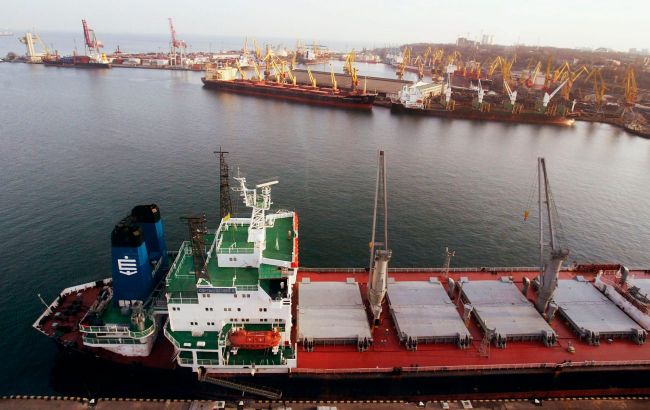 Photo: Minister for Recovery, Infrastructure and Transport Mykola Kalashnyk (facebook.com/mykola.kalashnyk)
As a result of systematic Russian attacks on port infrastructure, cargo handling in the ports of Greater Odesa has decreased more than 15-fold since July. Officials, agencies, and businesses are attempting to resolve the situation, according to a Facebook post by Infrastructure Minister Mykola Kalashnyk.
As the minister emphasized, Russia continues to systematically strike port infrastructure and civilian shipping. Not only the ports themselves but also piers, vessels, anchorages, and entry routes have come under Russian attack.
This, in turn, affects Ukrainian exports, the economy, and logistics stability, Kalashnyk said. The situation is planned to be addressed.
"Together with People's Deputies, the commands of the Naval Forces and Air Forces, Odesa Regional Military Administration, USPA, Ukrainian Railways, Maritime Administration, Ukrainian Danube Shipping Company, and port business, we analyzed the current situation and the decisions that need to be made," the minister stated.
In numerical terms, the scale of damage to port infrastructure remains significant. Since the beginning of the full-scale invasion, Russia has damaged or partially destroyed 1,173 port infrastructure facilities.
Additionally, during this time, 274 civilian vessels have been damaged or partially destroyed.
Kalashnyk separately drew attention to the sharp decline in cargo handling volumes in the ports of Greater Odesa. After July 22, this indicator decreased more than 15-fold.
At the same time, the consequences extend far beyond the operations of the ports themselves.
"This is a direct blow to Ukrainian exports, the economy, and also the food security of other states," the Infrastructure Minister emphasized.
What was discussed with port business
It is known that during the meeting in Odesa, government representatives and port business discussed problems that arose due to Russian attacks, as well as the conditions under which enterprises can continue operating amid constant threats.
Discussions included, in particular, the need to ensure port operations, protect people, vessels, and infrastructure, as well as financial conditions for operations.
"Substantive conversation with port business. From maintaining port operations, protecting people, vessels, and infrastructure - to financial conditions, insurance, compensation for losses, and logistics costs," the government official noted.
Kalashnyk emphasized that despite the level of threats, Ukrainian business must continue to operate. At the same time, according to him, it is precisely the state's task to create the necessary conditions for this.
One area of work is finding alternative routes for cargo transportation.
"The state's task is to create opportunities for this. Together we are looking for alternative routes for cargo, primarily through railways and Danube ports," the minister reported.
Thus, due to Russian strikes, Ukraine is forced not only to restore damaged port infrastructure but also to seek additional logistics capabilities to preserve exports and business operations.
Summarizing the results of the meeting, Kalashnyk emphasized the need to move from general statements to specific solutions.
"This conversation was necessary. Without general formulations - with specific problems that are currently hindering operations, and solutions that we need to adopt," he concluded.
Russian strikes on ports
Recently, the enemy has intensified strikes on ports in Southern Ukraine, although such practices were observed last year as well, just less pronounced. For example, in 2025, Russia struck a port in Odesa, damaging a vessel with soybeans.
In summer 2026, Russia intensified strikes on vessels and ports, which significantly impacted Ukraine's economy, as grain exports, which provide significant budget revenues, were also significantly affected. Also, due to Russian strikes on sea routes, people are dying; as reported, such a case occurred recently at the port of Mykolaiv.