Ukraine holds over 10,000 Russian POWs since full-scale invasion

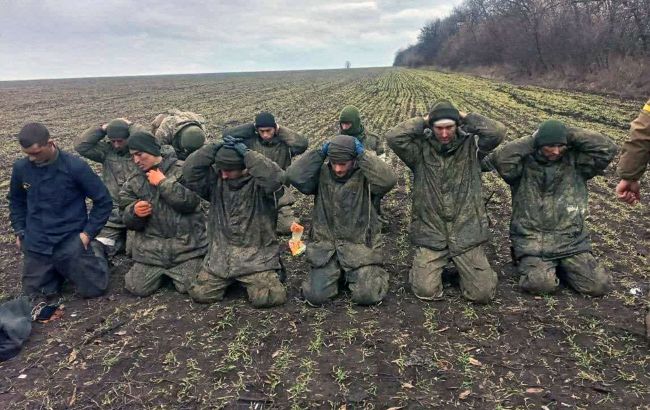 Russian prisoners of war in Mykolaiv region (photo: Getty Images)
More than 10,000 Russian military personnel have been taken prisoner in Ukraine since the start of the full-scale invasion. The number of foreign mercenaries among them is increasing, the Coordination Headquarters for the Treatment of Prisoners of War reports.
"The I Want to Live project is publishing comprehensive statistics for the first time on more than 10,000 Russian servicemen who have been taken prisoner during the full-scale invasion," the statement said.
According to the project, the number of Russians surrendering to captivity has been increasing every year. In the incomplete year of 2025, more soldiers were taken prisoner than in 2022 and 2023 combined.
On average, between 60 and 90 Russian servicemen surrender each week, while in August 2024, this figure reached 350 people per week. Since June 2023, Russian soldiers have been taken prisoner more often than Russia has captured Ukrainian soldiers.
The largest number of prisoners has been recorded in the Pokrovsk and Bakhmut districts of the Donetsk region, the Kursk region, and the Polohy district of the Zaporizhzhia region.
In 2025, the number of foreign mercenaries taken prisoner rose sharply, with two to three citizens of third countries identified each week. Overall, about 7% of all Russian prisoners of war in Ukraine are foreigners from 40 countries around the world.
A typical Russian prisoner of war is:
-
83% rank-and-file soldiers;
-
13% sergeants;
-
Almost 3% officers;
-
Age range: 18 to 65
-
About 76% are contract soldiers, including those recruited in prisons and private military companies;
-
19% are mobilized personnel;
-
Almost 5% are conscripts.
Twenty-four percent of prisoners reported coercion or deception. Forty percent have criminal records, most commonly for theft, drug offenses, robbery, aggravated assault, and murder.
Only 7% have higher education, while 30% did not complete even secondary school. Before the war, 38% were unemployed. Almost half have children, including 8% with three or more.
Hundreds of individuals were taken prisoner with serious chronic illnesses, including HIV/AIDS, tuberculosis, diabetes, and mental disorders.
According to the project, more than 6,000 prisoners of war have already returned to Russia as part of exchanges for Ukrainian defenders, with more than half of them exchanged in 2025.
At least 237 former prisoners of war are known to have been killed or gone missing at the front after being exchanged. Four Russians are being held in captivity for a second time.
Russia primarily takes ethnic Russians without serious injuries and with short periods of captivity from exchanges, while it does not request foreign mercenaries for exchange.
The project also notes that thousands of Russian army prisoners of war, including the wounded, the sick, and conscripts, remain in Ukraine. Russia has, for the fourth year, refused to engage in exchanges based on the principle of all for all.
Prisoner exchanges
Ukrainian President Volodymyr Zelenskyy recently said that amid negotiations on ending Russia's war against Ukraine, the Russian side has begun to slow down prisoner exchanges. According to him, Moscow is doing this to achieve overall agreements.
Earlier, on November 15, Rustem Umerov reported that the Ukrainian and Russian sides had agreed to activate the Istanbul agreements on prisoner exchanges, which provide for the exchange of 1,200 people.
On November 19, Zelenskyy expressed hope that Ukraine would resume prisoner exchanges with Russia by the end of 2025.