Ukraine has taken nearly half of Russia's oil refining capacity offline - General Staff

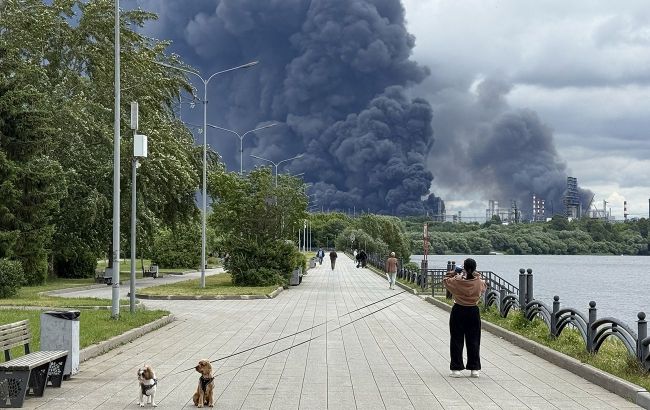 Photo: Drone attack on the Moscow Oil Refinery (Getty Images)
Ukraine's long-range strikes on Russia's oil refining industry have produced an effective result. Nearly half of the refineries have halted operations, according to a statement by the General Staff of the Armed Forces of Ukraine.
Nearly half of Russia's refineries on pause
The General Staff noted that as of September 21, following the strike on the Moscow Oil Refinery, more than 45% of Russia's oil refining capacity has been taken offline.
"One of the consequences is a shortage of high-quality fuel in Russia. Among other things, there has been a sharp decline in the production of gasoline and diesel fuel meeting the Euro-5/K5 standard," the statement said.
Ukraine's long-range strike successes over the past week
From September 14 to 20, units of Ukraine's Defense Forces struck a number of important enemy facilities in Russia and in the occupied territories.
The strikes hit enterprises supporting the aggressor country's military and economic potential:
- On the night of September 15 — the Syzran Oil Refinery in Russia's Samara region: the AVT-6 primary oil refining unit and the tank farm;
- In Taganrog, Rostov region, Russia — Atlant Aero, which produces Molniya strike and reconnaissance UAVs and components for Orion UAVs;
- On the night of September 17 — Slavneft-YANOS Oil Refinery in Yaroslavl, with an annual capacity of about 15 million tons of oil: the AVT-3 primary oil refining unit;
- On September 20 — Gazprom Neft-Moscow Oil Refinery in Moscow: the AVT-6 unit, a comprehensive oil processing unit, and an isomerization unit.
Systematic targeting of air defense systems and drone launch sites
A separate focus was the systematic targeting of air defense systems, radars, electronic warfare systems, and command assets:
- A 92N6 radar from the S-400 Triumf system in Sochi;
- Two S-400 launchers in the area of Vygonichi, Bryansk region, Russia;
- A Buk-M3 air defense system in the area of Ukrainka, Zaporizhzhia region;
- A Nebo-U radar in the Donetsk region;
- Electronic warfare stations, radars, and repeaters in the Bryansk region.
Significant attention was also paid to the infrastructure supporting the Russian strike UAVs:
- In the areas of Donetsk, Kursk, and Severodonetsk, storage, preparation, launch, and production sites for drones were struck;
- At Saki airfield, an Orion UAV ground control station was hit.
Numerous UAV command posts of the Russian army were also struck:
- At Rostov-on-Don (Central) airfield — two An-26 aircraft, an An-12 aircraft, and three helicopters;
- At Saki airfield — a Su-24 aircraft.
Throughout the week, Ukrainian troops also struck the enemy's ammunition, fuel and lubricants, and material and technical supply depots.
Earlier, RBC-Ukraine reported that Ukraine's Defense Forces struck several important enemy targets during the night of September 21. Among them was the rare Kasta radar station.
In addition, on September 20, Ukraine's Defense Forces carried out one of the largest-scale attacks on Russian territory, using more than two thousand strike drones and missiles.