Ukraine deploys dozens of AI-powered systems against Russian forces

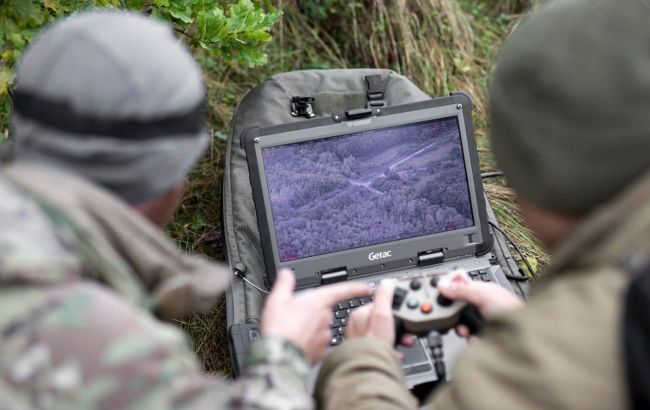 Photo: Ukrainian soldiers operating a drone (facebook/usofcom)
Artificial intelligence and machine vision technologies are being increasingly used in the unmanned systems of Ukraine's Defense Forces. These technologies assist military personnel with navigation, object recognition, and guiding drones to targets, according to the Ministry of Defence of Ukraine.
According to the Ministry of Defence, there are currently more than 200 companies in Ukraine producing drones using AI. At the same time, 46 AI developments are available to military personnel on the state defense technology marketplace, Brave1 Market.
Among them are target recognition modules, optical stabilization systems, and automatic homing modules.
The Ministry of Defence has set a goal that, in the future, 100% of drones on the front line should be equipped with machine vision and artificial intelligence technologies.
How AI helps drones on the battlefield
The use of such technologies is transforming the way unmanned systems are employed. Algorithms can take on a range of tasks — from navigation and object identification to autonomous target engagement.
At the same time, according to the Ministry of Defence, the final decision on target selection and engagement is made by a human operator.
Specifically, machine vision can be used for navigation without satellite systems. Algorithms analyze the terrain and landmarks beneath the drone and match them with preloaded maps. This allows the drone to position itself without GPS signals, both day and night.
Another application is object recognition. Neural networks analyze visual data and can detect enemy equipment and personnel.
Computer vision technologies are also used during target engagement. As the drone approaches a target, it can lock onto it and continue its approach autonomously. According to the Ministry of Defence, this allows targets to be engaged even when communication with the operator is lost due to active Russian electronic warfare measures.
Thus, AI can be involved throughout the entire engagement chain — from detection and identification of a target to engagement and assessment of the results.
Real data is used to train AI
The Ministry of Defence notes that effective algorithm performance requires large volumes of verified data.
Such data is provided, in particular, by the Brave1 Dataroom — a secure environment where developers gain access to structured datasets for validation, training, and fine-tuning of AI-based solutions in the military domain.
The platform's primary focus is on aerial target interception. According to the Ministry of Defence, more than 100 Ukrainian companies have already gained access to Brave1 Dataroom and are using the platform to train AI models based on real-world data.
The Dataroom contains datasets with various target types, collected under different weather conditions and at different times of day, using various sensors, including optical and thermal imaging.
This enables developers to train models across a broader range of real-world drone deployment scenarios.
Context of the material
Artificial intelligence is not only helping on the front lines but also in the rear in the effort to intercept Shahed drones. Automated target recognition and acquisition systems are being actively used, reducing the margin of error to zero and delivering guaranteed results in a short time frame.
Earlier, Brave1 held its first online Demo Day event, focused on upgrading FPV drones. More than 50 manufacturers presented components and new technological solutions for the front line.