Ukraine deploys AI-powered ground robots: Here's what they can do

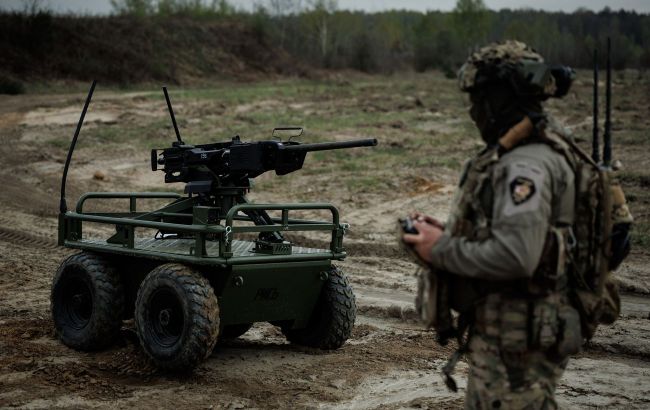 Photo: UGVs actively use AI (Getty Images)
The drone manufacturing industry is gradually shifting from fully manual control of ground operations to the automation of individual processes, and eventually to autonomous mission execution, according to an article by RBC-Ukraine.
Today, one of the main challenges for unmanned ground vehicles (UGVs) is their dependence on communication and the operator. When a robot travels several kilometers along a complex route, the operator must constantly monitor its movements. If communication is lost, there is a risk of losing the vehicle.
That is why several key areas are being actively developed. The first area is autopilot, which allows the platform to navigate part of the route autonomously and avoid obstacles. The second is Backtrack, meaning the ability to retrace its steps along the route it has already traveled in the event of a loss of communication.
A separate area concerns the use of artificial intelligence to detect threats, particularly FPV drones. The main advantage of automation lies in reducing the operator's workload, increasing resilience to communication loss, and enabling the simultaneous control of a larger number of platforms.
At the same time, the battlefield is constantly changing, and a ground robot must operate in conditions of mud, dust, poor visibility, obstacles, and electronic warfare. Algorithms must correctly recognize the environment and make safe decisions.
Furthermore, developing full autonomy requires significant investment, time, and skilled engineers. Therefore, developers are proceeding gradually: first, individual sections of the route are automated, then most of the mission. The long-term goal is to create a unified ecosystem in which ground-based and aerial unmanned systems will interact with one another.
The main challenge in AI is accuracy. Achieving a threat detection rate of over 95% is a major challenge. That's why retraining models is a constant, painstaking process.
It is possible to train AI using only real-world video footage, but not within such a short timeframe and not in the military sector. For example, TechUnity combines two sources: video from combat missions and its own synthetic datasets. The model learns from tens of thousands of generated synthetic data points, and its accuracy is verified using hundreds of real-world videos and through testing.
TAF Industries has launched the Kolibri 10" Advance FPV drone, equipped with a detection and automatic guidance module based on AURA AI from DOD Solution.
In addition, the Ukrainian Liutyi strike drone has been converted into a missile carrier. It was first unveiled at an international exhibition in England.