Ukraine could lose 2% of GDP as Russia targets Odesa ports - Bloomberg

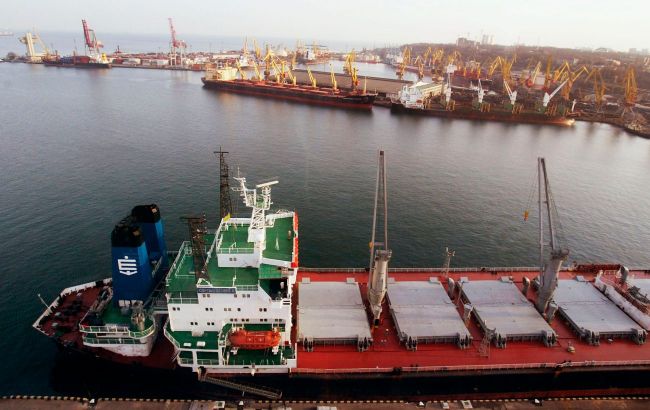 Photo: Odesa port (Getty Images)
Russian attacks on the ports of Odesa have nearly halted Ukrainian grain exports right in the middle of the harvest season. Analysts forecast that the country's GDP could contract by 2% this year as a result, according to Bloomberg.
Grain export figures
Bloomberg notes that the ports of Odesa usually account for about 90% of the country's grain shipments. However, due to Russian strikes, the flow of goods has practically stopped, creating problems not only for the agricultural sector but for the entire economy.
As is known, agricultural products account for more than half of Ukraine's export revenue.
As a result, farmers are being forced to store their harvest in the fields or sell it at significant losses.
Farmer's story from the south
Bloomberg highlights the situation faced by a farmer from the Kherson region — Ravil Dzhamally. After the de-occupation of part of the region, he returned to his farm, cleared the fields of mines, and began growing wheat, barley, and sunflowers.
This year, the farmer was expecting a good harvest from 800 hectares, but due to export problems, he cannot sell it properly.
"When we started harvesting, the feeling was very positive. But now we’ve been brought back down to earth a bit," Jamalli said.
He is currently storing tons of unsold grain in plastic reservoirs laid out right in the fields.
According to him, this allows the harvest to be preserved until March, but Ukraine's overall grain storage capacity could be exhausted as early as November if export shipments do not resume.
Farmers are selling grain below cost
In addition to the above, export problems are already putting pressure on the domestic market. The number of deals remains minimal, and grain prices are approximately one-third of global quotations, failing to cover producers' costs.
Farmer Oleksandr Havryliuk, who cultivates 3,000 hectares in the Kharkiv region, said he does not even have enough funds to transport his grain to storage facilities. He also fears that rains could destroy the harvest.
According to him, the financial reserves that helped farmers weather export disruptions in 2022 have now been depleted. Havryliuk is still paying off loans taken out to purchase agricultural equipment, part of which was destroyed by Russian strikes.
Bloomberg notes that the inability to sell the harvest is forcing farmers to borrow again. It is forecast that if the situation does not change, some farms may postpone autumn sowing, reduce acreage, or switch to crops that can be planted later.
Ukraine could lose 2% of GDP
According to estimates by the National Bank of Ukraine, the country could lose up to $2.5 billion this year due to the export blockade. This creates a risk of mass bankruptcies among farms.
Oxford Economics estimates possible losses to Ukraine's economy at 1.8% of GDP in 2026 and 2.1% in 2027. In the event of a prolonged serious disruption to exports, losses could reach 5.3% of GDP in 2027.
Attempts to avoid the crisis
The authorities have already approved preferential loans for agricultural producers and plan to increase grain storage capacity. Kyiv has also requested a €220 million grant from the European Union to fund relevant measures.
In parallel, Ukraine is attempting to boost alternative exports via western railway routes and Danube ports. However, their capacity is limited, and low water levels are complicating transportation along the Danube. Furthermore, alternative routes are more expensive than maritime routes.
Export forecasts
According to estimates by the Ministry of Agricultural Policy, due to port problems, wheat exports in the 2026–2027 season could fall to 8.3 million tons, down from the previously forecasted 17.6 million tons.
Overall, Ukraine will be able to export approximately 30 million tons of agricultural products this season, even using all alternative routes. Roughly the same amount could remain in storage or rot in the fields.
Kyiv School of Economics economist Pavlo Martyshev warns that a prolonged blockade of Black Sea ports will have broader consequences for the Ukrainian economy.
"There will be inflation, and GDP growth will slow down," he noted.
As of the end of July, the UN acknowledged that Russian attacks on ports and ships threaten global food security.
As of early August, the Russians had destroyed 1,054 Ukrainian port infrastructure facilities and struck 232 civilian vessels since the start of the full-scale invasion.