Trump's friend with Kremlin ties: How Witkoff–Russia call scandal could end


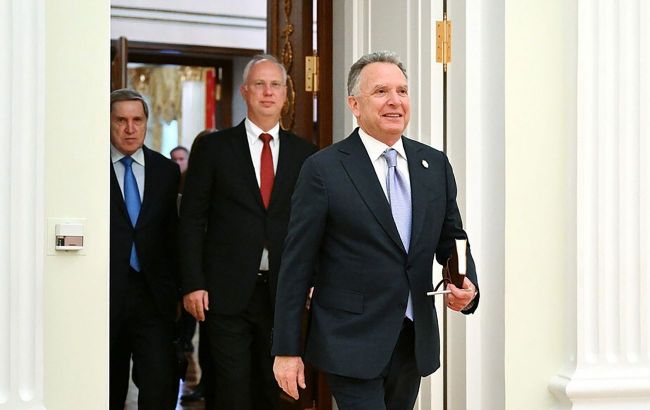 Steven Witkoff, behind him Kirill Dmitriev and Yuri Ushakov (photo: Getty Images)
This week, US special envoy for Russia Steven Witkoff will visit Moscow once again. Unlike his previous trips, this time he arrives amid severe political turbulence for the official.
RBC-Ukraine explains how Witkoff became a key lobbyist for Russian interests at the White House — and, at the same time, a problem for Ukraine and Europe.
Key questions:
- What connects Witkoff and Trump?
- How did Witkoff effectively take Russia's side?
- How could the new scandal affect his position?
The US president and his special envoy are linked by more than thirty years of friendship. In 1986, young lawyer Steve Witkoff happened to meet Donald Trump in a late-night New York diner. Trump, then an up-and-coming developer, had come in for a bite but had forgotten his wallet. Seeing a lawyer he knew, he asked him to pay for his sandwich. Witkoff paid — and forgot about the small favor.
Seven years later, they again ran into each other by chance, and Trump immediately recognized him, saying that he was the guy who had bought him a sandwich. This episode marked the beginning of a long-term friendship and partnership.
Witkoff's portfolio includes hotels, office centers, and residential complexes in several American cities. As Jewish Insider writes, he understands people, market dynamics, and how to convince major investors to open their wallets.
A year ago, Witkoff began using these skills in a different sphere — on the international stage. Partly successfully, and partly not, especially when he himself began to be used as an instrument of influence on the US president.
''Steve will be an unrelenting voice for peace,'' Trump said when presenting him as a special envoy. But the problem is that he does not hear everyone equally.
Envoy for Russia
Witkoff had no experience in public service. This became both his advantage and his disadvantage. The first serious task for the new special envoy was a mission in the Middle East — an attempt at mediation in the Gaza Strip war. Although he quickly established contacts with Israel and Hamas's sponsors, he did not achieve fast results. The parties signed an agreement only in October, and its implementation is still facing problems.
Despite this, Trump quickly steered Witkoff in another direction — toward contacts with Russia. And almost immediately, this created problems for Ukraine: the special envoy stopped even pretending to be neutral.
Unlike Keith Kellogg, the special envoy for Ukraine and a retired general who thinks in Cold War categories, Witkoff sees the world through the logic of a deal. He approaches negotiations on Ukraine with the same business mentality he once used when converting old workshops in Harlem into luxury apartments.
All this coincided with personnel decisions favorable to Russia. The Kremlin appointed businessman Kirill Dmitriev as Witkoff's negotiating counterpart — someone very similar to Witkoff in temperament and outlook. Combined with the lack of diplomatic experience, this effectively turned the American special envoy into a semi-official conduit of Russian narratives in Washington.
During his numerous trips to Moscow, Witkoff held hours-long conversations with Putin and other Russian officials. It is known that during at least one of these meetings, he used not his own interpreter but a Russian one, which is a gross violation of protocol and security rules.
After each such visit, Witkoff returned to Washington with Russian talking points about Russia's desire for peace. This sharply contrasted with the situation on the frontline and the ongoing attacks on Ukrainian cities.
As a result, the negotiation process stalled. And instead of pressuring Russia, Trump, apparently under Witkoff's influence, limited himself to vague statements and general phrases.
Scandal over the conversations
On November 26, Bloomberg published a transcript of Witkoff's phone call with Putin's aide Yuri Ushakov. In it, the special envoy was essentially advising the Russians on how to present their peace proposals on Ukraine to the US president in the most advantageous way.
The publication triggered a wave of outrage in Washington. Democrat Ted Lieu called Witkoff a traitor. Republican Don Bacon demanded his immediate dismissal, saying he was a Russian agent.
Donald Trump, meanwhile, reacted calmly and said that nothing extraordinary had happened:
''He's gotta sell this to Ukraine, he's gotta sell Ukraine to Russia. That's what a dealmaker does... I haven't heard it, but I heard it was standard negotiation. And I would imagine he's saying the same thing to Ukraine, because each party has to give and take,'' the US president explained.
There are different versions regarding the source of the leak: the recording could have been shared by American officials to disrupt or complicate the negotiations; by Russia itself, for the same reasons; or even by Ukrainian intelligence, which aims to weaken Witkoff's position in the White House.
Despite Trump's public defense, Witkoff's reputation in the US has deteriorated sharply. And that is a factor even the president cannot ignore. In the long run, the scandal could significantly weaken the envoy's position.
In the wake of this story, American media have already called for transferring full control of the negotiation process to Secretary of State Marco Rubio, who has a more balanced approach. Vice President JD Vance still supports Witkoff, but with each passing month, he is becoming a more independent political player. He has already shown his willingness to sacrifice other figures for his own ratings. If the criticism of Witkoff continues, Trump will likely have to choose: either publicly sacrifice an old friend or risk a split within his own party.
However, unlike former national security adviser Michael Waltz, who earlier this spring was caught in a similar scandal, Signalgate, and ultimately lost his position over it, Witkoff has a significant advantage — he is a personal friend of Trump. And Trump does not give up his real friends.
Sources: CNN, Politico, Bloomberg, Jewish Insider, The New York Times, New York Post, Axios.