Time travel may be feasible, physicist reveals unexpected theoretical argument

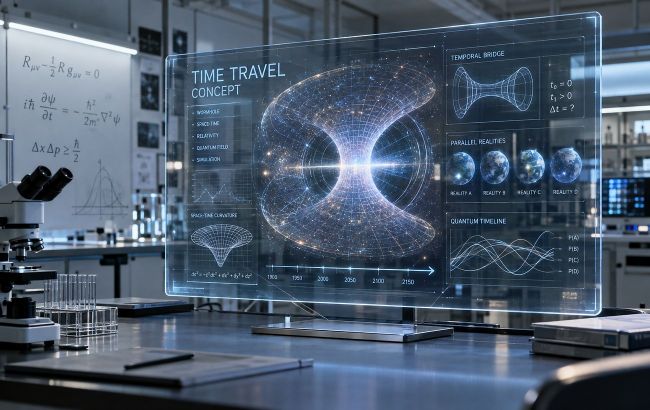 The geometry of light refutes fantastic scenarios (image: RBC-Ukraine)
Time travel to the past may remain purely fictional: a new study casts doubt on the very possibility of such actions. A physicist from China has proposed a mathematical justification that requires neither complex quantum effects nor exotic matter, according to a study published on the arXiv preprint server.
The dream of time travel has always fascinated humanity, but science is becoming increasingly skeptical about it.
In a new study, Hongsheng Zhang, a physicist at Jinan University in China, offered a simple mathematical explanation for why returning to the past is physically impossible.
Why was time travel to the past considered so difficult?
Until now, scientists believed that proving the impossibility of time loops required complex calculations, extreme energy, or quantum anomaly effects. However, the new approach turned out to be much simpler and does not require sophisticated equipment.
The scientist used the "null eikonal equation" - a classical tool for studying the propagation of light.
According to the author, the proof fits into just three lines and is based on one simple rule: the trajectory of light can never be perpendicular to the path of a time traveler.
The scientist explains that since a light ray cannot move at a right angle to an object's path, a certain indicator inevitably increases during motion.
This means that the path can never close into a loop and return to the starting point. In such a world, movement is possible only forward - like on a one-way highway where there is no possibility of turning back.
How does the new method differ from previous theories?
This work complements three already known scientific approaches by which physicists explain the prohibition of time loops:
- Universal time: the existence of a global clock that always moves only forward.
- Energy constraints: the prohibition of exotic matter and negative energy.
- Topological criteria: features of the shape and connectivity of spacetime itself.
The main difference of the new method is that it allows dismissing the idea of time travel using simple algebraic calculations, without delving into the chaos of complex cosmic models.
Furthermore, researchers proposed "slicing" spacetime not by ordinary moments in time, but by using light surfaces, relying exclusively on pure geometry.
Don't miss: Universe may have formed inside another cosmos, new study suggests
Do loopholes for fiction remain?
However, theoretical exceptions still exist.
Time loops could arise only if spacetime itself wraps around itself—for example, near an extremely massive rotating black hole, or if the special structure of the entire Universe naturally forms a closed contour.
The study still has to undergo peer review, but it already provides a clear understanding: if someone ever creates a time machine, it will have to violate the basic laws of light propagation in the Universe.