Stop buying black-and-white toys: Pediatrician explains their effect on vision

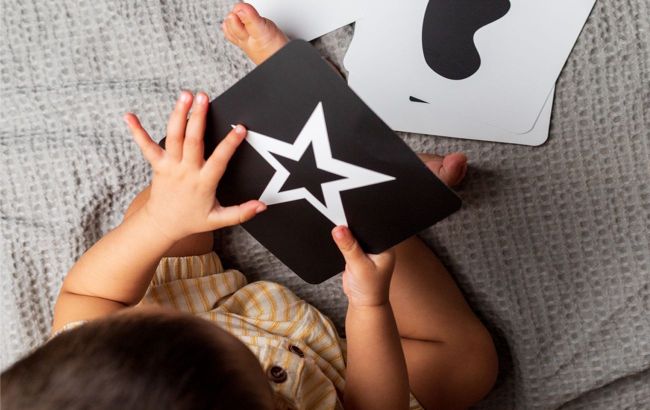 Pediatrician explains why you shouldn’t buy black-and-white toys for babies (photo: Getty Images)
Black-and-white toys for babies are not a necessary purchase. A child’s visual development depends not on specific objects, but on a diverse visual environment and interaction with parents, according to a post by pediatrician Dariia Vlasenko on Instagram.
How newborns see
There is a belief that newborns must have special black-and-white cards or high-contrast toys for visual development. However, this is not true.
“Modern scientific data is clear: newborns are not limited to black-and-white vision. In fact, even in the first days after birth, a baby is capable of perceiving certain colors, although very faintly,” the doctor explained.
A newborn’s vision is indeed very different from an adult’s, but not because of a lack of color — rather due to low sharpness and focusing ability. Objects appear blurry, and a baby can clearly see only at a distance of 20–30 cm.
How vision develops
Vision develops rapidly during the first year of life. Key stages include:
0–1 month. The baby sees unclearly and is most interested in faces at a distance of 20–30 cm. They can distinguish light and shadow and large shapes. Color perception is already present — babies respond to very bright, saturated colors, especially red.
2–3 months. At this age, the baby focuses on faces and bright objects and begins to track moving objects with their eyes. Vision gradually becomes stereoscopic (3D). By 2 months, babies can already distinguish red and green, and shortly after, yellow and blue.
4 months. Eye coordination improves, and the baby reaches for visible objects. Color vision matures noticeably — different shades become clearer.
6 months. The baby sees all basic colors, almost like an adult. Visual sharpness improves, allowing recognition of smaller details and faces in photos.
1 year. By the end of the first year, most children navigate space well, crawl or walk confidently, using vision to explore the world. A healthy child aged 3–5 already sees as well as an adult.
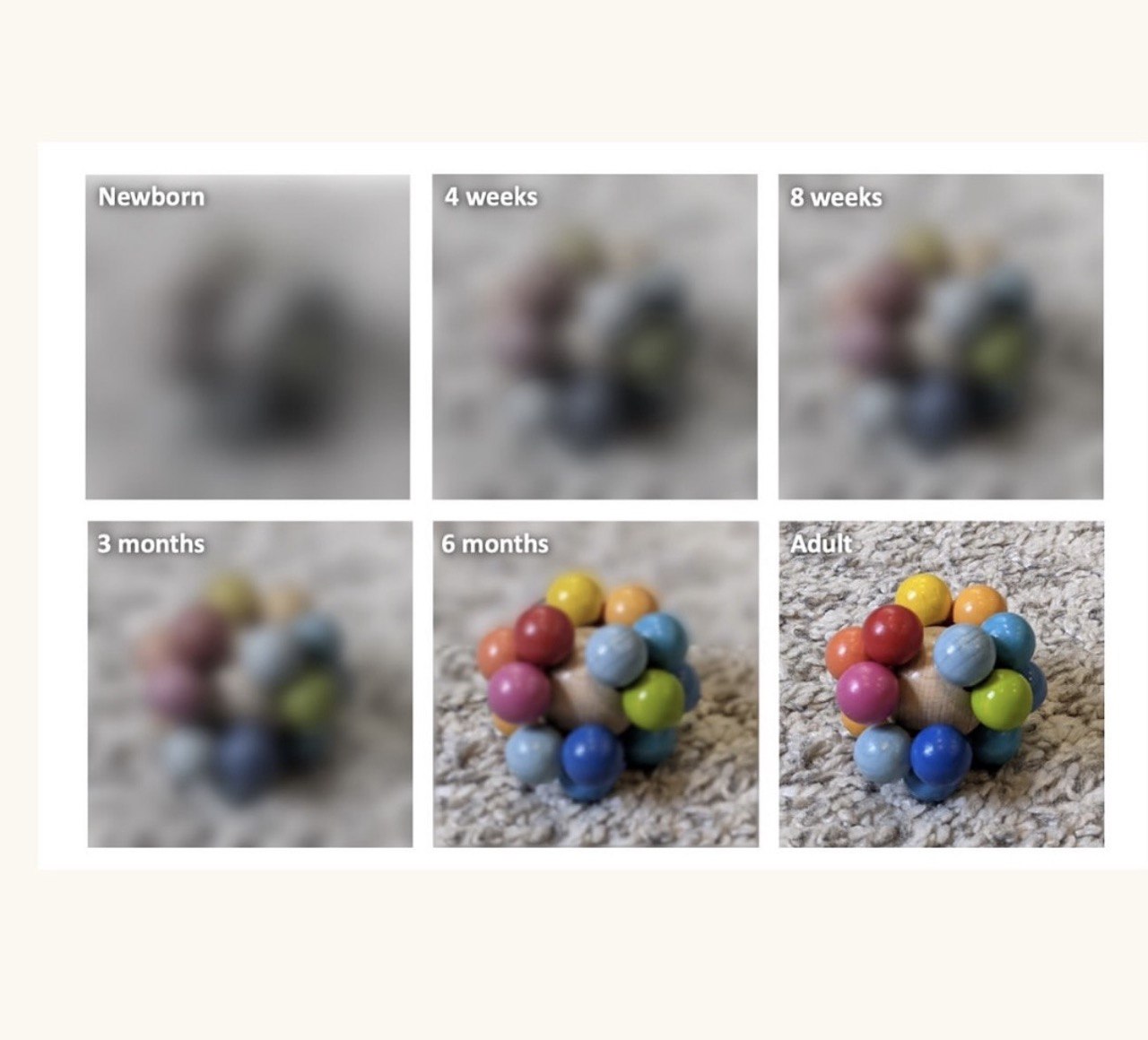 How a child’s vision develops (photo: instagram.com/dashkus)
How to naturally stimulate an infant’s vision
Face-to-face interaction
The pediatrician advises holding the baby so they can see your face during feeding or carrying. Smile and change facial expressions — this helps train focus and attention.
Playing with facial expressions
Show different gestures so the baby learns to follow facial features and even sometimes imitate them. This is not only visual training but also an early “lesson” in communication.
Showing contrast toys
Black-and-white books or bright rattles can be used to attract attention. Slowly move a toy at a distance of 20–30 cm and observe whether the baby follows it with their eyes.
Avoid overstimulation
Too many stimuli — loud sounds, flashing lights, and toys at the same time — can cause fatigue and crying.
This material is for informational purposes only and should not be used for medical diagnosis or self-treatment. Our goal is to provide readers with accurate information about symptoms, causes, and methods of detecting diseases. RBС-Ukraine is not responsible for any diagnoses that readers may make based on materials from the resource. We do not recommend self-treatment and advise consulting a doctor in case of any health concerns.