Russia sees spike in delayed salaries as GDP growth driven by defense sector

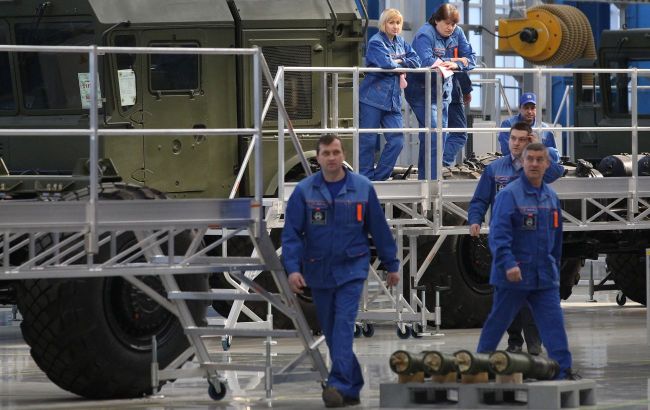 Illustrative photo: Military factory in Russia's Nizhny Novgorod (Getty Images)
Russians are increasingly reporting labor rights violations. According to Russia's Federal Service for Labour and Employment (Rostrud), the number of complaints exceeded 70,000 by early December, which is one and a half times more than last year, reports the Foreign Intelligence Service of Ukraine.
Most complaints concern delayed salaries, with over 26,000 cases recorded by early December, marking a 60% rise from last year. At the same time, reports of illegal dismissals rose by 33%.
Despite official Rosstat reports of economic growth, its structure shows a critical dependence on the military-industrial complex. Analysts at the Foreign Intelligence Service note that two-thirds of this year's GDP growth came from the defense production sector, which is operating in a three-shift mode.
Meanwhile, corporate profits decreased by 7.7% over the first three quarters of 2025, increasing the risk of delayed wage payments. This also drives higher credit arrears, creates challenges in the banking sector, and raises the threat of a broader economic crisis.
"This trend emphasizes that formal GDP growth in Russia is increasingly based on military spending, while socio-economic indicators show a deepening crisis," the Foreign Intelligence Service of Ukraine said.
Income declines across Russia
Previously, the Foreign Intelligence Service reported that prisoner salaries in Russia now exceed teacher incomes.
Intelligence data show that in 2019, prisoners received an average of 14,700 rubles, which rose to 33,000 rubles by 2025, a 125% increase. By comparison, in 73 regions, teachers earn less than the minimum wage of 22,440 rubles.
The Foreign Intelligence Service noted that Russia’s school system suffers from a shortage of more than 250,000 teachers. About one-third of educators are over 50, and young specialists are leaving due to low pay and heavy workloads. As a result, Russia's educational infrastructure is deteriorating, and the status of teachers is declining.
According to an ISW report, Russia is also experiencing a decline in volunteers for the war against Ukraine, signaling that the Kremlin's strategy of replenishing the army through high financial incentives is losing effectiveness.