Russia's upgraded Geran drones pose new threat — ISW

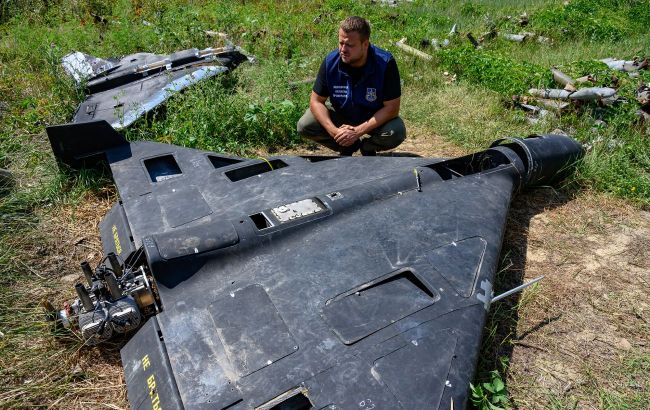 Photo: Russian Geran attack drone (Getty Images)
Russia has made a number of modifications to the Geran-4 long-range drone, including upgrades to its navigation system and warhead, which could enhance its resilience to electronic warfare, according to the Institute for the Study of War (ISW).
As ISW analysts note, Russia continues to improve its strike drones, developing new variants to carry out attacks on Ukrainian infrastructure and targets near the front lines.
At the same time, Russia is attempting to expand the capabilities of its drones faster than Ukraine can scale up effective countermeasures against them.
How Geran-4 changed
Russia has modified several key systems of the drone at once—its optical navigation, compass, and warhead.
In particular, the Geran-4 has been equipped with new autonomous navigation components. Among them is a high-precision magneto-inductive sensor manufactured in the United States.
This component can help the drone independently determine its direction of travel and navigate even when electronic warfare systems are in operation.
Thus, the upgrade may make the drone less dependent on external navigation signals and make it more difficult to jam with electronic warfare systems.
The changes also affected the power plant. Russia replaced the Chinese-made jet engine with a new engine of its own production.
It is manufactured in the Alabuga special economic zone, which Russia uses to localize the production of certain drone components.
This allows Russia to gradually shift part of its production processes within the country and reduce its dependence on ready-made foreign components.
New warhead designed for strikes against bridges
Another significant change was the new warhead for the Geran. The upgraded drones are equipped with a specialized KRSN cumulative-cutting warhead.
It is designed to destroy fortified steel and concrete structures. In particular, the warhead can be used to damage cable-stayed bridges.
The ISW notes that in recent days, Russian forces have intensified strikes on Kyiv's Pivnichnyi (Northern) and Pivdennyi (Southern) bridges across the Dnipro River.
Russia expanding capabilities of other drones
At the same time, Russia continues to expand the capabilities of other drones. This involves not only their production but also increasing their speed, maneuverability, and the use of various launch platforms.
On October 5, the 8th Army Corps of the Ukrainian Armed Forces reported the interception of a new Russian reconnaissance drone, the Molniya-13.
According to available information, the new version is approximately one and a half times larger than previous models and is equipped with four engines.
ISW analysts note that Russian developers continue to adapt drones to wartime conditions and are attempting to expand their combat capabilities.
"Russia may seek to field new, more resilient and dangerous variants of its strike drones before Ukraine can develop effective countermeasures in order to degrade Ukrainian energy infrastructure and logistics in the fall ahead of what will very likely be a brutal strike campaign in the coming winter," the ISW concludes.
Russia is trying to increase the speed of its Shahed jet drones. According to aviation expert Anatolii Khrapchynskyi, the current interceptor drones are designed to engage targets traveling at speeds of up to 500 km/h.
If the Shaheds' speed increases to 800 km/h, Ukraine will need new solutions to intercept them and a faster air defense response.