Russia's nuclear threat grows: SIPRI reveals number of warheads ready for use

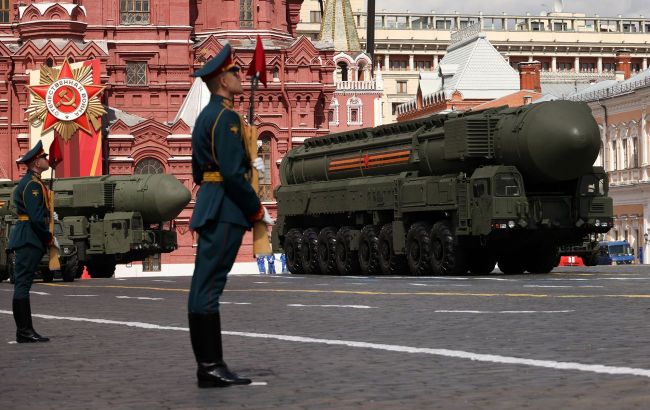 Photo: Russian strategic missile systems on Red Square in Moscow (Getty Images)
Russia has increased the number of its deployed nuclear warheads for the fourth consecutive year. The stockpile of warheads on delivery systems has reached its highest level in the past nine years, according to the Stockholm International Peace Research Institute (SIPRI)'s 2026 "World Nuclear Forces" report.
Russia continues to increase the number of its deployed nuclear warheads. As of January 2026, 1,796 such warheads were deployed on delivery systems and considered ready for use.
Russia's total nuclear arsenal is estimated at 5,420 warheads. Of these, 2,604 were held in central storage, while another 1,020 were considered retired.
Russia increases number of warheads for fourth consecutive year
The number of nuclear warheads deployed on delivery systems in Russia has increased for the fourth consecutive year.
There were 1,588 such warheads in 2022, 1,674 in 2023, 1,710 in 2024, and 1,718 in 2025. At the beginning of 2026, the figure rose to 1,796.
Compared with 2020, Moscow has increased the number of deployed warheads by about 14%. According to SIPRI, this is the highest figure since 2017.
By comparison, the United States has about 1,770 deployed warheads. France and the United Kingdom have 280 and 120, respectively.
China is also increasing its deployed arsenal. Over the past year, its number has risen from 24 to 34 warheads. Overall, according to SIPRI's estimate, Beijing has about 620 nuclear warheads.
Where Russia keeps its nuclear warheads
Russia's nuclear forces are divided among land-based missile systems, strategic nuclear-powered submarines, and bombers.
According to SIPRI's estimate, Russia's land-based forces can potentially carry up to 1,092 nuclear warheads. About 892 of them are currently deployed on intercontinental ballistic missiles.
The Russian Navy has 13 strategic nuclear-powered submarines with a potential capacity of 928 warheads. At the same time, two submarines are undergoing major overhauls. Therefore, the actual number of deployed warheads available to the fleet is estimated at 704.
Another 586 or so warheads are assigned to strategic bombers.
SIPRI also draws attention to the losses suffered by Russia's strategic aviation in 2025 as a result of Ukrainian Defense Forces strikes on air bases. Following the attacks, the Russian command dispersed some of its strategic aircraft, including Tu-160Ms and Tu-95MSs, to remote airfields.
Sanctions and war slow modernization of Russia's nuclear forces
Despite the increase in the number of deployed warheads, Russia's nuclear forces modernization program is facing delays.
Experts cite Western sanctions, problems in Russia's industrial sector, and the priority given to producing conventional weapons needed by Russia for its war against Ukraine among the reasons.
At the same time, Moscow continues to deploy new missile systems, including Oreshnik systems. Russia is deploying some of these systems on the territory of Belarus.
The report also highlights increased secrecy surrounding nuclear arsenals. One factor was the expiration in February 2026 of the Russian-US New START treaty, which was not extended.
SIPRI experts warn that the number of operational nuclear warheads could continue to grow, and the pace of this process could even accelerate in the coming years.
Earlier, there had already been public calls in Russia to use nuclear weapons against Ukraine. In particular, Russian State Duma lawmaker Alexei Zhuravlyov said that the Kremlin "must" launch such a strike if necessary.
In August, Turkish Foreign Minister Hakan Fidan also suggested that Moscow could resort to nuclear weapons if its forces become critically exhausted on the front and in the rear.
According to him, during his visit to Russia, he heard demands from some members of the public to use such a "last resort" and warned Western partners about them.