Russia's alternative to Western jets is afraid of frost and puddles, media reports

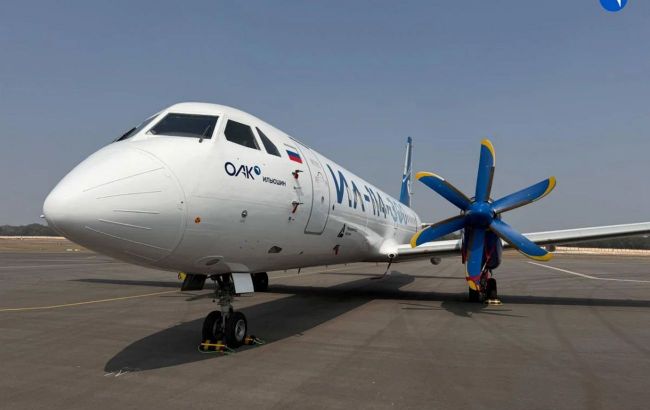 Photo: Russian Il-114-300 aircraft (Russian media)
Russia’s highly praised Il-114 aircraft, built without foreign-made components, is vulnerable to frost and water, according to The Moscow Times.
Russia protects its "import-substituted" Il-114 aircraft
The Il-114-300 turboprop is intended to replace foreign-made aircraft on regional routes, including in Russia's Arctic regions. Yet the plane has been banned from flying outside the temperature range of -9°C to +25°C.
The restrictions are outlined in the basic type certificate issued by Russia's Federal Air Transport Agency (Rosaviatsiya) in early June.
The 66-seat Il-114-300 is an upgraded version of the original Il-114-100. It had previously been promoted as capable of operating in extreme cold across northern regions, including the Arkhangelsk region and Yakutia.
However, the Il-114-300 is now prohibited from operating in:
- icing conditions,
- thunderstorms,
- wet or contaminated runways.
The certification document also states that the aircraft may operate only up to approximately 70 degrees north latitude — no farther than Russia's Arctic island zone — and at a maximum altitude of 7,600 meters.
What's wrong with the Il-114-300
The aircraft is fully based on Russia's import substitution program:
- Canadian-made PW127H turboprop engines (2,750 horsepower) have been replaced with Russian TV7-117ST-01 engines (3,100 horsepower);
- Hamilton Sundstrand propellers have been replaced with Russian-made AV-112-114 propellers;
- Instead of US-made Allied Signal systems, the aircraft uses a Russian-developed auxiliary power unit, the TA14-114, along with upgraded domestically produced avionics.
The aircraft was originally scheduled to receive certification in 2023. The deadline was later pushed back to 2025 and has now been postponed again to 2026.
In early June, Russian Transport Minister Andrey Nikitin said the first three aircraft are expected to be delivered later this year, with another three allegedly scheduled for production in 2027.
At the same time, the aircraft's price has risen from 1.44 billion rubles to 2.6 billion rubles.
As previously reported, Russia has decided to bring Soviet-era An-2 aircraft back into service due to sanctions and the failure of its import substitution programs. The Siberian Aeronautical Research Institute proposed restoring around 700 An-2 aircraft from long-term storage.
In July 2024, an import-substituted Superjet 100 passenger aircraft crashed in the Kolomna district of Russia's Moscow region. Three people were on board at the time of the crash.