Russia helps Iran build hypersonic missiles to target US fleet - FT

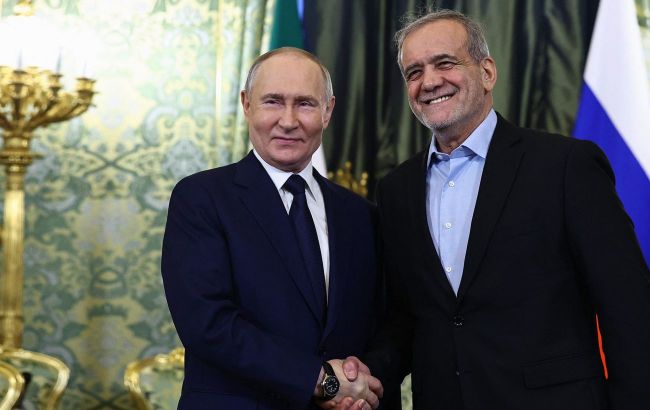 Photo: Russian leader Vladimir Putin and Iranian President Masoud Pezeshkian (Getty Images)
For years, Russia has secretly helped Iran develop supersonic cruise missiles - one of the most significant known transfers of strategic military technology from Moscow to Tehran, according to the Financial Times.
What is the secret program about
The multi-year secret program, codenamed C430L, has involved some of Russia's most experienced missile experts to help Iran create a new class of weapons capable of threatening American aircraft carriers and other ships in the Middle East.
FT's investigation uncovered the program, which began in 2023 and continued even during the American-Israeli war against Iran - based on leaked Russian correspondence, travel data, and analysis of military patents.
The main goal of C430L is to help Iran develop a ramjet engine that allows a cruise missile to fly at speeds several times faster than the speed of sound.
Why such missiles are dangerous
Supersonic cruise missiles combine speed with the ability to fly at low altitudes, reducing the time for detection and interception by modern air and missile defense systems.
This is particularly relevant for Iran in the Persian Gulf, where the United States and its regional allies use advanced ground and naval defense systems. Iran has already built and conducted flight tests of a ramjet engine, although there is no evidence yet of deploying a supersonic missile with Russian assistance.
Who was involved in the program?
The program was organized by Russia's state arms exporter Rosoboronexport, which coordinated the project together with NPO Mashinostroyeniya. The United States added this company to the sanctions list back in 2014, calling it Russia's leading missile enterprise responsible for sea- and ground-based cruise missiles, as well as work on Russia's strategic nuclear forces.
According to leaked travel documents, Russian arms export officials and several leading NPO Mashinostroyeniya engineers repeatedly traveled to Iran even before the official contract signing with Iran's Ministry of Defense in November 2023.
Among them were Alexander Dergachev, then deputy head of the enterprise and chief designer of sea-based missile systems, as well as Alexander Chebakov, head of the design department for jet propulsion systems, who visited Tehran three times in 2023. According to Russian patents, Chebakov is a specialist specifically in supersonic ramjet engines for cruise missiles.
How the cooperation progressed
By 2025, NPO Mashinostroyeniya had received a large volume of Iranian technical materials on the ramjet engine. Russian engineers analyzed data from one of Iran's flight tests and sent Tehran a detailed list of questions about the system's operation - including the fuel system, combustion stability, air intake, and engine nozzle.
In April 2025, Rosoboronexport proposed sending a delegation of about two dozen Russian specialists to Iran for technical consultations under C430L.
How this fits into broader Russia-Iran cooperation
The program is part of increasingly close strategic military cooperation between the two countries. Previously, Tehran supplied Shahed strike drones to Moscow and helped establish their production directly in Russia.
Ukrainian and Western officials have also accused Russia of providing Iran with battlefield assistance during its war with the US and Israel - including satellite imagery, drone support, and weapons components.
What the Kremlin says
The Kremlin, Rosoboronexport, and NPO Mashinostroyeniya did not respond to FT's requests. Russian President Vladimir Putin told his Iranian counterpart Masoud Pezeshkian on Tuesday that Moscow is trying to provide necessary assistance during this difficult period of the war with the US, supplying needed goods, without specifying details.
Is the program still ongoing
According to correspondence, C430L continued into 2026, already after the start of the American-Israeli war against Iran - Russia was preparing technical reports for Tehran, and the parties discussed the next phase of the program.
A letter from Rosoboronexport dated June 2026 indicates that the parties were still coordinating details of the next phase, although it is unclear whether it has already begun.
Russia's possible involvement in Iran's military actions against the US has been reported before. In July, Reuters reported that Russia might be involved in Iran's strikes on CIA facilities in the Persian Gulf - experts were then looking for a Russian connection in these attacks. Even earlier, the US struck a bridge connecting Iran with Russia and China.