Russia dismantles aircraft to keep others in service as aviation industry declines - Intel

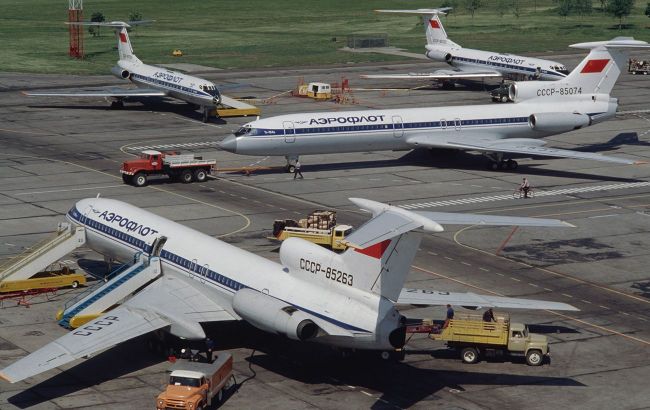 Photo: Russian Aeroflot aircraft (Getty Images)
The state of Russia’s civil aviation degradation is reaching a critical point. Without Western aircraft and spare parts, even billions of dollars are failing to save the industry, according to Ukraine’s Defense Intelligence (HUR).
Russia’s aircraft fleet has reached the end of its service life
Around 95% of all passenger flights in Russia are operated by Western-made aircraft, mainly Airbus and Boeing planes. This is especially true for medium- and long-haul routes, where the share reaches 100%, according to Ukraine’s military intelligence.
A significant portion of this fleet has already exceeded the manufacturers' guaranteed service life and is no longer fit for operation under international standards. However, sanctions against Russia prevent airlines from extending the service life of Western aircraft.
Currently, Russian airlines are carrying out repairs and maintenance without the necessary certifications. Some spare parts are being produced domestically, but without proper quality standards, the intelligence agency said.
Russia is also attempting to import some critical components through third countries, including:
- High-tech engine components;
- Cabin parts.
These aircraft are still flying only thanks to the high reliability of designs and components made by Western manufacturers, the intelligence agency believes.
Russian airlines face restrictions
In addition, Russian airlines are significantly limited in operating international flights.
To avoid having their aircraft seized abroad, they can use:
- Around 400 foreign-made aircraft;
- Fewer than 150 Russian- and Soviet-made aircraft.
To avoid seizure risks linked to sanctions, Russia also relies on shell leasing companies.
'Aircraft cannibalism' and import substitution
To repair aircraft, Russia is using the method of "aircraft cannibalism": some planes are dismantled for spare parts to keep others operational.
The intelligence agency said that even new, fully equipped aircraft are being stripped for parts in order to maintain the operation of dozens of other planes.
To replace Western aircraft, Russia has a questionable $12 billion program running until 2030, which envisages the production of:
- 994 civilian aircraft;
- 765 helicopters.
Russian aviation industry is incapable of meeting goals
Russia’s aircraft manufacturing industry is unable to develop and produce components that meet international standards and the declared technical specifications, according to the intelligence agency.
Recent examples include:
- The MC-21 aircraft, which was supposed to replace the Airbus A320 and Boeing 737, will carry fewer passengers due to technical issues and problems with the PD-14 engines. Its capacity was reduced from 210 to 163 seats.
- Similar problems have emerged with the PD-8 engines for the Sukhoi Superjet, which was intended to replace aircraft from the Embraer E-Jet family.
- Russia has decided not to order new Il-96 aircraft models at all.
- Replacing the An-2 and An-24/26 aircraft cannot be achieved without the involvement of Ukraine’s Antonov company.
- The LMS-901 Baikal aircraft is unable to perform the functions of the An-2, including takeoffs and landings on Russia’s unpaved runways.
- The Il-114-300 cannot replace the An-24/26 because it can operate only from airports with paved runways.
Russia is also capable of producing only 26 aircraft per year and will not be able to fulfill its aviation program by 2030.
Russian airports are outdated
Russia’s Western-made aircraft have been left without upgrades and access to digital air navigation systems. Russian forces also periodically jam GPS signals, but flights continue anyway, according to Ukraine’s military intelligence.
Airport infrastructure remains another major problem:
- 158 airports are operating in violation of safety requirements;
- 134 airports require reconstruction or major repairs.
Therefore, the intelligence agency concluded that Russia’s civil aviation sector continues to rapidly deteriorate due to:
- International sanctions;
- A lack of technology and expertise;
- The critical aging of its aircraft fleet.
"Flying with Russian airlines today carries significant risks. No matter how reliable Western aircraft are, Russia is unable to ensure proper maintenance and operating conditions for them," the intelligence agency said.
It was previously reported that Russia’s economy is entering a new phase of crisis. Stock market indexes are falling, state-owned banks are losing value, and problems are continuing to pile up.
Russian financial institutions are carrying much of the burden of the aggressor country’s wartime economy. Against the backdrop of new EU sanctions, experts predict an "explosive banking crisis."