Politico unveils 5-step roadmap for possible Ukraine's EU entry by 2027

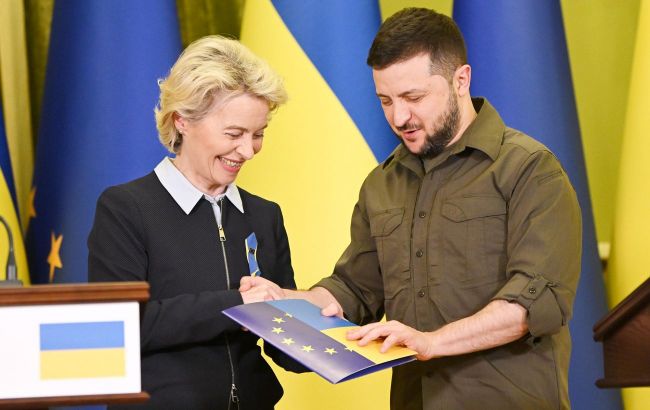 Photo: Volodymyr Zelenskyy and Ursula von der Leyen (GettyImages)
The European Union is developing a plan that could grant Ukraine partial membership even before the completion of all reforms and full accession to the bloc. The initiative is in its early stages, but Brussels is already discussing five key steps to implement this scenario, Politico reports.
Read also EU preparing unique accession format for Ukraine
According to the agency, based on preliminary work, Ukraine could gradually obtain the rights and obligations of membership while still fulfilling the accession criteria.
In Brussels, this concept is unofficially referred to as reverse enlargement because it involves the country's inclusion in EU institutions at the beginning of the reform process, rather than after its completion.
The EU emphasizes that the plan does not simplify the reform requirements, but is intended to be a political signal of support for Ukraine and other candidate countries whose progress is hampered by war or political disputes within the bloc.
At the same time, the main obstacle to the initiative's progress remains the position of Hungarian Prime Minister Viktor Orbán, who opposes Ukraine's accession to the EU. European capitals are considering various options for overcoming the blockade, from waiting for the results of the Hungarian elections to the possible use of political pressure mechanisms within the EU.
Step 1: Preparing Ukraine for negotiations
The EU is already providing Ukraine with informal recommendations on negotiation clusters — legal steps on the path to membership — so that Kyiv can move forward more quickly in the integration process.
The bloc has already provided Ukraine with detailed information on three of the six negotiation clusters. At an informal meeting of European Affairs Ministers in Cyprus in March, the EU wants to provide the Ukrainian delegation with detailed information on the other clusters so that work can begin on them as well.
At the same time, Brussels emphasizes that there will be no relaxation of the reform requirements. On the contrary, despite the difficult circumstances and the war, Ukraine is accelerating its reform efforts.
However, according to one EU official, there will be no cuts in the reforms.
Step 2: Introduction of membership-lite
The EU is considering a model of so-called reverse enlargement, which involves a country joining the bloc's institutions at an early stage and gradually acquiring the rights and obligations of membership.
"It would be a sort of recalibration of the process — you join and then you get phased in rights and obligations. So there would be a rethinking of how we do accession based on the very different situation we have now compared to when the Commission established accession criteria," says an EU official familiar with the discussion.
At the same time, this idea has its opponents in the EU. In particular, Germany is against the idea of creating several levels of EU membership. There are fears that countries that join the bloc without being ready for it will be promised things that Brussels will not be able to deliver.
Step 3: Resolving Hungary's position issue
One of the main obstacles remains the resistance of Hungarian Prime Minister Viktor Orbán. Brussels is awaiting the results of the Hungarian elections and, at the same time, is looking for political mechanisms to overcome the blocking of decisions.
According to Politico, none of the officials the agency spoke to believe that Orbán will change his mind about Ukraine after the election. Whether Orbán wins or loses the election will determine the EU's next steps regarding Ukraine's accession.
Step 4: Applying international political pressure
If Orbán wins the election, the EU may take four steps. The agency notes that although Orbán's position seems unshakable, US President Donald Trump may still influence him.
In particular, Trump's 20-point peace plan provides for Ukraine's accession to the EU by 2027. That is why, according to the agency, there is hope that Trump will call Budapest to secure an agreement.
Step 5: Extreme EU mechanisms
However, if all political agreements fail, the EU is considering the possibility of applying procedures that could limit the right of individual countries to block decisions on the bloc's expansion. Namely, to deprive Hungary of its voting rights.
According to the agency, even if Trump is unable to influence Orbán, the EU is considering the possibility of bringing Article 7 of the EU Treaty against Hungary back to the negotiating table.
This article is applied in cases where a country is considered to be at risk of violating the bloc's fundamental values. The article is the most serious political sanction that the EU can impose, as it suspends a member's rights, including the right to accept new countries into the EU.
Politico notes that the EU does not currently intend to take such a step, believing that it would play into Orbán's hands ahead of the April elections. However, the use of this instrument is being assessed if Orbán is re-elected and continues to obstruct EU decision-making.
Ukraine's accession to EU
In December 2025, information emerged that if a peace agreement is concluded and the war ends, Ukraine could join the European Union by January 1, 2027.
Recently, Serbian President Aleksandar Vučić confirmed that Ukraine's possible membership in the EU by that date is being considered as part of the plan to end the war. Ukraine also noted that the date of 2027 appears in one of the US peace plans, although the relevant provision is being revised due to objections from some EU member states.
At the same time, German Chancellor Friedrich Merz said that Ukraine's accession to the EU on January 1, 2027, is unlikely, as candidate countries must meet the Copenhagen criteria, which usually takes several years to fulfill.