Poland strips Zelenskyy of top honor: What's behind the decision and its risks for Ukraine


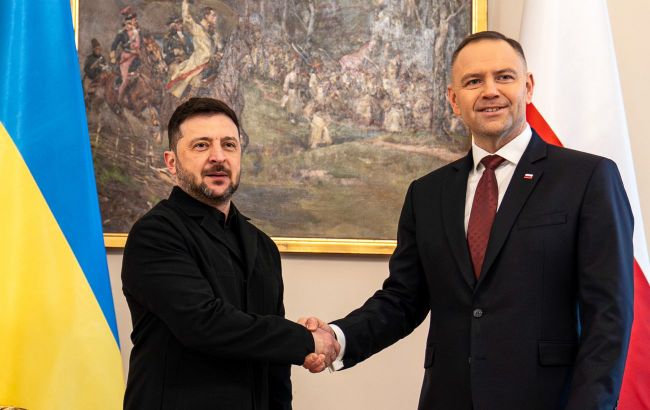 Archive photo: Ukrainian President Volodymyr Zelenskyy and Polish President Karol Nawrocki (Getty Images)
The crisis between Warsaw and Kyiv has entered a new phase following a controversial move by Polish President Karol Nawrocki.
RBC-Ukraine explains why Nawrocki chose to escalate tensions and whether the move could have real consequences for Ukraine.
Key points:
- Award revoked: Polish President Karol Nawrocki stripped Volodymyr Zelenskyy of the Order of the White Eagle.
- Cause of the dispute: The diplomatic crisis was triggered by the decision to grant a Ukrainian military unit the honorary name of the Heroes of the Ukrainian Insurgent Army (UPA).
- Political pressure: Nawrocki's decision was influenced by the opposition Law and Justice (PiS) party and domestic political considerations.
- Diplomatic protest: Ukrainian officials Andrii Sybiha, Kyrylo Budanov, and Vasyl Bodnar officially returned their Polish state awards in protest.
- EU accession risks: The dispute could prompt Warsaw to block the opening of new EU accession negotiation clusters for Ukraine, although Poland could also face negative consequences.
Revoking Ukraine's president of Poland's highest state honor is a powerful symbolic gesture. According to Nawrocki, the Order of the White Eagle represents the highest level of trust Poland can bestow, symbolizing a special bond with the state and the gratitude of the nation.
However, the Polish leader argued that Zelenskyy's decision in late May to grant the Separate Special Operations Center North the honorary title of Heroes of the UPA was deeply disappointing and undermined trust.
RBC-Ukraine has previously detailed the origins of the controversy and why it was received so negatively in Warsaw. A key factor is the vastly different historical perception of the UPA in Poland and Ukraine.
For much of Polish society, the UPA is inseparably linked to the tragic ethnic violence in Volhynia and Galicia during 1943-1944.
For most Ukrainians, however, the UPA is viewed primarily as a symbol of the armed struggle for Ukrainian independence. Founded in 1942, the UPA initially fought against Nazi occupation and later against the Soviet totalitarian regime.
According to the media outlet, the initiative to grant the honorary title came from the military unit itself, while Zelenskyy merely fulfilled a procedural role.
At the same time, recipients of the Order of the White Eagle still include Russian Empress Catherine II, who initiated the first partition of Poland, and Italian fascist leader Benito Mussolini, an ally of Adolf Hitler. This, critics note, appears to concern Polish authorities far less, suggesting the issue extends beyond the UPA itself.
A new escalation
The Chapter of the Order of the White Eagle made its decision on June 8, but it remained classified, with the final decision left to the Polish president.
Nawrocki reportedly delayed acting on it for nearly two weeks, apparently hoping Zelenskyy would reverse the UPA-related decision. However, it quickly became clear that Ukraine's president would not do so.
"The prevailing view in Warsaw is that Kyiv is simply buying time and has no intention of addressing the issue. There was no surprise here. If you say A, you have to say B," said Daniel Szeligowski, coordinator of the Eastern Europe program at the Polish Institute of International Affairs.
Nawrocki was also under pressure from the Law and Justice party, which backed his presidential campaign.
Moreover, revoking the award requires the countersignature of Prime Minister Donald Tusk, with whom Nawrocki is engaged in a political rivalry. Domestic political calculations, therefore, played a significant role in the controversy.
"Karol Nawrocki made a very calculated move. Whatever decision Donald Tusk makes could work against him. If he approves of Nawrocki's decision, it could damage his relations with Ukraine. If he rejects it, he could face significant backlash inside Poland," political analyst Stanislav Zhelikhovskyi told RBC-Ukraine.
This is particularly important because Poland is set to hold parliamentary elections next year.
Possible consequences
As a sign of protest, Ukrainian Ambassador to Poland Vasyl Bodnar, Defense Intelligence chief Kyrylo Budanov, and Foreign Minister Andrii Sybiha returned their Polish state decorations.
Further escalation could have broader consequences for both countries.
The Ukraine Recovery Conference is scheduled to begin in Gdańsk on June 25. Zelenskyy's participation now appears unlikely, despite the conference being a major European event. The future of the conference itself has also come into question.
"In terms of countering Russian aggression, I don't think support will be halted for now, because that would damage Poland's relations with its Western partners and significantly weaken Warsaw's own position," Zhelikhovskyi said.
However, the greater risks for Ukraine concern its EU accession process.
Ukraine is currently working to open new negotiation clusters — areas of legislation that must be aligned with EU standards before membership.
Sources previously told RBC-Ukraine that Poland would not obstruct the process. However, if the crisis deepens, Warsaw could reconsider its position.
Future developments will depend not only on statements from Kyiv and Warsaw but also on practical consequences for Poland itself, given the close ties between the two countries.
"It is possible that certain contracts will not be signed, particularly in the field of drone technologies. I also cannot rule out that some Ukrainians working in Poland may leave, either returning home or moving to other countries if anti-Ukrainian sentiment intensifies. That would affect Poland's economic performance," Zhelikhovskyi said.
Many Polish politicians understand this well. Polish Foreign Minister Radosław Sikorski pointed out that Nawrocki's decision was welcomed in Moscow.
Russian Security Council Deputy Chairman Dmitry Medvedev said it had "finally" happened. Using his usual rhetoric against Zelenskyy, he argued that Poland's highest award was never particularly valuable to the Ukrainian president anyway.
Former Polish Ambassador to Ukraine Bartosz Cichocki called for restraint despite the controversy, even though he recently returned a Ukrainian state award himself.
"From every crisis, one can find a way out. Success awaits those who demonstrate restraint today. Every offensive sentence spoken today will linger long in memory," Cichocki wrote on X.
At the same time, some political parties in Poland are eager to capitalize on anti-Ukrainian rhetoric ahead of upcoming elections. Much will depend on whether Poland's political class can maintain strategic thinking rather than give in to emotions and short-term political gains.
Quick Q&A
– Why did Polish President Karol Nawrocki strip Volodymyr Zelenskyy of the Order of the White Eagle?
The official reason was Zelenskyy's decision to grant one of Ukraine's military units the honorary title of the Heroes of the Ukrainian Insurgent Army (UPA), which Poland viewed as a blow to bilateral trust. Nawrocki's decision was also significantly influenced by domestic political pressure from the opposition Law and Justice (PiS) party ahead of upcoming elections.
– Which Ukrainian officials returned their Polish awards over the controversy?
As a diplomatic protest against Warsaw's actions, Ukrainian Foreign Minister Andrii Sybiha, Defense Intelligence chief Kyrylo Budanov, and Ukraine's ambassador to Poland Vasyl Bodnar publicly returned their Polish state honors.
– How could the controversy affect Ukraine's EU membership bid?
The main risk is that Poland could obstruct parts of Ukraine's EU accession process. If the diplomatic crisis deepens, Warsaw may reconsider its previous support and begin delaying the opening of new negotiation clusters required for Ukraine's membership in the European Union.
– What economic consequences could the escalation have for Poland and Ukraine?
The dispute could jeopardize important defense contracts, particularly in the field of drone technologies. In addition, growing anti-Ukrainian sentiment in Poland could encourage some Ukrainian workers to leave for other European countries or return home, potentially affecting Poland's economy and labor market.